
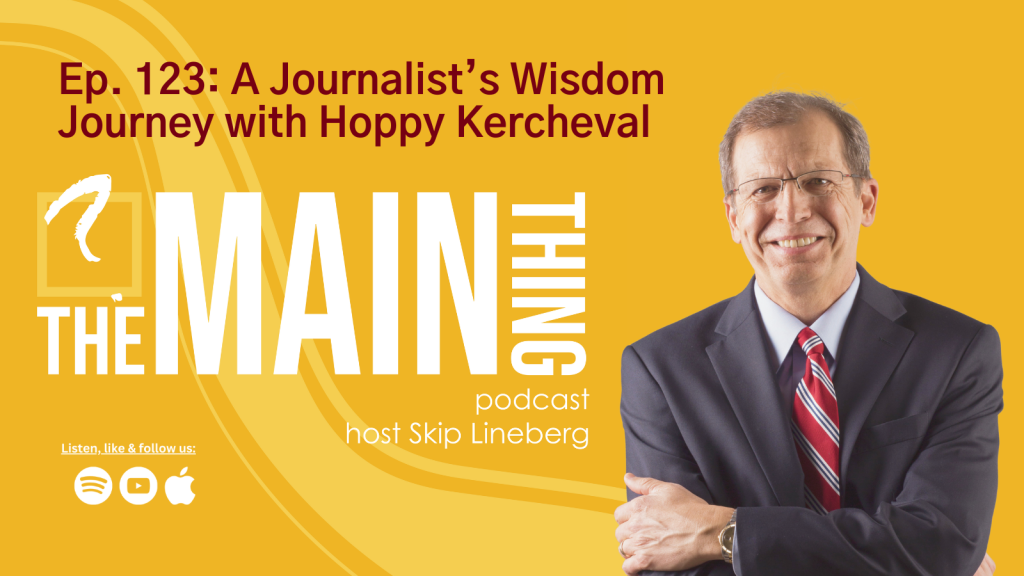
Hoppy Kercheval, the esteemed “dean of broadcasting” in West Virginia, brings his wealth of experience in journalism to this dynamic episode, offering listeners valuable insights into the art of showing up every day and the transformative power of wisdom.
A Broadcaster’s Path to Lifelong Learning and Legacy
Hoppy, renowned for his work in covering public affairs, politics, and sports, shares personal stories that illuminate the importance of being present and recognizing the pivotal moments that define our paths.
We explore Hoppy’s unexpected start in journalism during high school, which set him on a remarkable career trajectory, and discuss the subtle signals that might indicate when it’s time to step back or retire. Throughout the episode, we underscore the value of lifelong learning and stepping out of comfort zones to embrace diverse perspectives.
Today you will discover Hoppy’s main thing, the most important wisdom lesson he wants to share from his lifetime and his career. In this rich, authentic wisdom conversation you’ll also learn about:
- Power of seminal moments to shape life’s direction and course;
- What can happen when we’re fully present and listening;
- How beautiful results can flow from simply showing up every day.
More About Our Special Guest Hoppy Kercheval
Hoppy Kercheval joined West Virginia Radio Corporation in 1976. A founder of MetroNews, Kercheval served as news director until assuming the role of vice president of operations in 1991. In 1993, he created “Metro News Talk Line,” which became the signature program of the network. Hoppy has received a number of honors over the years, including the Mel Burka Award, which is given to the state’s top broadcaster.
An avid traveler, Hoppy’s adventures have taken him to 19 different countries around the world. He and his wife, Karin, live in Morgantown, West Virginia.
Resources
Link to Hoppy’s company website WV MetroNews
Link to podcast site for 3 Guys Before the Game
Hoppy’s treasured interview with Anthony Bourdain
RAGBRAI website – the bike ride across Iowa
Credits
Editor + Technical Advisor Bob Hotchkiss
Brand + Strategy Advisor Andy Malinoski
PR + Partnerships Advisor Rachel Bell
Marketing, Social Media and Graphic Design Chloe Lineberg
Stay Connected with Us on Social
YouTube @themainthingpod
Twitter @themainthingpod
Instagram @themainthingpod
Facebook @TheMainThingPod
Help Support and Sustain This Podcast
- Become a subscriber.
- Share the podcast with one or two friends.
- Follow us on social media @TheMainThingPod
- Buy some Main Thing Merch from our Merchandise Store.
- Buy a book from our curated wisdom collection on bookshop.org.
- Become a patron and support us on Patreon with funding.
Episode Chapters
[0:04:53] – Radio careers and riding a bicycle across Iowa;
[0:07:33] – How Hoppy and Skip are connected; Eastern Panhandle roots
[0:10:03] – An opportunity, a nudge and a seminal moment
[0:12:46] – A deciding factor for Hoppy; knowing when it’s time to move on
[0:14:34] – Hoppy shares his Main Thing
[0:18:49] – Reflecting on interviews – the good, the bad and the key to it all
[0:24:33] – Hoppy’s next chapter; future endeavors; and his legacy
[0:28:15] – A parting thought from Hoppy on the value of being fully present
Episode Keywords
Wisdom, Fairness, Transitions, Hoppy, Kercheval, Journalism, WVU, Mountaineers, Broadcasting, Showing Up, Radio, Podcasting, Talk, TalkLine, Seminal, Retirement, Learning, Growth, Understanding, Curiosity, LGBTQ, Interviews, Anthony, Bourdain, McGraw, Legacy, Balance, Consistency, Dedication, Network, WAJR, WRNR, WXVA, Jefferson, WV, West Virginia, Balance, Credibility, Walter, Cronkite, RAGBRAI, cycling, Iowa, MetroNews, Martinsburg, Eastern Panhandle
Episode Transcript
0:00:00 – Announcer
Wisdom. It’s an incredibly valuable asset, some would say more precious than gold. It’s attractive, appealing, admirable. Conversely, a lack of wisdom is the basis of immaturity, blind spots and bad decisions. Wisdom, it can be gained over time, but it can’t be rushed. But wisdom can be shared. That’s precisely what we are here to do right now. Today, we are here to hack wisdom, to distill it, to understand it and to process it. Why? To get better at life. Welcome to the Main Thing. This is your new nine-minute podcast. I’m your host, skip Lineberg, and I’ve set out to interview the wisest people I know. We’ll see what we can learn from each one when they’re faced with an incredibly difficult, soul-piercing question.
0:00:58 – Skip
Hello and welcome to your wisdom podcast. I’m Skip Lineberg and I’ll be your host today. Twice a month, we bring you a concise, high-impact wisdom lesson, fresh insights and unique perspectives from the wisest people around, studying their wisdom and learning together. We all get a little better at this thing called life and, speaking of the wisest people, our special guest today is certainly one of them.
Hoppy Kercheval is a widely respected journalist who’s been covering public affairs, politics and sports in West Virginia for four decades. He brings to his craft a rare gift for processing, comprehending and making sense of politics and public affairs at the state and national levels. Politics and public affairs at the state and national levels. Affectionately known as the “Dean of Broadcasting” in the Mountain State, Hoppy is a gifted and admired interviewer who’s known for being fair, factual, balanced and source-checked. About a month ago, Hoppy announced to the world his retirement from full-time radio broadcasting work.
Today you will discover Hoppy’s main thing, the most important wisdom lesson he wants to share from his lifetime and his career. In this rich, authentic wisdom conversation you’ll also learn about:
- the power of seminal moments to shape life’s direction and course;
- what can happen when we’re fully present and listening fully; and
- what can come from simply showing up every day.
Hoppy Kercheval joined West Virginia Radio Corporation in 1976. A founder of MetroNews, Kercheval served as News Director until assuming the role of Vice President of Operations in 1991. In 1993, he created “Metro News Talk Line,” which became the signature program of the network.
An avid traveler, hoppy’s adventures have taken him to 19 different countries around the world. He and his wife, Karin, live in Morgantown, West Virginia.
0:03:28 – Skip
Hoppy Kercheval, welcome to the Main Thing Podcast.
0:03:33 – Hoppy Kercheval
Thank you, thanks for asking me, I appreciate it. Skip.
0:03:35 – Skip
Yeah, so great to be with you this morning. I understand you’re doing something special this summer in the cycling realm. Tell us a little bit about that.
0:03:44 – Hoppy Kercheval
Well, my wife and I like to ride our bikes and it’s great exercise and where we live in Morgantown there’s some really nice trails, rails to trails. We’ve taken advantage of that. It’s a good way to get exercise, be outdoors and especially exercise when you’re aging a little bit. It’s a little easier on the body, except for your backside, than running. So we got into that and we have a couple of dear friends who a few years ago did RAGBRAI, which is the ride across Iowa, and they pitched that to us and so we agreed to go with them this year.
So in July we’re going to Iowa to ride across Iowa about 400 plus miles over about seven days. It’s anywhere from 40 to 70 miles a day and what we understand is it’s a really neat event that small towns roll out the red carpet. Each town that you visit has a festive atmosphere, so it’s like a seven-day carnival mixed in with some really rigorous exercise. So we’re a little bit anxious about it because that’s a lot of riding, but we’re also. We have some time to get in shape for that and we’re really looking forward to that this summer.
0:04:53 – Skip
We both are involved in a podcast. You, of course, with “Three Guys Before the Game.” And Hoppy, I’ll confess, like I did to Tony, that I have an addiction. And I’ve listened to every show, every episode, practically every minute of every show. I don’t know … last I did the math … last summer, I told Tony that I had spent nearly 30 days of my life listening to you three talk about our beloved Mountaineer sports.
0:05:24 – Hoppy Kercheval
Well, I hope you haven’t wasted 30 days of your life by doing that.
But Three Guys was Tony’s idea, and he just came up with it. So let’s just sit down and talk about sports, WVU sports primarily in this informal atmosphere. And so it began rather innocently and innocuously, and it really has caught on. It’s a lot of fun. I think it works for a couple reasons. One is that there’s so much interest in WVU sports, and not just by people, such as yourself, who live in West Virginia, but people all over the country and all over the world. And they’re looking for WVU sports information, WVU sports discussion, and we try to provide that with some insights.
0:06:11 – Skip
Hoppy, I wondered if you might just contrast that vibe being on the podcast and how you sit down for it, how you produce it, versus what you’ve done for the last four decades with hosting a daily radio talk show. The cycling analogy comes to mind for me—a different gear perhaps?
0:06:28 – Hoppy Kercheval
Completely different gear. And I’ll start with TalkLine, which I hosted for a number of years. That was a lot of prep, a two-hour show and there’s probably, you know, four hours of prep for a two-hour show, which involved lining up guests, reading a ton, understanding issues and being prepared. So the preparation is a lot less stressful for Three Guys, and then some of it is. What happens in that show is just organic. That you know. Here’s three guys who are friendly, who are willing to give each other a hard time. Two may gang up on one. we may have different opinions about certain things and just see what happens. So there’s less preparation and it’s more organic.
I gotta tell you that I spent 40 years plus, covering news in West Virginia and doing TalkLine … and I get more comments on Three Guys than I ever did on TalkLine. Isn’t that crazy!
0:07:30 – Skip
Wow, that’s awesome!
0:07:33 – Hoppy Kercheval
I think that either says something really good about Three Guys or really bad about TalkLine. I’m not sure.
We’re both from the Eastern Panhandle, and I grew up in Jefferson County on a dairy farm just outside of a little town, Summit Point. At night I’d listen to the radio. We had a big radio. It happened to be in our bedroom, and I’d listen to the radio and I’d listen to some of those classic big 50,000-watt AM radio stations WCFL in Chicago, WKBW in Buffalo. Listened to these great disc jockeys, and I got very interested in what they were doing. The theater of the mind …. Because they were doing skits, and doing crazy things. And I thought: that’s what I want to do. You know, lonely kid growing up on the farm— I want to do that.
So I got interested in that, and then I started hanging around at the local radio station in Charlestown WXVA and WXVA-FM. There was a young guy who was in high school, a couple of years older than me, who was a night disc jockey. And he said, yeah, come on, hang around. And so then I got to kind of take the next step. And then, when I was 19, I got a job as a disc jockey at WXVA – the night disc jockey playing country music. And the first day I showed up for work, he handed me a manila folder, and it had some phone numbers written on it: prosecutor, state police, city police, county commission.
I said, What’s this? He said, well, you’re also the news guy. And I said, well, I don’t want to be a news guy—I’m going to be a famous disc jockey. He says, You call these people every day and see what happened.
So okay, I’ll do that. But I’m not interested. But I quickly became interested.
0:09:32 – Skip
Oh, wow.
0:09:34 – Hoppy
Because the news was interesting, right, yeah, yeah, things happened. Things caught on fire, there were accidents, there were train derailments, there was political news, controversies, Controversies, controversies. So I became interested in news and I was attending Shepherd at the time, so I transferred to WVU because they had a journalism program.
0:09:51 – Skip
The point that is really lighting up for me is that nudge that the manager from WXVA gave you and nudged you into the news and look what happened from that that one nudge.
0:10:03 – Hoppy Kercheval
Yeah, I’m a big believer in seminal moments. Yeah, and you often don’t know it at the time, but in hindsight they become very clear because they direct a path. And maybe I would have ended up in news anyway, I don’t know. But I remember that moment so clearly that it must have been a seminal moment for me and started me on a path.
Related to that, I also think about the fact that I told you that I started hanging around WXVA in Charles Town. I wasn’t an employee. And I remember clearly too, that I was maybe a freshman in high school. And the older student, Steve Cooper, who had a great voice, was really good on the radio, had already matured—I hadn’t—and he was working that night shift at WXVA. I remember clearly walking up to him in the cafeteria one day. He didn’t know me. I introduced myself, and said: I’m interested in radio, could I come down and hang out?
And he said, Yeah.
And I’ve thought, often, what if he said, “No, get out of here?”
But he didn’t. He said, Yes.
And because of that …. I think about that a lot when I think about my life and my career. That again, a seminal moment. Somebody said okay to something, and it continued me or started me down the path.
0:11:22 – Skip
When did you start to think it might be time to retire? What were giving you some inklings or signals that it might be time?
0:11:28 – Hoppy Kercheval
Sure, I imagine everybody along the course of his or her life thinks about when or if they’ll retire. And for me, that really picked up over the last couple of years. I’ll be 70 this month. So there was an age factor, you know, just thinking about that. And you start thinking about quality of time left. You don’t know. So that was a factor.
Combined with—as you get older, you start reading the obituaries …. And a dear friend of ours passed away over the last year, who’s my age, from cancer. So you start to think, you know, the mortality becomes more evident. That’s number one.
And number two, I’ve been very blessed to work for a wonderful company, and I’m very grateful for that. But also … I did my part, too. I worked six, seven days a week, you know, eight, 10, 12 hours a day for 40-plus years. And I did that willingly, and it was very rewarding. But at the same time, you just at some point get a little bit weary. And so that factored into it. And so those are the primary factors.
0:12:39 – Skip
And then was there a time when you had that surety. You’re like, Yeah, this is it. You knew for sure: it is time to retire, let’s do this.
0:12:46 – Hoppy Kercheval
One other piece to that puzzle which is a little bit more controversial is that I was very critical, and have been very critical, of Donald Trump and this state. Seventy percent (70%) of the people voted for Donald Trump. A lot of my listeners support Donald Trump, and that’s fine. That’s their decision. This is America. They can do that.
So I found myself at odds with a lot of the folks who listen, and that’s okay for a while, but maybe for their benefit and for mine, it probably contributed to the decision to move on.
0:13:23 – Skip
I get that man. Appreciate your candor on that too.
0:13:25 – Hoppy Kercheval
Yeah, thank you.
0:13:26 – Announcer
One. Nine. Two. 192 extra minutes of wisdom. That’s what you get when you become a patron of the Main Thing podcast. Many of you continue to say we want to hear more from these wise guests. That’s precisely what patrons of our podcast get Exclusive access to bonus episodes called the Whole Thing. These 30-minute special shows bring you a deeper dive into our guests’ wisdom. Less editing, more laughter, Less time limits, more stories.
Unlock those 192 extra minutes of wisdom for yourself for as little as $9 per month through the Patreon platform and when you become a patron, you also get access to wisdom essays, behind the scenes glimpses and access to special patron only wisdom gatherings. Head over to patreon.com/themainthingpodcast.
Go unlock your 192 extra minutes of wisdom.
0:14:25 – Skip
Hoppy Kercheval, what’s the main thing you’ve learned in your lifetime so far?
0:14:34 – Hoppy Kercheval
Skip, the main thing I’ve learned is to be a lifelong learner.
0:14:40 – Skip
Be a lifelong learner. That is such powerful advice. Hoppy, will you break that down for us? I know there’s nuance there and there’s meaning that you want to convey and transmit to our listeners, so please dig into that with us meaning that you want to convey and transmit to our listeners. So please dig into that with us.
0:14:55 – Hoppy Kercheval
Sure, and learning doesn’t stop when we get out of school. It just kind of creates the base for you. I’m a curious person and I think, as long as you’re curious and pursuing knowledge, I think it just broadens you, I think it gives you wisdom, it gives you, it gives you fulfillment. And I have found—and this is nothing earth shattering—is that the more you learn, the more you know. The more you know, the more you don’t know.
And that that’s sort of a spiral, but it’s a spiral up, not a spiral down, And it causes you to want to learn even more. I enjoy that. And it makes you smarter about the world around you. And when you have that, I think you see things, the colors become brighter.
It’s easy to end up in silos … and just have narrow views of things. And it’s safe in those silos.
When you think you know what you need to know about something, and you’re not bothered by—or don’t want to be bothered by—other information. And it’s safe there. And sometimes it can be unsettling or discomforting to learn other information that challenges what you think you know. I have found … I’ve struggled with … like you know at times. Where I think, okay, I know about this; I really don’t want any other information. But I try to force myself to consider other information. And that’s been helpful to me, certainly on the show when I was doing TalkLine, but also in life. There’s a lot more to see outside the silo, if you’re willing to look.
0:16:41 – Skip
Hoppy, if someone listening hasn’t embraced this wisdom nugget that you’ve shared with us: to be a lifelong learner—what kind of things might they be bumping into?
0:16:52 – Hoppy Kercheval
There are other opinions or views or facts that are out there. And you may not want to hear them. But they’re going to be there. And if you’re not willing to listen, if you’re just going to shut them off … or try to block them out … or push back, based on what you think is so … then you’re going to have a lot of conflict in your life. And you’re going to have a lot of anger and anxiety.
The world is more nuanced and for some reason that really stuck with me about how we could spend a little more time focusing on the commonalities rather than the differences. I’ll tell you a story related to that is that I’ve had life experiences that have caused me to change my views radically about the LGBTQ community. I was at the legislature and it was LGBTQ day and a transgender woman came up and sat down with me and I started talking to her and I said can I, can I ask you everything? Yeah, and she said yes, and so I had this conversation and I saw this person not as a transgender woman, but as a human being. And you know, another light bulb goes off, yeah, so that’s cool, you had a safe space.
0:18:10 – Skip
I love how you asked permission and you had a safe space to just ask every curiosity question that was popping in your mind.
0:18:19 – Hoppy Kercheval
Two points about that, Skip: that person’s willingness to engage in that. By the same token, not say, If you say the wrong word or phrase it wrong ….
0:18:33 – Skip
I’m out of here. It’s over.
0:18:36 – Hoppy Kercheval
I’m out of here, yeah. And that to me was so mutually beneficial. Because I hate the blame game, especially if somebody is trying to learn.
0:18:49 – Skip
Hoppy, what’s one of your most unforgettable, cherished moments in your broadcast career?
0:18:55 – Hoppy Kercheval
I believe that most everybody has a story about his or her life, or life experiences. So I’ve done a lot of soft interviews where you know, not breaking news, but soft interviews where I’ve tried to …. If someone is willing to share information about themselves and be candid about themselves, I just think that’s great. There’s a great interview, not because of me, but because of them, and that they’re willing to share.
0:19:24 – Skip
Yes.
0:19:24 – Hoppy Kercheval
I got a great interview with Neil Brown, exit interview with the former West Virginia coach, and he was willing to answer the questions, not just give you coach-speak. And that to me is … I prize that and not everybody …
Sometimes I ask the bad questions. Sometimes they just are not willing to share.
But over the years, I’ve prized those moments, and there have been many. One that does stand out is Anthony Bourdain, the late Anthony Bourdain.
0:19:51 – Skip
Oh, yeah, loved him.
0:19:53 – Hoppy Kercheval
Yeah, and he had done a piece about West Virginia. I don’t know if you saw it or not?
0:19:58 – Skip
I did!
0:20:00 – Hoppy Kercheval
And so I had reached out to interview him, when the piece was coming on. And his people got back to me and you know this happens a lot when you’re trying to reach somebody who’s pretty famous. And they’d say, Yeah let me see what we can do; we’ll get back to you.
And I thought, okay, well, that’s that. And they got back to me and said, Okay, we can do it here. And then it got postponed like two or three times, and I thought okay, I’m being jerked around here.
0:20:20 – Skip
It’s okay; just tell me no.
0:20:24 – Hoppy Kercheval
And finally I said look, it’s not going to happen. Just forget about it.
Just as his people came back and said, No, no, he, he really wants to do this.
So we did. We did the interview, and it was very candid and revealing.
And then I watched the pieces you have, and I thought: he gets us. Yes, he really made an effort here. We could have …. How many stories that we’ve seen or heard where like, okay, you have a preconceived notion about who we are. You come in, you fill in the blanks, that’s the story. And I thought he, really, he gets it. He may not agree, but he made a great effort there to understand.
0:21:07 – Skip
And there was a real discovery element to it.
0:21:10 – Hoppy Kercheval
What can I discover here in West Virginia? Exactly, exactly. So there are a lot of individual interviews, but that one stands out to me.
But then overall, it’s about those moments, and maybe you get a few in a show. Maybe you don’t get any in a show. Maybe it’s just like: oh, that’s a moment.
0:21:33 – Hoppy Kercheval
And if you listen. If you listen while you’re doing the interview, they may give you an opening. But you gotta listen.
0:21:42 – Skip
I’d love for you to recall for us … and share a little bit of detail with us on … maybe one of the toughest interviews, or most challenging interview guests that you ever ever interacted with.
0:21:53 – Hoppy Kercheval
Well, I will tell you one. I guess, unfortunately there have been a lot. I’ll tell you two, instead of 200.
But the late Warren McGraw was running. Maybe he was running for Supreme Court, I forget. But I had been critical of him, and he was aware of that. And he was in studio, and I was pressing him pretty hard on some things. It was getting a little bit tense.
And then we took a commercial break, and he could hear the commercials. One of his opponents had run an ad or someone ran an ad, where they were saying terrible things about Warren McGraw. He’s right there. He’s looking at me, you know, and he’s just like ….
And he said, “You sandbagged me.”
I said, “What?”
He says, “You sandbagged me. You set me up to hear that.”
I said, “No, I didn’t. It’s just a commercial.”
So that got a little tense.
0:22:52 – Skip
I bet. It’s a great story.
0:22:54 – Hoppy Kercheval
Some of the Don Blankenship interviews have been a little bit intense.
I usually tell people …. I’ll tell them ahead of time: you’re going to get some tough questions; you’re going to get some moderate questions; and you’ll get a couple of things that you’d like to talk about. You know, try to provide a spectrum. It’s not just going to be all blood.
0:23:19 – Skip
Fair, balanced, credible. That’s, to me, your brand. We believe you. You’re believable. You’re credible. You’re always fact-checked and well-researched.
In many ways, I and others think of you as the “Walter Cronkite of West Virginia.”
0:22:35 – Hoppy Kercheval
Oh my gosh.
0:22:37 – Skip
No really, and that’s a widely held view. Do you think there’ll be another Hoppy Kercheval in West Virginia … let’s say, in radio journalism?
0:23:48 – Hoppy Kercheval
Well, first of all, you’re very gracious, and I’ll humbly accept a compliment. It’s you know, I just I kept showing up, that was big. I kept coming to work.
0:24:00 – Skip
And you did it right though, but you did it right.
0:24:04 – Hoppy Kercheval
Well, I joke with the two guys that have taken over for me, Dave Wilson and TJ Meadows, who I think, are doing a really good job. And when the subject of my semi-retirement came up, I said: “Day one, it’s going to be where’s Hoppy? Day two is who are the new guys? And day three, it’s going to be the controversy of the day.” So it moves on, life goes on.
0:24:29 – Skip
Tell us a little bit more about the vision for the chapter ahead.
0:24:33 – Hoppy Kercheval
Yeah, I’m trying to figure it out. Everybody said have a plan, have a plan. And I had a plan. I have a plan, but ….
Doing work for West Virginia Radio, commentary, Talkline appearances. I have one tomorrow. I’m giving some feedback, doing some consulting with them, and maybe developing a new program of some long-form interviews, kind of podcasting, like you’re doing. Three Guys. The NIL work for WVU Medicine. I’m on a board, the Stubblefield Institute at Shepard University, which is a small think tank that promotes civil discourse. So I’m on that board.
And I just finished …. WVU Publishing just asked me to give feedback on a book they’re going to publish. So I just finished that. About the only thing I’ve had additional time for is naps. I do take more naps now.
0:25:30 – Skip
I love it. And you write a column once a week.
0:25:33 – Hoppy Kercheval
Once a week. I was doing five a week.
0:25:36 – Skip
Yeah, I know—they’re good.
0:25:38 – Hoppy Kercheval
Well, you’re very kind. It’s the thing about five a week. In some ways one a week is harder than five a week, because with five a week you have that discipline. You’re at work; you have to write one. You’re thinking about it all the time, and you’re churning it out. And it’s the repetition. You know it’s like batting practice, right? So you keep doing it. And each one is …. It’s not easier, but it’s easier when you’re doing five, than one. So I’m getting in the habit of doing one.
0:26:08 – Skip
Hoppy, closing out here—what do you think will be your legacy? What will folks remember about you 25 years from now?
0:26:16 – Hoppy Kercheval
Well, you’re very gracious, I would say, 25 years from now. People will say, Who was that? Well, who was that?
0:26:22 – Hoppy Kercheval
When I was in high school, one of the seminal events in my life. When I was in high school I had a current events class. And so we got involved in current events and that piqued my interest in the news. The teacher was Miss Knott K-N-O-T-T. Miss Knott. And as I pursued my career I thought: one of these days I’ve got to go back; I have to thank her for lighting that spark. I need to do that.
So I thought about it for a long time, and finally I had the opportunity. I was back in the Eastern Panhandle, and I came across her. I said, “Miss Knott, I’ve got to tell you, I had this career and I’ve been in news. I’ve been in current events and all these things. And a lot of it goes back to the current events class and what I learned from you in class.”
She looked at me, and she said, “I don’t remember you.”
She said, “I remember your brother. But I don’t remember you.”
0:27:26 – Skip
That was not how the script was going to go in your mind at that time!
0:27:34 – Hoppy Kercheval
So not how I thought … so probably the same thing. I don’t think I, I honestly do not believe that … I’m not just being self-deprecating, I don’t think I have this legacy.
Again, I’m not being falsely modest. I just don’t think there’s a lasting value. I think it was very immediate. You know, radio is very immediate. The commentary is very immediate. So I don’t think it has this lasting influence.
Now, if somebody wants to, if there’s a reflection by you or others on what I did, I would hope, just as you said, that people would think: he was fair. You know he was, he was fair, he was tough but fair. And that’s—that’s good enough.
0:28:12 – Skip
Any intention or word of encouragement for my audience, which I’ll characterize for you as a thousand folks who are interested in personal development and growth and seeking wisdom?
0:28:22 – Hoppy Kercheval
Just as with our interview today, and I probably had to learn this … and still practice it. And that is whatever you do, whatever encounters you have, try to be present. And I think of that, whether I’m doing something like this interview and listening to you and trying to respond honestly to the questions, whether I’m doing something that’s more high profile. Or whether I’m, like this morning, greeting the receptionist at the hospital before I got my blood taken for labs, and to be present with the people that you encounter, whether it’s for a few seconds, or whether it’s for hours, or you know, your, your life partner, whatever, and it’s not always easy, but I think it’s important. And I think that from being present, it deepens relationships, even if it’s just for a few minutes, and adds value to your life. So that’s something I’m working on, but something I think is a is a good life practice. Just that.
0:29:29 – Skip
I’ll take that, and I’m joining you in that quest to be more present.
Hoppy Kercheval, thank you so much for coming on today and sharing wonderful stories, sharing your wisdom. It’s been a real pleasure.
0:29:41 – Hoppy Kercheval
Well, thank you for asking me. I think you’re filling a different need. It’s not just your usual stuff. So good job on your part to try to find a niche, a relevant niche, in a very crowded field. Well done.
0:29:53 – Skip
Thank you for the compliment, Hoppy. So long for now.
0:29:56 – Hoppy Kercheval
So long.
0:29:58 – Announcer
That goes by incredibly fast, doesn’t it? Time flies when you’re hacking wisdom.
Thank you for listening to this wisdom conversation. If you enjoyed this podcast and found the wisdom lesson valuable, then I encourage you to share it with a loved one or friend. Did you know: podcast recommendations from one person to another remain the strongest form of podcast growth worldwide? It’s true, and we’d appreciate you helping spread the good word.
Let’s give a big, hearty thank you to the crew of the Main Thing podcast. These are the folks who truly keep the wisdom pipeline flowing: audio engineer – Bob Hotchkiss; strategy advisor – Andy Malinoski; public relations and partnerships guru – Rachel Bell; social media and digital marketing expert – Chloe Lineberg; graphic designer – Emma Malinoski. And, of course, our patrons, those generous folks who provide monthly funding support to help underwrite our costs of production. I couldn’t do it without you, nor would I want to.
Your feedback matters a lot. If you have a question, a suggestion, maybe an idea or even a nomination of a future show guest, I’d love to hear from you. Email me at info at themainthingpodcast dot com.
Well, that’s a wrap for this show. I’m your host, Skip Lineberg, signing off for now and inviting you to join us again next time for another special delivery of wisdom.
Transcribed by https://podium.page