
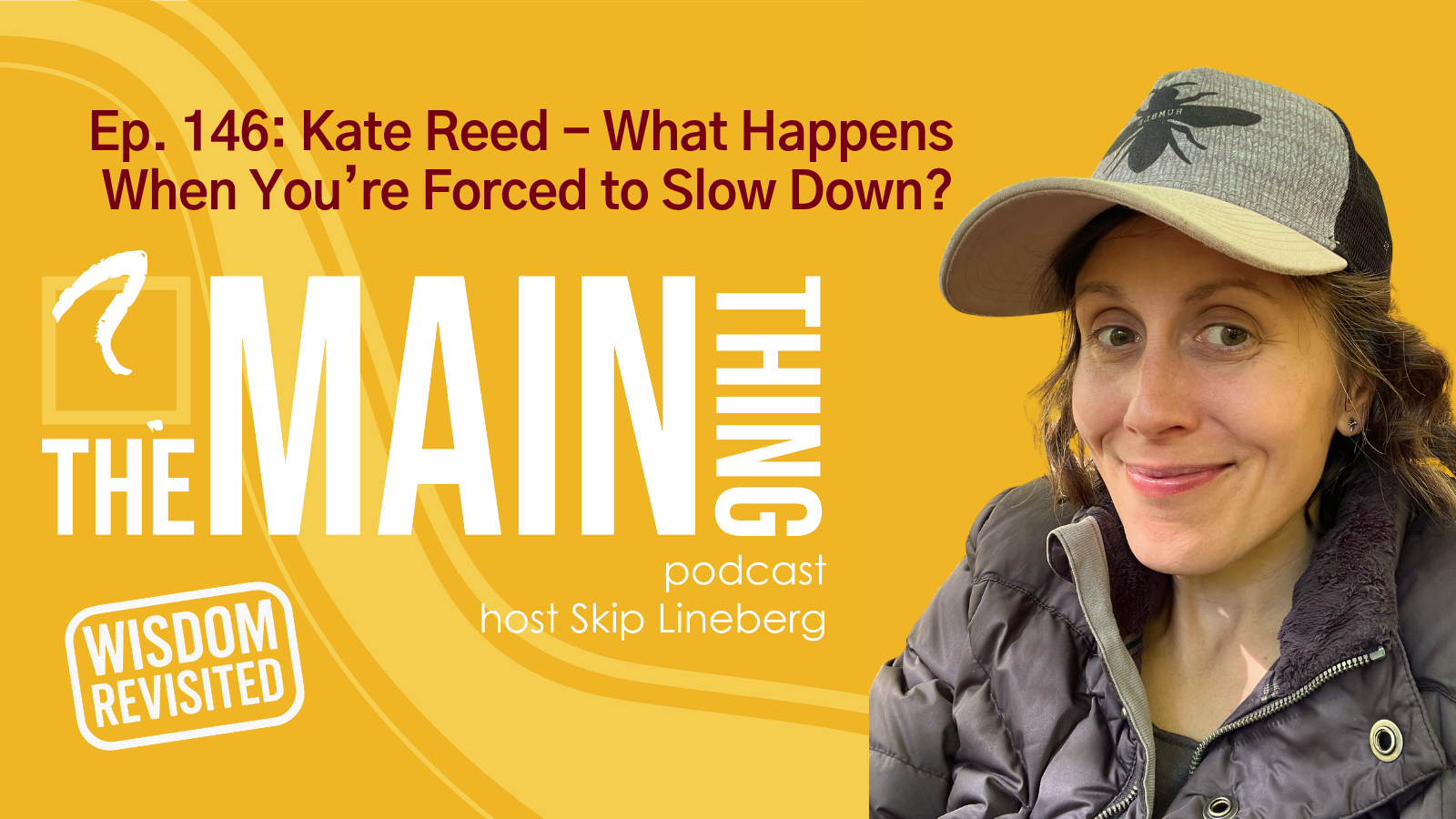
What Happens When We’re Forced to Slow Down?
Wisdom Revisited with Wellness Entrepreneur Kate Reed
Three years after first sharing her wisdom to “slow down” on The Main Thing Podcast, Kate Reed returns for a deeply personal conversation. Together, she and Skip explore entrepreneurship, burnout, recovery, mindfulness, and what changed after a traumatic brain injury forced her life into a different rhythm.
Kate opens up about leaving a longtime career to build Wonder and Grow full time, learning healthier boundaries around work and family, protecting friendship inside business partnership, and navigating the difficult road of concussion recovery.
In this wisdom conversation, they explore what happens when slowing down moves from good advice to absolute necessity.
Why This Episode Matters
This conversation speaks directly to anyone navigating stress, burnout, overwork, recovery, midlife transition, or the quiet feeling that life is asking them to live differently. Kate’s story is a reminder that healing is not weakness, rest is not failure, and meaningful living often begins when we stop forcing ourselves to move so fast.
A Bit More About Our Wise Guest – Kate Reed
Kate Reed took the entrepreneurial leap and left her 9-5 job to focus on her start-up “Wonder and Grow.” Today, she focuses full-time on providing coaching and consulting services as mindfulness guide with multiple certifications.
Kate is a certified teacher, experienced in yoga, along with various modes of meditation and mindfulness. She helps groups and individual clients build mindfulness practices and connect with nature to overcome stress, anxiety and burnout.
In addition to being a wellness entrepreneur and innovator, Kate is also a wife and mother of two teenage children. She joined us from her home in Elkins, West Virginia.
Wisdom Awaits You in This New Episode
- Entrepreneurship and the hidden inner-work it requires
- Protecting friendship inside business partnership
- Recovery after a traumatic brain injury
- Brain fog, memory disruption, and forced rest
- Why nature became essential to healing
Wisdom Resources & Links
- Wonder & Grow website
- Connect with Kate on LinkedIn
- Episode 87 of this show – Kate’s prior appearance from 2023
Credits
Editor + Technical Advisor Bob Hotchkiss
Brand + Strategy Advisor Andy Malinoski
PR + Partnerships Advisor Rachel Bell
Marketing, Social Media and Graphic Design Chloe Lineberg
Brand Designer Emma Malinoski
Episode Chapters & Wisdom Timestamps
[00:01:59] – Leaving the 9-to-5 for Wonder and Grow
Kate reflects on stepping away from Leadership West Virginia to pursue more meaningful work full time.
[00:07:21] – The Inner Work of Entrepreneurship
Why building a business required more emotional and spiritual work than Kate expected.
[00:10:45] – Starting a Business With Your Best Friend
Kate shares the challenges—and surprising strength—of building Wonder and Grow alongside Valerie Hart.
[00:12:25] – The Snowboarding Accident
A joyful family pastime suddenly turns into a life-altering concussion and brain injury.
[00:15:01] – Memory Loss, Brain Fog, and Forced Rest
Kate describes the emotional and physical realities of concussion recovery and the struggle to truly slow down.
[00:17:40] – Healing Through Nature, Stillness, and Care
How gentleness, neuroplasticity, mindfulness, and time outdoors became part of the healing process.
[00:20:19] – When Memory Is Part of Your Identity
Kate opens up about the fear of losing a defining part of herself—and Skip shares his own experience with traumatic brain injury.
[00:22:26] – Grace, Softening, and Hope
A conversation about caregiving, encouragement, and how relationships adapt after brain injury.
[00:24:11] – Wisdom Revisited: Slow Down and Soften
Kate revisits her original wisdom and reveals how this season of life has deepened and expanded it.
Stay Connected with Us on Social
YouTube @themainthingpod
Twitter @themainthingpod
Instagram @themainthingpod
Facebook @TheMainThingPod
TikTok @TheMainThingPod
Help Support and Sustain Your Wisdom Podcast
- Become a subscriber.
- Share the podcast with one or two friends.
- Buy a set of Wisdom Cards
- Follow us on social media @TheMainThingPod
- Buy some Main Thing Merch from our Merchandise Store.
- Buy a book from our curated wisdom collection on bookshop.org.
- Become a patron and support us on Patreon with funding.
Episode Keywords
Kate Reed, Wonder and Grow, insightful wisdom, mindfulness, concussion recovery, brain injury, slow down, soften, mindfulness, mental health, emotional healing, nature connection, burnout, entrepreneurship, founder journey, resilience, memory loss, personal growth, outdoors, nature
Full Transcript of This Wisdom Conversation
Skip (00:00)
Kate Reed, what’s the main thing you’ve learned in your lifetime so far?
Kate Reed (00:04)
Skip, the main thing I’ve learned so far is to slow down.
Announcer (00:10)
That was the main thing. Timeless wisdom shared by our wise guest, Kate Reed, here on The Main Thing Podcast in February 2023. Her wisdom resonated with us perhaps rather deeply. You spoke up. You said, “We want more from these wise thought leaders.”
We heard you loud and clear, and so we are reconnecting with a few of our most popular guests from past seasons. We’ll revisit those guests and revisit their wisdom, their main thing.
What will we find? Some say true north will always be true north. Others say there’s nothing permanent except change. Has it remained the primary driving force in their life, or has something new taken that place of prominence in their hearts and minds? Here in this special episode of Wisdom Revisited, we’ll find out how each prior guest has applied and perhaps even evolved their wisdom.
But first, a bit of background on Kate Reed.
Much has changed since Kate first joined us three years ago. First and foremost, Kate took the entrepreneurial leap and left her nine-to-five job to focus on her startup, Wonder and Grow. Today, she focuses full time on providing coaching and consulting services as a mindfulness guide with multiple certifications. Kate helps groups and individual clients build mindfulness practices and connect with nature to overcome stress, anxiety, and burnout.
Recently, Kate experienced a brain injury, and we’ll engage in a very deep, authentic conversation about how that’s affected her, how she’s coping and recovering. Along the way, we’ll have some advice for you and others.
Kate Reed, who’s a wife and mother of two teenage children, joined us from her home in Elkins, West Virginia. Now, here’s our Wisdom Revisited conversation with Kate Reed. Enjoy.
Skip (01:59)
Kate Reed, welcome back to The Main Thing Podcast.
Kate Reed (02:02)
Hi. Thanks for having me.
Skip (02:04)
Yeah. It’s been a few years since you’ve been on, and it’s so great to get you back. And this morning, we’re gonna revisit your wisdom that you shared with us in 2023 and talk about what’s been going on with you since then. But thank you for making time to visit with us.
Kate Reed (02:19)
Yeah. I’m really excited. I can’t believe it’s been three years.
Skip (02:24)
I know a lot’s changed since you shared your main thing wisdom with us in February 2023. Of course, you stepped out of your day job and being a full-time employee into an entrepreneurial pursuit and took the leap into full-time business ownership. What’s that journey been like, Kate?
Kate Reed (02:41)
Oh my gosh. As I was reflecting on this prior to our call, so much came up for me because the career I was in in Leadership West Virginia—that lasted twelve years.
So all of my thirties and into my forties, when I was in the midst of raising kids and all that. And as I look back at that time, it was such good work, and I gave everything I had into that.
The relationships mattered to me in that work so much. My mentor, my boss, Pam Farris, she was so influential in my life in so many ways, and I continue to use so many words that she shared with me in my day-to-day life. Lessons I learned from her, those words are still there.
But somewhere along the line, it was the day-to-day that really stopped feeling challenging to me, and it didn’t feel in alignment anymore.
It was the connection that kept me there for so long. So it really was. Like, the people—I love meeting people. I love talking to other people in West Virginia who have this deep desire to make an impact. So that’s super valuable to me.
Once I lost that spark of, okay, what I’m doing today in this work—it just didn’t feel right. And at that time, I was growing Wonder and Grow at the same time.
Skip (04:07)
That was a side hustle while you were full-time employed with Leadership West Virginia, which was your full-time job.
Kate Reed (04:18)
And so when I left, I was in charge of all the communications around Leadership West Virginia. I was also doing a good bit of training for the cohorts. In every cohort, we would do practices around intentional listening and sharing. So I led a lot of that work. That was really the bridge for me between the work I did with Wonder and Grow and Leadership West Virginia, was being able to share that resilience and mindfulness in conversation and authenticity. And I loved that. So I was doing that when I left Leadership West Virginia. It was Valentine’s Day. 02/14/2025 was my last day.
Skip (04:58)
I love how you ramped it up slowly and also how you wrapped up the other position. You honored it by stepping out slowly and intentionally over a very careful long exit path.
Skip (05:11)
What did it take to make that decision to take the leap into being a full-time business owner? Was there some fear there?
Kate Reed (05:21)
Yeah. That’s an understatement. I think that’s why it took so long because Wonder and Grow had been growing alongside it. Well, it would’ve been about seven years at the time because we started Wonder and Grow in 2018.
It was designed on purpose as a nonprofit to really bring—at the time when we started it—it was to bring youth in connection with nature through very simple ways that we were accustomed to growing up, but then also bring in those mindfulness-based practices around that.
So I had extensive training in mindful outdoor leadership over the course of two years—to do that. But it was really very much purpose-driven, so I didn’t really think of it as something I would grow into full-time when we started Wonder and Grow. And when I say “we,” I want to just emphasize Valerie Hart, my partner in Wonder and Grow.
Kate Reed (06:19)
It was almost like a tension started building in me that I couldn’t ignore because that work felt so much more meaningful.
As we expanded into more and more work with youth, so many adults were coming to us and saying, “Hey, I need this too. I have this disconnect, and I’m not sure how to deal with all this stress in my life. And I just want to feel some of that calm again, and I’m not sure how to do that.” So we started doing more with adults, and that led to some of the retreats like you had been with us. But that tension just became so much I couldn’t ignore it.
Skip (06:58)
Isn’t it interesting how—let’s say when we approach midlife or enter into midlife—that meaningful work and having meaning in our lives becomes just so elevated and so important to us.
Skip (07:13)
You’re full-time running and growing Wonder and Grow. What were some surprises that came as you started doing that full-time?
Kate Reed (07:21)
Surprises. It’s so interesting to me because when I think about the hard stuff, it’s logistics. It’s building programs. Finding clients. It’s making all those finances work. You know? How do all these pieces fit together? And those are hard. I don’t want to negate any of that because running a business is just hard logistically.
But really, the biggest surprise for me has been all this inner work that was required of me because I’ve done a lot of inner work too. It’s really held up a mirror to the way that I operate professionally in a way that employment never did.
I know when I feel best is when I have these routines in place. But I also recognize even stepping out of the grind of day-to-day nine-to-five that this desire to work didn’t just go away. It wasn’t like, “Oh, I have all this space in my calendar to do what I want.” That did not happen.
So I had to open up to processes in a new way and think about my fears a lot because a lot of that had to do with worthiness. Like, can I do this? Am I an expert? Does anyone even care?
Skip (08:40)
Can we probe into that for a moment?
Kate Reed (08:41)
Yeah. Absolutely.
Skip (08:43)
Do you battle the desire to always be productive and checking boxes and producing work output and staying busy? How does that live within you?
Kate Reed (08:52)
Sure. I would not say that I have this desire to stay busy because I’ve worked through that, and I don’t. I think it’s the opposite of that—wanting to have more space in my day-to-day, but realizing also too I have clients I want to show up for that’s really meaningful to me. So what happens is I kind of get lost in that work that I enjoy, so I can easily lose track of time.
So, I have to set alarms on my phone. I have to set boundaries around that. Everyone is aware in my house that 06:30 is when I end work regardless. And I do not have my computer open after that, so I’ve had to set up accountability around that because I do—I get lost in it. That’s really what it is.
Kate Reed (09:40)
I mean, with my kids, I want my daughter especially—and my son, of course—I want them to see someone who’s working toward something I really want. So that modeling matters to me. I feel like I’m more aware of it, now that I am in my own business, because I don’t want to model burnout again.
I don’t want to be at a place where I’m modeling that or she sees me putting the value of work before my relationships with her or Kyle, my son. Don’t want them to see me doing that, and it’s not gonna be perfect.
So I think that awareness around my family has definitely increased because that was part of the reason I wanted to start a business—was to be able to spend more time with them and have that freedom. I’ve been able to take more time and take the snow days off and go snowboarding, and we’ve had a lot more flexibility around that, doing some of the things we really love.
Skip (10:43)
Is there anything else that completes that story?
Kate Reed (10:45)
Yeah. Actually, my relationship with Valerie. I’d love to share a little bit about that.
Valerie and I, we started Wonder and Grow as best friends. So we’ve known each other since 1992. We met at Girl Scout camp back when we were in fifth grade.
Running a business with your best friend is really difficult, and we didn’t realize that until about two years ago when things really started picking up. There genuinely could have been a fracture there where this tension and business was putting a strain on a relationship.
But every single time—and we were even reflecting on this last night—every single time as things evolve and change, we have come out stronger. That does not happen, I don’t think. And I hear it all the time: “You can’t have a business with your best friend.” “Don’t start a business with your family members.”
I think what’s been different here is we’ve been willing to put our friendship first every time because if it meant choosing between the business or friendship, it was always gonna be the friendship. And we’ve had to be really honest.
Skip (12:01)
So wise. That’s such a wise position to take.
Kate Reed (12:06)
Yeah. But it’s been very hard. It’s been very hard, and we’ve had to have really uncomfortable conversations we haven’t had before. So that’s just deepened our relationship because we’ve been through pretty much everything now.
Skip (12:18)
Well, that’s your founder story, and on it goes and on it goes.
Kate Reed (12:25)
I love snowboarding. It’s something that our family does together, and I really just enjoy it so much. I feel so good in my body when I’m doing it.
And I was snowboarding with friends. It was my friend Jess’s birthday, and I was out there with Jess and two other friends. It was later in the day. I was coming down to the end of a run, and I just caught an edge. I really don’t remember what happened. Still don’t.
To hear it described to me, my friend Jess watched me cartwheel through the air and hit my head and land face up toward the slope.
Like I said, I don’t remember it. I remember right before I was gonna fall. I don’t remember anything else.
Kate Reed (13:12)
But I wasn’t knocked unconscious. However, I have zero memory—there’s a huge gap in my memory—from the point I was getting ready to fall till the point we were almost back home in Elkins and I was being forced to go to the hospital—to get a CT scan.
So that’s what happened. I had a very, very bad concussion. CT was all good, but I was sent home with very little direction after that.
Skip (13:43)
What have been some of the symptoms that you’ve experienced since you were diagnosed with a concussion?
Kate Reed (13:47)
Well, after I came home that day, I had a crushing headache. And, you know, this is normal. I had whiplash, so my neck and my shoulder were very sore, and that lasted a while. And I went to see a wonderful PT a few days later just to work through some of that—someone I’m very comfortable with here in our community that’s helped me through multiple injuries.
After I saw him, I’d feel good at first, and then I’d get a crushing headache again as soon as I’d go home. That went on for a while. It was daily headaches—daily—especially looking at my computer screen. It was very uncomfortable. Lots of neck pain, and I’d get a lot of dizziness.
I started back to exercise too, after about two weeks, and I’d run. And if I hit a certain pace, I would get really dizzy and nauseous or I’d have a headache. I started lifting again—same kind of thing. I just felt off balance all the time, lots of brain fog. My mood was really off too.
Skip (14:59)
Oh gosh. Yeah.
Kate Reed (15:01)
And even just how I was experiencing my thoughts and memories weren’t organizing how they normally do. I can’t really explain what that means, but I wasn’t finding words very well, and things I would remember I was not remembering. And that was very worrisome and bothersome. This went on for months. And I really pushed through that for months before I went back to the doctor.
Kate Reed (15:31)
So I went back to my GP initially, and we went through everything and did some labs just to make sure that everything else was all on the up and up. And it was.
She said, “Well, some thoughts here because, yeah, you followed a concussion protocol.”
I’ve had two other concussions in my life.
And she said, “But you really didn’t rest.”
You know, I thought I was doing all the things. I was because I’m very much a rule follower.
She’s like, “I want you to take two weeks completely off. If you cannot work, do it. Minimal, minimal screen time. No exercise other than really gentle walks. That’s it. And see if it improves.”
Skip (16:16)
How did that land with you?
Kate Reed (16:18)
Shock. And I did—I sat with her. “What? Two weeks?” Like, she misspoke. You know, because I was—I was healthy. You know, in my mind, I’m healthy.
Skip (16:30)
Hold up. You meant two days. Didn’t you mean two days?
Kate Reed (16:33)
Uh-huh. Yeah. Two weeks.
Skip (16:37)
So did you do it? Did you follow that direction?
Kate Reed (16:40)
Yeah. I really did. Yeah. I took it very seriously.
Skip (16:43)
So the twenty minutes outdoors—was this part of your recovery?
Kate Reed (16:48)
Part of it was too that it had to be because I wasn’t running. I wasn’t snowboarding. I wasn’t doing those things that usually are an outlet for my body. And, yeah, I just—I needed to slow down.
Skip (17:04)
I know connecting with nature is vital to you. To your being. Like, that has to happen. So you couldn’t do A, B, C, and D, but you could get outside and just be in nature even if you were sitting or walking a gentle walk while you healed. That was good for you. Not only for your brain, but for your soul. Right?
Kate Reed (17:30)
Yeah. It was vital. It was vital.
Skip (17:36)
Are things coming back and coming up, or are you just coping better?
Kate Reed (17:40)
I actually found another physical therapist who has really helped me in different ways. And it wasn’t because I wasn’t necessarily getting what I needed where I was before, but I needed a slower pace. I needed some private time because what I was dealing with was really emotional too.
He has been wonderful. And there were some bones that were out of place in the back of my neck and my head that when they were in alignment again, the headaches disappeared.
So I haven’t had a headache in almost a month-ish.
Skip (18:17)
So happy to hear that.
Kate Reed (18:18)
Yeah. Which—that relief in itself has made a huge difference in everything. My mood, just how I feel during the day, how I can work and operate, just in my relationships too. So that alone—that having that pain go away—has been huge. It’s been amazing. My memory feels like it’s mostly back too.
Skip (18:39)
Good. Good.
Kate Reed (18:40)
Yeah. I do think it’s so strange that I don’t have any recollection of really what happened that day. And I’ve just resigned myself to the fact I probably never will.
Skip (18:51)
Yeah. Yeah.
Kate Reed (18:52)
But that’s so strange to me that our brain can do that. It could just block something out completely.
Skip (18:59)
It is strange. And the other strange thing about our brain—it’s strange in a wonderful way—is how plastic it is. Most of us have heard about neuroplasticity, and the good news there is that the brain will reconnect pathways, and it will adapt to bring back these functions that you depend on, like memory recall or balance.
Kate Reed (19:22)
Yeah. And that’s a beautiful thing. I thought about this a lot actually while I was healing, and I would visualize all those little neurotransmitters trying to reconnect and all those things.
And I think meditation and time outside helped me in that healing. You know, no true evidence of that, but as I’m healing now and taking that time to really be able to be in this stillness even when my head hurt or I felt foggy—but actually sit with it and just notice what was happening. It also helped me in finding the right care for myself and figure out, okay, it’s time to really pay attention to this.
Skip (20:02)
When you went to the second care provider and you said, “Not only did I need more because the symptoms were persistent, but also it had become very emotional for me.” Could you just share—
Kate Reed (20:16)
Yeah. I’d be happy to.
So it’s funny what we end up identifying with as part of us, right, as we grow up and grow into adulthood. One of those things for me has been my memory.
My parents would always be like, “Oh my gosh, how do you remember those things?”
Valerie, my best friend, she’ll be like, “Thank goodness you remember these things because I’m not gonna be able to tell people about my life. It’s gonna have to be you.”
Skip (20:43)
Part of your identity.
Kate Reed (20:44)
Mhmm. It’s part of my identity. So having that worry that my memory is never gonna be the same—that’s what I thought. I’d go down these paths of thinking about the future and what that could be like if I didn’t have that, and that was really, really hard. It was very tender.
Skip (21:02)
Yeah. Thanks for sharing that.
Skip (21:05)
I had a traumatic brain injury at age nineteen that has really compromised and pretty reduced my short-term memory. I can’t remember something maybe that you told me yesterday, or I can’t necessarily—without some work—remember what I ate for lunch yesterday. My brain just doesn’t log those things. And that’s—I think as I’ve lived with it—it’s an adaptation that it’s made because it allocates that RAM, that mental processing capability, to other more important things.
And so for me, one of the things that I bump into with my wife Lisa—who’s amazing, and you know Lisa, and she’s just an incredible partner, and I could go on and on …. But sometimes she’ll say to me, “Skip, don’t you remember?” About something that she told me two days ago.
Skip (22:03)
And she’ll start with “don’t you remember,” and that feels very kind of invasive and aggressive to me because I don’t. And it’s not that I don’t care enough to remember or that it wasn’t important to remember. Or that I didn’t make the effort. That’s just not how my brain works.
And so what if I don’t? Let’s just talk about what we need to talk about and make a decision that we need to make whether I remember what you said last time or not.
Kate Reed (22:26)
Mhmm.
Skip (22:26)
So that’s one thing I would share—is to have some grace—and be gentle with the person that has a brain injury that they live and compensate around as they live their daily life.
Kate Reed (22:40)
I think the word that keeps coming up for me is to soften too.
Skip (22:48)
Yes.
Kate Reed (22:49)
And when I think of it in those terms, it is—it’s moving out of that rigidity of maybe even what routine is for you because our routine was not the same for a while.
And just being open to receiving too that feedback that I’m struggling, and then how do I move within that and soften? Without trying to fix anything too, I think that’s part of it too because, you know, you can’t fix it.
Or change it. To really be there in a way that feels more like service and softer and maybe even a little uncomfortable for you as a caregiver because that means that something has to shift either within you and how you think about things or how you operate day to day.
Skip (23:44)
Yeah. Yeah. That’s great advice. So give them grace. Soften.
I would add: be an encourager. Give them hope. Fuel their hope that things are gonna come back. Talk about how the brain is plastic and how it adapts and reconnects and forms to be effective again. Don’t let them forget and lose sight of that hope.
Kate Reed (24:05)
Yeah. That’s so important too, the encouragement.
Skip (24:11)
Kate, I want to wrap up with an item of business that we do when we bring back a former guest. We have this thing called Wisdom Revisited. And so what we’re gonna do is revisit your main thing wisdom that you shared with us.
Skip (24:32)
As I recall, we recorded in January 2023, and our episode was published in February of that same year. When I asked you this question, I said, “Kate Reed, what’s the main thing you’ve learned in your lifetime so far?” You said, “Slow down.” That was your main thing wisdom. And so I ask you today: is that still your main thing? And how has that either deepened, or how have you maybe changed direction on that? Where do you sit with that now?
Kate Reed (24:55)
Still very much so. And it’s an important reminder to come back to. And the deepening—yes, there’s so much deepening. It’s interesting. This word “soften” keeps coming back up for me. It has over the past week.
Kate Reed (25:10)
And I think I would add that. I think it’s “slow down and soften” together because of all of this that just happened to me as well. Because I feel like there’s all these sharp edges around how we structure—or how I’ve structured—my life a lot even as I’m slowing down.
It’s like this routine, this way of being, this identity, whatever it is. And this season has really asked me to loosen my grip on that. And I feel like that’s where the softening is too.
Skip (25:40)
The slowdown, I totally get, and I share that value with you. I share that wisdom with you. As we talked before we started recording, I said I had a wonderful slow morning on purpose. I slowed down. I slowed down my morning, and it was beautiful. I’d love to hear you guide us through that second part of your wisdom.
Kate Reed (26:03)
Yeah. Absolutely. So when I think of softening—and this is a learning actually that’s come to be with me recently too—I was at a mostly silent EcoDharma retreat last week for five days, spending fifteen hours in silence a day.
Skip (26:18)
Oh, wow.
Kate Reed (26:19)
And part of the instruction when we were on the land was to slow down, of course, to sense. And you know this very well—sense through all of sight, hearing, smell, sound, all those beautiful things that bring us pleasure. All of those things. And they’re so pleasurable to be with. But softening doesn’t just mean allowing. It also means to feel into the sadness and the grief a little bit too.
Kate Reed (26:46)
For me especially in that space—and in a lot of these spaces in mindfulness and well-being—it’s easy to become the eternal optimist without allowing space for what is coming up that feels like grief or sadness. And that’s what I mean by that.
Because allowing that softness in me too to grieve the fact that I had over four months of recovery for a brain injury—I had to soften, and I had to grieve that. And now maybe I might not be a hundred percent ever. I don’t know.
Skip (27:24)
You might not be. Your identity might not be going forward, “Kate, who has the steel-trap memory.”
Kate Reed (27:29)
Yeah. And that’s just as important. I really do think that.
Skip (27:36)
Kate, thank you for coming back and revisiting your wisdom, for sharing about your founder journey, for talking with us about brain injuries and mental health. It’s just been so great to reconnect with you, and I appreciate your time, your stories, your insights, all the wisdom that you shared today. Thank you.
Kate Reed (27:55)
Thank you. I am so grateful for you and for this, Skip. It means so much to me.
Kate Reed (28:00)
My cheeks are hurting from smiling so much being around you.
Skip (28:03)
So long for now, Kate.
Announcer (28:06)
That goes by incredibly fast, doesn’t it? Time flies when you’re hacking wisdom. Thank you for listening to this wisdom conversation.
Let’s give a big hearty thank you to the crew of The Main Thing Podcast. These are the folks who truly keep the wisdom pipeline flowing. Audio engineer, Bob Hotchkiss. Strategy adviser, Andy Malinoski. Public relations and partnerships guru, Rachel Bell. Social media and digital marketing expert, Chloe Lineberg. Graphic designer, Emma Malinoski. And, of course, our patrons. Those generous folks who provide monthly funding support to help underwrite our cost of production. I couldn’t do it without you nor would I want to.
Your feedback matters a lot. If you have a question, a suggestion, maybe an idea, or even a nomination of a future show guest, I’d love to hear from you. Email me at info@themainthingpodcast.com.
Well, that’s a wrap for this show. I’m your host, Skip Lineberg, signing off for now and inviting you to join us again next time for another special delivery of wisdom.