
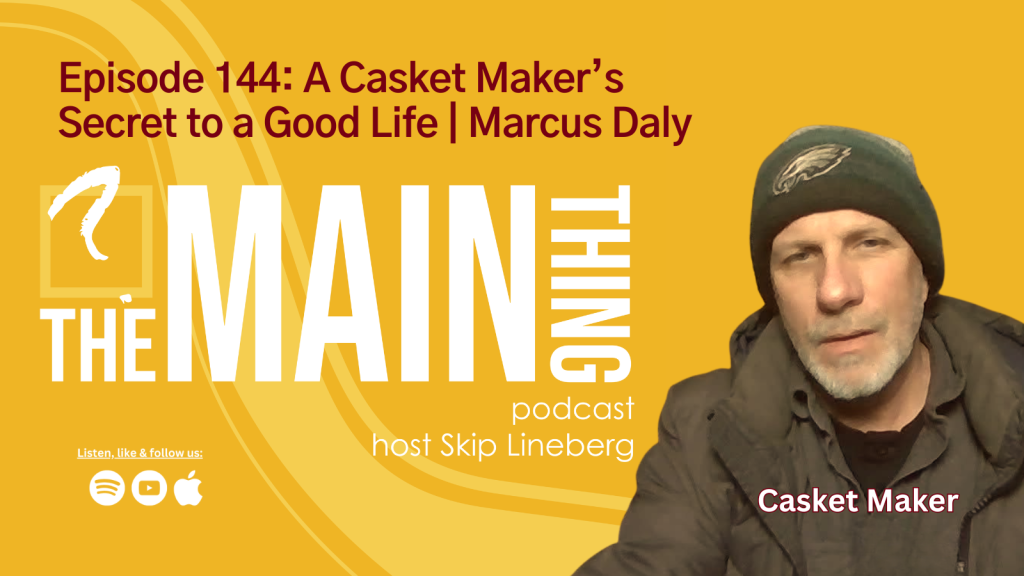
The Casket Maker’s Secret to a Good Life
My Wisdom Conversation with Marcus Daly
What does a casket maker know about life? More than you might expect. In this deeply thoughtful wisdom conversation, Marcus Daly shares how a life spent building caskets has shaped the way he thinks about living, loving, and what ultimately matters. What begins as a conversation about craft and career unfolds into something far more meaningful—touching on loss, purpose, faith, and the quiet choices that shape a good life.
A Bit More About Our Wise Guest
Marcus is the founder of Marian Caskets, a husband and father of eleven. He’s a former commercial fisherman and boat builder. A craftsman by trade and a student of life by disposition, Marcus brings a grounded, deeply human perspective to questions most of us tend to avoid.
From a formative season in Alaska to a deeply personal moment that led him to build his first casket, Marcus offers wisdom that is both practical and profound.
This episode doesn’t feel heavy—it feels clarifying, even peaceful. Because at its core is a simple, searching question: Am I living in a way today that I won’t have to run from later?
Wisdom You’ll Take Away
- Why thinking about death can sharpen how we live
- What most of us spend our lives worrying about (it doesn’t matter)
- Two simple, practical steps to begin living differently—today
Closing Thought
A good life isn’t built all at once. It’s built one decision at a time—often in quiet, unseen moments—shaped by what we choose to value, who we choose to love, and how we choose to show up. And maybe, just maybe, the end of life isn’t something to fear… but something that reveals whether we’ve been living it well.
Wisdom Resources
Marcus Daly’s Podcast - “Die Human” on YouTube
Website for Marian Caskets
Short film documenting Marcus’ work
Wisdom Chapters
00:00 – Why Thinking About the End Changes How We Live
Skip opens with wisdom, mortality, and the idea that a good death begins with a good life.
03:15 – Meet Marcus Daly: The Casket Maker
Marcus is introduced, along with the unusual work and perspective he brings.
05:10 – How Marcus and Skip are Connected
Skip and Marcus reconnect over their college days and Phi Sigma Kappa roots.
06:39 – A Podcast About Life, Death, and Meaning
Marcus shares wisdom on how his work led to deeper reflection through Die Human.
09:19 – Chasing Adventure in Alaska
Marcus recalls commercial fishing and the pull toward hard, honest work.
11:41 – From Carpentry to Calling
How working with his hands eventually led Marcus toward casket making.
12:34 – The First Casket: A Defining Loss
Marcus shares the deeply personal story behind the first casket he built.
15:38 – What Death Reveals About Life
How casket making reshaped his perspective on gratitude, priorities, and what endures.
17:44 - Marcus Reveals His Main Thing Wisdom
24:45 – Living It Out: Two Practical Steps
Marcus offers simple, actionable ways to begin living differently.
Show Credits
Editor + Technical Advisor Bob Hotchkiss
Brand + Strategy Advisor Andy Malinoski
Stay Connected with Us on Social
YouTube @themainthingpod
Instagram @themainthingpod
Facebook @TheMainThingPod
Support the Show
Your support helps us continue to find, capture, and share wisdom that helps us all get better at life.
- Become a subscriber.
- Share the podcast with one or two friends.
- Buy some Main Thing Merch from our Merchandise Store.
- Buy a book from our curated wisdom collection on bookshop.org.
- Become a patron and support us on Patreon with funding.
Transcript of This Wisdom Conversation
Announcer (00:00)
Wisdom. It’s an incredibly valuable asset. Some would say more precious than gold. It’s attractive, appealing, admirable. Conversely, a lack of wisdom is the basis of immaturity, blind spots, and bad decisions.
Wisdom. It can be gained over time, but it can’t be rushed. But wisdom can be shared. That’s precisely what we are here to do right now today. We are here to hack wisdom, to distill it, to understand it, and to process it.
Why? To get better at life. Welcome to The Main Thing. This is your new wisdom podcast. I’m your host, Skip Lineberg, and I’ve set out to interview the wisest people I know.
We’ll see what we can learn from each one when they’re faced with an incredibly difficult, soul-piercing question.
Skip (00:58)
Most of us spend our lives trying not to think about how it ends. We avoid it. We distract ourselves from it. Push it as far down the road as we can.
But what if the end of life isn’t something to fear? What if it’s something that’s shaped quietly, steadily by the way we choose to live today? Because as my guest this week puts it, to die a good death is the result of having lived a good life.
Welcome back to The Main Thing Podcast, coming to you as always from Parkwood Studios nestled right here among the hills of Almost Heaven, West Virginia. I’m your host, Skip Lineberg.
Skip (01:41)
Our guest today is Marcus Daly, a man who has spent much of his life doing something most of us would rather not think about at all. He’s a casket maker. Marcus is the founder of Marian Caskets, a husband and father of 11—yeah, you heard that right—11 children. A former commercial fisherman and a boat builder. A very well-read student of life, and a man of deep, abiding faith.
But here’s what makes this conversation different. Marcus doesn’t talk about death in a way that feels heavy or dark. He talks about it in a way that brings peace. Because for Marcus Daly, the goal isn’t simply to prepare for death. It’s to live a life so full, so grounded in faith, in family, and in community that when the time comes, there’s nothing left to fear.
And maybe that’s why this conversation stayed with me. Because beneath it all is a simple, powerful truth: we all are created for community.
Skip (02:45)
Now Marcus and I go way back. We were classmates at West Virginia University in the late 1980s. And somewhere between then and now, his life took a path that led him to wrestle with some of the biggest questions we all face and to arrive at answers that feel steady, grounded, and deeply human.
This is a conversation that doesn’t pull you toward the end of life. It draws you back to what matters most while you’re living it.
Marcus joins us today for this conversation from his home in Scranton, Pennsylvania. So settle in and get ready. Over the next 30 minutes, you will discover why Marcus Daly is one of the wisest people I know.
Skip (03:33)
Marc Daly, welcome to The Main Thing Podcast. Great to be with you this morning.
Marcus Daly (03:37)
Thank you so much, Skip. It is great to be with you as well.
Skip (03:41)
So, Marc, folks will have just heard—and perhaps they clicked to listen because they heard you introduced as a casket maker—what kind of reaction do you get when people ask you what you do, and how do you respond to that?
Marcus Daly (03:56)
I usually sort of eke out an answer. I don’t say because I don’t shout, “I build coffins.” I usually say, “I’m a woodworker.” And then very often, there’s a follow-up question. Oh, what sort of things do you build?
Marcus Daly (04:06)
And then I say, “I build caskets.” And the reactions I get can be either intrigue or recoiling depending on who the person is and maybe where they are at that moment.
Marcus Daly (04:18)
And if the opportunity exists, though, I try to get in there as quickly as possible that it’s not anything I ever expected to be doing with my life. I don’t come from generations of casket makers. But that I had been a boat builder.
Marcus Daly (04:33)
And I was a boat builder because I liked the idea of making something beautiful with my hands for people to have little adventures. And then I say, “And now I get to make something with my hands for people to have the greatest adventure of all.”
Marcus Daly (04:44)
And it’s an opportunity to kind of bring the reality of death into people’s minds and their awareness because that’s what we’ve heard throughout history, that there’s a lot of wisdom in recognizing that this life is passing.
Marcus Daly (04:59)
But I try to do it in a way that opens the possibility of that being an exciting curiosity instigator rather than just a jarring, “Oh, that’s a weird thing to be doing with your life.”
Skip (05:10)
Right on. Marc, before we get much further into this conversation—and I can’t wait to explore your wisdom and the work that you do—I want to just help the listeners understand who’s talking to who here. How do these two rascals know each other?
Marcus Daly (05:31)
So 1986, I loaded up the family Nissan Sentra, and I headed off at the age of 18 to college. And I went to West Virginia University in beautiful Morgantown, West Virginia. There it is. Let’s go Mountaineers. Right.
Marcus Daly (05:46)
And, you know, I moved in. I actually went there with a couple of friends of mine from high school, we all lived in the same room. I wasn’t even sure if I was going to go to college, and I ended up going to WVU.
Marcus Daly (05:56)
And they were, I think, maybe the ones who were like, we should check out some fraternities. And so—or maybe we would just walk back to our not so organized dorm room, and we would go by this place that looked like people were having a lot of fun outside right across the street from where we were.
Marcus Daly (06:12)
We thought, well, let’s go check that out. And that was the fraternity house for Phi Sigma Kappa, and you were already a brother there. And so I pledged there and somehow, you know, gave enough appearance that I could be accepted into that fine group of men and made it through the various, you know, modest hurdles and challenges that come with that. So we met we met at WVU in Phi Sigma Kappa.
Skip (06:39)
We sure did. Marc, the other thing that, you and I have in common, we have much in common, but one of those things is that we’re we both have a podcast. This one that we’re recording right now, and then, yours, is called Die Human. Yes. Tell our audience a bit about your show and what what they’ll find and why they might wanna tune into it for a bit.
Marcus Daly (07:02)
Doing this work, you know, over the years, it’s obviously—it generates a lot of pondering. I mean, a lot of the times I have my sons or employees work with me in the shop, but a lot of times I’m by myself also.
Marcus Daly (07:14)
And so, you know, I’ve returned to my faith, my childhood faith. I’m Catholic. And thinking about death, thinking about death in light of God’s love for us and this hardship—it’s like there’s so many books to read. There’s so much scripture to ponder. There’s just so many thoughts that come into my head through conversations that I have with people.
Marcus Daly (07:34)
I feel like I’m having poured into me through this work a lot of wisdom—about what it is to live a good life, to die a good death, which is the result of living a good life.
Marcus Daly (07:46)
And I’ve just—with this medium we have, with the communication technology we have—my desire is to reflect some of that back in some way to people, to be an encouragement.
Marcus Daly (07:56)
And so with Die Human, really, like, the essence of the name is just that holding on to our humanity is the most important thing we need to do because everything that’s good, true, and beautiful comes out of human flourishing or leads to human flourishing and comes out of human flourishing.
Marcus Daly (08:14)
And the divine and human par excellence is our Lord Jesus. And so the more we can, like, try to follow His example and live a, you know, a holy life, the easier our death’s gonna be because He paved the way.
Marcus Daly (08:32)
And so, really, Die Human is just my attempt to have conversations about good books I’ve read or with people who are very thoughtful about these things or people who have written books, people who have had even, like, near death experiences.
Marcus Daly (08:46)
But just to help people to see that, really, the key to a good life and a good death is just—it’s just an imitation of Christ to the best degree we’re able to so that we can have the fullness of the humanity that He’s given us, which is His image and likeness.
Skip (09:05)
And I can’t think of anything really more important, so thank you for that work that you’re doing. Where can folks find it?
Marcus Daly (09:12)
It’s at YouTube, and it’s Die Human Podcast. That’s the name of it. And so it’s at Die Human Podcast at YouTube.
Skip (09:19)
Okay. Cool. You, were a commercial fisherman at a different stage of your career and worked on a commercial fishing boat. I’d love to hear a glimpse of what that life was like. What led you to that? And, you know, is it like what we see on some of the cable reality shows?
Marcus Daly (09:38)
Well, if you can’t be a stuntman, there’s another risky profession. But it wasn’t as risky as, like, the Deadliest Catch where they’re up in, like, the Bering Sea in the middle of winter and there’s ice on the deck.
Marcus Daly (09:53)
I was a salmon fisherman in Southeast Alaska, so ice wasn’t a factor. But people did get hurt. People did die.
Marcus Daly (10:00)
But what led me to it, I think, was really the draw to go out and just have an adventure in a beautiful place. So I went to Alaska.
Marcus Daly (10:07)
And actually, the time I went up there, I ended up hitchhiking around the state and working in a cannery. I didn’t get on a boat. And so I was just on a slime line cleaning fish.
Marcus Daly (10:17)
Talking about blood and guts—there was fish blood and fish guts, but there was a lot of it.
Marcus Daly (10:21)
And then I went back a little while later, and I got on a purse seiner fishing for salmon.
Marcus Daly (10:31)
And the work itself—it was really honest, and I appreciated that. It was just super elemental. You’re just trying to bring the fish in and get them off and get paid for them.
Marcus Daly (10:42)
And you get a percentage of the catch. So if the boat does well, you do well. And if it doesn’t do well, you don’t do that well.
Marcus Daly (10:49)
It was also hard because it’s close confinement with—there are five people on the boat—and not everybody was necessarily, like, seeking to live the most virtuous lives.
Marcus Daly (11:04)
But I just wanted to go far away with nobody I knew, do something hard, and to do it in a beautiful place. That was great.
Marcus Daly (11:12)
It led me out West, and the boat that I ended up on was out of Seattle. So we would go up from Seattle to Southeast Alaska. It was, like, a three-day journey, and it was beautiful going up through there.
Marcus Daly (11:25)
And that’s what led me kinda to end up settling in Seattle, which led me to meet my wife and all sorts of great things.
Marcus Daly (11:30)
So, you know, I didn’t see a map. I didn’t have a perfect plan like I never have. And God just blessed me abundantly.
Skip (11:41)
So let’s talk a bit more, Marc, about casket making, the process, the craft of it. How did you learn to do it?
Marcus Daly (11:49)
Kinda like fishing. You know, I wanted to do something that was tangible. Actually, when I was working on the fishing boat, there would be little projects like in the galley, building a new galley table and doing some work like that.
And I started working a landscaping job, and I started doing landscape carpentry for that. Then after Kelly and I got together, I started taking classes at a school called Seattle Central Community College that actually had a maritime carpentry program so you could learn boat building there.
And that’s where I was like—and so I was hoping to kind of merge, you know, like, the love of the sea and the fishing and all that with work with my hands. So I took classes there, and that’s where I really started to dial in on, like, oh, there’s a lot that can be done, and there’s a lot of ways it could be done better.
Skip (12:34)
You’re building boats and you’re getting good at carpentry. You’ve got this kind of innate talent skill for building things. And then so from boats, when when was the first casket?
Did you make a square boat and it just wasn’t seaworthy? You’re like, hey. This this might be a good casket if we just, you know, finished it out a little differently and trimmed it.
Marcus Daly (12:58)
As funny as that is, I did make one thing that did not work the way I wanted to when I was doing landscape carpentry. It took me a long time, and I ended up having to throw it in the dump.
And I was like, maybe—my work just belongs in the ground. So that was a little foreshadowing, I guess. Yeah.
Marcus Daly (13:22)
But no, I didn’t make a square boat so much. We were doing landscaping, Kelly and I. And actually, it was when she had a miscarriage.
So the first casket I built was for our little baby because it was just like, you know, you have to respond to this in some way.
Like, we were home, and it was early in the pregnancy, but not so early that there wasn’t a little body there. It’s like, what do I do? And it’s like, oh, I need to honor this little life that, you know, has impacted us—and please God, will impact us forever.
So that was the first time. And I was just like, oh, that was really—was really important to be involved.
And so much of, like—especially with a miscarriage—a lot of people don’t really acknowledge humanity. It was like, this is my baby. And I have to still do everything I can. And now this little one has passed, but there’s got to be something I can do. And so that’s what we did.
And we had, I think, two little—we had our two children at that point. They were just super little. But I wanted our family to be like—we had been excited about mommy’s pregnancy.
And now I didn’t wanna just be like, this is—well, it’s just gone. It’s like, okay. We’re gonna see this through in whatever way we can in, you know, under God’s providential care.
And so that was the first casket.
Skip (15:03)
Wow. Okay. That’s a—yeah. Touching story. I’m sorry for your loss.
Marcus Daly (15:10)
Thank you. Lots of people—lots of people undergo that loss quietly. That’s one of the things we do now is build caskets for families who suffered miscarriage and give them to them.
Also for people who’ve lost a child, you know, as an infant or an adolescent, just because—yeah—try to alleviate that burden and and let them know that they’re loved.
Skip (15:38)
When you spend most of your life building something that’s gonna hold a person’s final chapter, how has that changed the way you think about living your own life?
Marcus Daly (15:53)
Yeah. It’s a great reminder, obviously, that no one knows the day nor the hour frequently.
But it’s also—it’s also a really potent reminder that we’re never—it’s not a movie, and it’s not gonna be perfectly tied up and perfectly wrapped up at the end.
But it’s reinforced that, for sure, we spend most of our time, most of our efforts, and certainly most of our thoughts and anxieties around things that are not anything that we’re gonna be thinking about at the end of our lives.
And that investing in eternity, investing in things that endure is—it’s something that needs to be called up repeatedly because there’s just so many flashy things trying to pull us away from the essential, you know, purpose of of why we’re here and what God’s put in our lives.
Marcus Daly (16:55)
So, you know, I just have—I do—I would just say that a thing that a lot of people think, which is that, you know, you gotta keep—you gotta—you gotta keep the gratitude first and foremost in in your day. I get—I get a lot more kind of potent or visceral reminder of that both in building the caskets and then also in having the conversations with the families.
Some of whom call me and say, you know, tragedy has struck, but I’m happy to report most of the time call me and say, oh, my dad or my grandfather just died or—and it was beautiful. And to—to see that hope too, I guess, amidst it all is—I’m, I’m very fortunate to have that. There’s tremendous hope.
Skip (17:44)
Marc Daly, what’s the main thing you’ve learned in your lifetime so far?
Marcus Daly (17:49)
Skip, the main thing I’ve learned in my lifetime so far is that we are created for community.
Skip (17:57)
That’s a rich statement. Marc, would you take us through that?
Marcus Daly (18:01)
Sure. So one of the things with the casket making particularly for the last sixteen years has been, you know, thinking about what makes for a good life and a good death.
And actually in the opposite order, what makes for a good death? Well, it’s a good life. Okay, so let’s go. There’s been a lot of wisdom for thousands of years that people have written down on what a good life is. That led me to thinking a lot about the virtues as sort of a systematic way of thinking about what a good life is.
Marcus Daly (18:30)
And so, you know, the classical virtues in the Christian tradition are—there’s the cardinal virtues of prudence and justice and temperance and fortitude, and then the theological virtues of faith, hope, and love.
And I see those almost as steps in some ways, especially when we get to the theological virtues of faith to hope to love. And I was like, so that’s it. Right? So love—Saint Paul tells us—love endures. Of these things, love endures.
And so love, as I’ve thought about it over the years, love is not actually an end—it is a state that leads to an end. And what does it lead to? Well, love leads to the will of the good of another. And so that desire for another’s good, that’s obviously, if we think about it, where real happiness and real peace comes from.
And our heavenly destination that God has created us for is union with Him, and He is a communion.
He is a Father, Son, and Holy Spirit. And in that pattern, we are called through Him to love one another and to replicate that sort of community, that sort of love here on earth as best we can.
Which obviously is not far from perfect, but striving for that so that when we come into that heavenly paradise, please God, we will take our place with—through Him—with our brothers and sisters.
And so I just—that’s really the path that took me to the “we are created for community” is that everything that is sinful is divisive, and everything that is unifying is holy.
Skip (20:31)
If you want to embrace and live out the greatest commandment, which is a two-part commandment—part A and part B—they both start with love. I'd better understand it, learn it, practice it, and get pretty decent at it so that I can love the Lord with all my heart, soul, mind, and faith, and likewise my neighbor as myself.
Marcus Daly (20:52)
Isn’t that really the great adventure of life? Like, as we live every day and every moment—and when things are going badly, why are they going badly? And when things are going well, why are they going well?
So often—I mean, it could ultimately—if you follow the thread, it’ll get to that. Am I being self-centered or am I being God-centered and then other-centered?
Skip (21:12)
I could not love this main thing anymore. Marc, I wanted to ask you when that crystallized for you.
We all have a lot of beliefs, and we have things we’ve learned. We have advice that we carry with us from teachers and mentors and parents. Just curious when this bubbled to the top for you as your main thing.
Marcus Daly (21:30)
I think maybe COVID had something to do with it. And the aftermath of it.
It wasn’t like in the midst of COVID, but I think feeling that sort of—whatever forces that were at work that were isolating us from each other and seeing just how disastrous that was.
And then that got me maybe thinking more about solitary confinement—why that’s the worst punishment that you can give to a person—and how people could just die from being alone.
And so then taking that from just—not just the physical level—but into the transcendent reality of what that means for who we are at our deepest being. That that’s an eternal desire. That’s not merely a temporal desire.
But I think COVID brought it to light just how damaging it was to be alone.
Skip (22:23)
Marc, your main thing—we are created for community—if someone hasn’t embraced that wisdom yet, if that hasn’t lit up for them, what might their life be like?
Marcus Daly (22:33)
So fear about—fear of others—fear of, you know—if you find your—we have this very—you know—we have a basic animal nature where we have to survive or we want to survive.
We’re driven to survive. And so we feel competition. We feel threats. And that’s totally understandable on a human level—I mean, on an animal level.
Skip (23:05)
Survival. Identifying threats quickly. Using our reptilian brain to evade those threats.
Marcus Daly (23:12)
Yeah. Right. But we have a spiritual nature as well as a physical nature.
And the physical nature—it’s got its time here. It’s passing.
And our spiritual nature is created to endure forever.
And then, obviously, in the resurrection, the recreation of our physical nature.
But the adventure of life in some ways is to try to bring that physical nature into our spiritual nature—that fearful, survival-driven physical nature.
But that can get in the way of our trust in God’s love and desire for us to be with Him forever—you know—in heaven and with the people we love.
And so I think a lot of times the challenge to the sense that we are created for communion is that we get competitive.
I—this is something I wrestle with, actually, Skip. Just that fear that somehow other people are in competition for what God wants for all of us.
I think that creeps in and pops up in different ways—from just a sharp word to someone we care about to a global war—as opposed to, you know, brothers and sisters on this journey together.
To keep that in mind every day with all the little petty concerns is not a small task.
But that’s the ultimate reality. And the more we invest in that ultimate reality by the choices we make—as far as what we say and what we think and what we do—the easier it will come to us and the happier we’ll be, I’m sure of it.
Skip (24:45)
So your main thing is that we are created for community. If someone is not there yet—so they are a sole survivor individualist, striving to outshine everyone around them—and they want to step out of that, they want to grow into more of a community, a communion way of living—
Skip (25:03)
What are two steps that they could take today or tomorrow to start down that path?
Marcus Daly (25:16)
Yeah. Well, on a natural level, I would say put somebody else before yourself in a way that hurts even just a little bit.
Whether that’s because it costs you something monetarily or because it’s a little humiliating.
Maybe that’s asking for forgiveness in something and recognizing, you know, the value of another person in that way. That—and then—I mean, that’s a spiritual level also—but then I would say praying.
Praying for your enemies. Like, thinking about the people that you have the biggest axe to grind with—whether it’s somebody you know or somebody in another place or whatever that is—and asking God to give him or her or them what they need.
Skip (26:05)
You’ve led us to some great wisdom in a beautiful place, and I just want to wrap it up with an open mic for you to leave our audience of about a thousand listeners who are very concerned with getting better at life, personal growth, spiritual development, finding personal practices that’ll help them live a better life—what would you leave them with today?
Marcus Daly (26:27)
Humility comes from the same word as earth. What we see outside is becoming more and more fantastic and more and more artificial in a lot of ways, meant to sell us something or get us on board with something.
But remember that, ultimately, God breathed us—our lives—into us out of the earth. And we’re going to return to the earth.
And so much of the stuff—the vast majority of the stuff—that we are worrying about and thinking about and spending our time chasing after is going to go away.
But love remains. And it remains so that we can be in community with God and each other.
Try to keep that first and foremost and not the passing, fleeting, sensational pleasures that are constantly being dangled in front of us.
Skip (27:21)
Excellent advice. A great place to leave it. Marc, thank you so much for coming on today, for sharing some wonderful stories, and for sharing your wisdom with us.
Marcus Daly (27:31)
Thank you so much, Skip. It’s great to be with you and honored to be a part of your podcast.
Skip (27:36)
So long for now. So long.
Skip (27:43)
Hey, it’s Skip, and I’m back to share just a couple quick closing reflections for you. There were a couple things from my conversation with Marc Daly that stayed with me.
The first is this idea that to die a good death is the result of having lived a good life.
That’s simple, but it’s not easy because it quietly asks a bigger question: am I living in a way today that I won’t have to run from later?
Not perfectly, but honestly, intentionally. That one stuck with me.
And my second takeaway is this one—his main thing: we are created for community. Not isolation, not independence at all costs, but connection, shared life, people who know us, and people we show up for.
And the more I think about it, the more I realize those two ideas are just interconnected because a good life isn’t built alone.
Skip (28:29)
There was something about this conversation that didn’t feel heavy at all to me.
You know, it felt settling, peaceful even—like being reminded that the things that matter most aren’t complicated. They’re just easy to drift away from if we’re not paying attention.
So I’ve been sitting with this: what would it look like to live a little more on purpose this week?To lean into the people around me and to give my attention to the things that actually matter.
Because maybe a good life isn’t something we arrive at someday. Maybe it’s something we build one decision at a time.
Announcer (29:10)
That goes by incredibly fast, doesn’t it? Time flies when you’re hacking wisdom.
Thank you for listening to this wisdom conversation. Let’s give a big hearty thank you to the crew of The Main Thing Podcast. These are the folks who truly keep the wisdom pipeline flowing: audio engineer, Bob Hotchkiss; strategy adviser, Andy Malinoski; public relations and partnerships guru, Rachel Bell; social media and digital marketing expert, Chloe Lineberg; graphic designer, Emma Malinoski.
And, of course, our patrons. Those generous folks who provide monthly funding support to help underwrite our cost of production. I couldn’t do it without you, nor would I want to.
Your feedback matters a lot. If you have a question, a suggestion, maybe an idea, or even a nomination of a future show guest, I’d love to hear from you. Email me at info@themainthingpodcast dot come.
Well, that’s a wrap for this show. I’m your host, Skip Lineberg, signing off for now and inviting you to join us again next time for another special delivery of wisdom.