
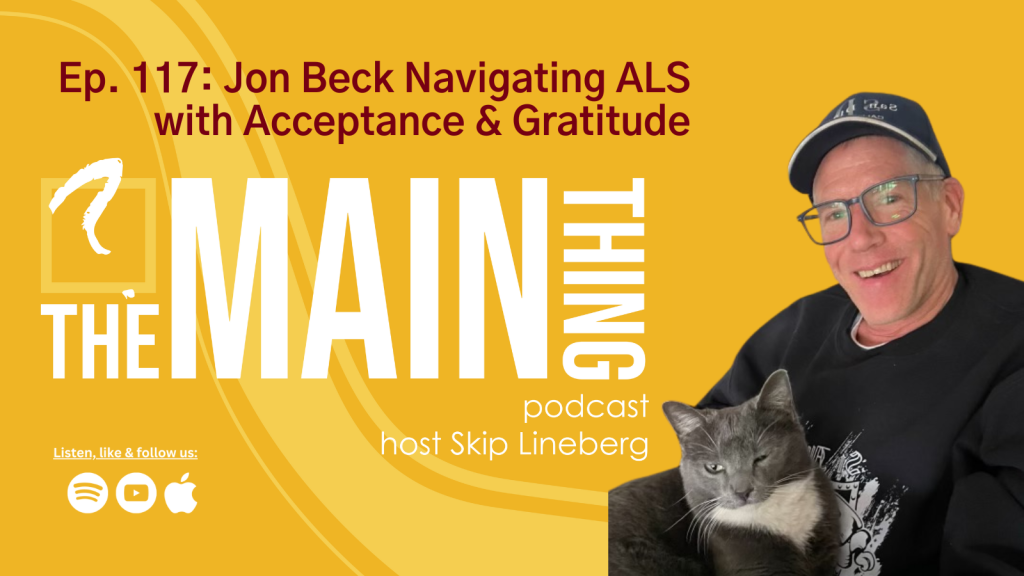
If you were diagnosed with a serious, perhaps fatal, health condition, would you be able to approach it with acceptance—much less gratitude? I’m fairly certain I’d struggle to do so. Yet those qualities are exactly what have enabled Jon Beck to get where he is today.
Unyielding Spirit in a Father’s Journey through Lou Gehrig’s Disease
Our special, wise guest is a new friend, a special human being with the most amazing spirit and attitude, and someone battling a fatal disease. Jon Beck is seven years into a battle with ALS. As you will hear in this powerful conversation, Jon is not defined by his disease. Though ALS will eventually take his life, he will not allow it to rob him of his joy.
In this uplifting episode, you will learn the three keys to navigating any challenge, to making it through any form of adversity.
More About Our Guest
Jon Beck, explored the Western United States, often by bicycle, in his younger years until one day he decided to enroll in physical therapy school at Emory University in Atlanta. While there, he met the love of his life, lisa. Shortly thereafter they got married and began having kids and raising a family.
Jon’s nearly 20-year career as a physical therapist was ironically truncated by a physically debilitating disease ALS in 2017. Seven years later, Jon remains very active in his power wheelchair. He applies his background in biomechanics to good use every day. This despite the initial prognosis from doctors that he might only have two years to live.
Jon is the proud father of three adult children. They continue to provide tremendous inspiration to him, as does his wife, Lisa.
Jon Beck spoke with us from his home in St Albans, West Virginia, USA.
Resources
Connect with Jon on Facebook
Book recommended by Jon: “The Road Less Traveled” by M. Scott Peck, MD
Find it in The Main Thing’s Book Shop online store or on Amazon
Credits
Editor + Technical Advisor Bob Hotchkiss
Brand + Strategy Advisor Andy Malinoski
PR + Partnerships Advisor Rachel Bell
Marketing, Social Media and Graphic Design Chloe Lineberg
Stay Connected with Us on Social
YouTube @themainthingpod
Twitter @themainthingpod
Instagram @themainthingpod
Facebook @TheMainThingPod
Help Support and Sustain This Podcast
- Become a subscriber.
- Share the podcast with one or two friends.
- Follow us on social media @TheMainThingPod
- Buy some Main Thing Merch from our Merchandise Store.
- Buy a book from our curated wisdom collection on bookshop.org.
- Become a patron and support us on Patreon with funding.
Episode Chapters
[0:04:05] – Fatherhood and life stages
[0:06:05] – Sensing something is not quite right; the onset of ALS
[0:07:00] – Daily life with ALS, symptoms, challenges and adaptations
[0:08:57] – How Skip and Jon are connected
[0:11:07] – Jon reveals his Main Thing wisdom
[0:13:02] – Goosebumps moment for Skip
[0:15:40] – The cornerstones of a spiritual life
[0:18:02] – Dealing with a daunting diagnosis; snapshot of a day in Cleveland
[0:20:22] – Truly understanding the principle of acceptance as courage, not cowardice
[0:23:18] – Why Landscape View is better than portrait mode
Keywords
Acceptance, Adversity, ALS, Fatherhood, Resilience, Wisdom, Inspiration, Positivity, Transcendence, Mark Twain, Worrying, Train, Journey, Reflections, Life’s Challenges, Joy, Parenting, Physical Therapy, Prognosis
Full Transcript of This Episode
0:00:00 – Announcer
Wisdom. It’s an incredibly valuable asset, some would say more precious than gold. It’s attractive, appealing, admirable. Conversely, a lack of wisdom is the basis of immaturity, blind spots and bad decisions. Wisdom, it can be gained over time, but it can’t be rushed. But wisdom can be shared. That’s precisely what we are here to do right now, today. We are here to hack wisdom, to distill it, to understand it and to process it. Why? To get better at life.
Welcome to the Main Thing. This is your new nine-minute podcast. I’m your host, skip Lineberg, and I’ve set out to interview the wisest people I know. We’ll see what we can learn from each one when they’re faced with an incredibly difficult, soul-piercing question.
0:00:59 – Skip Lineberg
Hey, hey, hey. Welcome to your wisdom podcast. I’m Skip Lineberg and I’ll be your host today.
Don’t hit that fast forward button just yet, because I have two important announcements for you. First off, we’re changing our show format. You’ve come to know us for nine minutes of wisdom. Now, after five years and more than 100 episodes, we’re expanding our show to a 25-minute format. Same great guests, more wisdom, same price, free to you twice a month, more powerful insights and more stories. In just a moment, we’ll dive into a wisdom conversation with our special guest. But next the second important announcement. I want to give a shout out of gratitude to our newest patron, Brad from West Virginia. Thank you, brad, for supporting this podcast with your funding. Not only are you helping to underwrite our costs of production and programming, you are helping to keep this pipeline of wisdom flowing. Thanks to Brad and other patrons. By way of their monthly funding, they’re helping hundreds of people discover new wisdom, helpful insights, valuable lessons and fresh perspectives. All of that helps us get just a little bit better at life.
Our special guest today is a new friend, a special human being with the most amazing spirit and attitude, and someone battling a fatal disease. Jon Beck is seven years into a battle with ALS. As you will hear today in this powerful conversation, Jon is not defined by his disease. Though ALS will eventually take his life, he will not allow it to rob him of his joy.
In this uplifting episode today, you will learn the three keys to navigating any challenge, to making it through any form of adversity.
Our special guest, Jon Beck, explored the Western United States, often by bicycle, in his younger years until one day he decided to enroll in physical therapy school at Emory University in Atlanta. While there, he met the love of his life, lisa. Shortly thereafter they got married and began having kids and raising a family.
Jon’s nearly 20-year career as a physical therapist was ironically truncated by a physically debilitating disease ALS in 2017. Seven years later, Jon remains very active in his power wheelchair. He applies his background in biomechanics to good use every day. This despite the initial prognosis from doctors that he might only have two years to live.
Jon Beck is the proud father of three adult children who live near, across town and far in Alaska. His kids continue to provide tremendous inspiration to Jon, as does his wife, lisa. Jon spoke with us from his home in St Albans, West Virginia.
Get ready for a big blast of inspiration. Over the next several minutes, you will discover why Jon Beck is one of the wisest people I know.
0:03:58 – Skip Lineberg
Jon Beck, welcome to the Main Thing Podcast. So great to be with you this morning.
0:04:02 – Jon Beck
Great to have you here, Skip.
0:04:05 – Skip
Thanks for inviting me into your home. Jon, you and I are both fathers, and I know that’s a big part of the joy of our lives and our identity. What do you love most about fatherhood at this stage with grown kids?
0:04:22 – Jon Beck
The best thing about it now is that if they want my input, they ask for it, and I don’t feel obligated to tell them right from wrong anymore.
0:04:34 – Skip
Yeah, yeah, it’s, it’s different. It’s different when they’re grown. It has changed a lot since they were little and I’m just on the cusp of that, on the leading edge, just making that adjustment from having kids that were at home and more dependent on me to now my mindset is to pull back, give them more freedom, release control and let them. Let them grow and learn and live.
0:05:02 – Jon Beck
My oldest just turned 30, so I’m living that reality too.
0:05:10 – Skip
Jon, you were for most of your professional life a physical therapist. Yes, what made you get into that and choose PT as your profession?
0:05:19 – Jon Beck
Probably because I’d been a patient. I was athletic and had some injuries and working with therapists following knee and back surgery was powerful and restored my belief that I could get back to being active. So, it felt good to be the recipient of that kind of care, and I’ve always been fascinated with the body and how it works. How it heals itself, if you get out of the way, and how sometimes it needs some help.
0:05:53 – Skip
So you did that until one day when you said your hands wouldn’t do what you wanted them to do anymore.
0:06:00 – Jon Beck
I had become slightly weaker on bike rides but noticed some weakness in my hands working on our house in Morgantown.
And also we did a family walk at Little Creek Park. It was maybe in the 40s and I didn’t have gloves on and when we got back in the vehicle I couldn’t move my hands at all.
Those were sort of atypical experiences, but those two events got me seeking an evaluation.
06:36 – Skip
And about how many years ago, Jon?
0:06:38 – Jon Beck
That would have been about 2015. And I didn’t get diagnosed until 2016, in this month of September of 2016.
0:06:52 – Skip
Diagnosed with …?
0:06:53 – Jon Beck
ALS – Lou Gehrig’s Disease.
0:06:58 – Skip
Tell us a little bit about what you experienced, what the symptoms are like and and some of the things that you have to navigate through?
0:07:05 – Jon Beck
It’s a neurologic disorder where the nerves that carry the signal to the skeletal muscles in the body are diseased and they don’t carry the signal appropriately and the muscles eventually kind of shrivel up and die. So obviously it has ramifications for all kinds of things. I’m in a wheelchair. I can’t walk. I can bear some weight on my legs, if someone is helping me to transfer. I need help to move out of the chair.
My hands have gotten quite weak, almost useless. Right hand and my left thumb works real well, but most of the fingers on the left hand don’t work very well, so I’m kind of lacking the opposable thumb kind of grasp and pincer grasp is quite weak.
Additionally, my muscles of respiration have gotten weak, so my numbers on my pulmonary function tests have declined and I use a ventilator at night, okay, but I breathe on my own during the day with accessory muscles for respiration, by bearing weight on my arms, kind of instinctively now okay, okay, I don’t really have to think about.
0:08:27 – Skip
It makes sense so is it a progressive thing?
0:08:29 – Jon Beck
It gets worse yes, it’s a progressive degenerative disease and, uh, actually, in 2016, when I got diagnosed, they gave me two to five years to live. So I’m knocking it out of the park.
0:08:42 – Skip
Way beyond that, yeah, way beyond that!
0:08:44 – Jon Beck
Yeah, I’m at eight years now and counting, and nowhere near kicking the bucket as far as I’m concerned. So very, very blessed to be in the world still.
0:08:57 – Skip Lineberg
One of the things that you mentioned that you’re able to do, and that you do pretty much every day, is get together with a group of folks in the morning, early in the morning, and one of those folks that you get together with is a gentleman by the name of Andy Malinoski. Yes, so, Andy is how we’re connected. Thanks to Andy Malinoski.
0:09:18 – Jon Beck
Andy is a very thoughtful, intelligent man and had been through some difficulties quite gracefully, despite major challenges. I loved his willingness to share his journey and the way he shared it. So, he’s a dear friend of mine.
0:09:43 – Skip
I’m very, very grateful to know Andy. Andy’s a real, true friend and he not only helps me learn new things, but he’s got a tremendous sense of humor and keeps me laughing pretty much every day and we encourage one another through the hard times and we distract each other and make each other laugh through the lighter times. And we distract each other and make each other laugh through the lighter times.
0:10:05 – Announcer
One. Nine. Two. 192 extra minutes of wisdom that’s what you get when you become a patron of the Main Thing podcast.
Many of you continue to say we want to hear more from these wise guests. That’s precisely what patrons of our podcast get Exclusive access to bonus episodes called the whole thing. These 30 minute special shows bring you a deeper dive into our guests wisdom, less editing, more laughter, less time limits, more stories. Unlock those 192 extra minutes of wisdom for yourself for as little as nine dollars per month through the Patreon platform.
And when you become a patron, you ALSo get access to wisdom essays, behind-the-scenes glimpses and access to special patron-only wisdom gatherings.
Head over to patreoncom/themainthingpodcast. Go unlock your 192 extra minutes of wisdom.
0:11:07 – Skip
Jon Beck, what’s the main thing you’ve learned in your lifetime so far?
0:11:13 – Jon Beck
Skip, the main thing I’ve learned in my lifetime so far is that acceptance is the answer to all my problems today.
0:11:25 – Skip
Acceptance is the answer to all our problems today. Jon, would you expand on that for us and take us inside the lovely nuance of that phrase, your main thing phrase?
0:11:43 – Jon Beck
Well, it’s actually helped me to recognize whether or not something that I’m dealing with is even a problem whether or not something that I’m dealing with is even a problem. It makes me think of Scott Peck in the book the Road Less Traveled right the very beginning of the book, he says life is difficult. However, when we accept that life is difficult, through the acceptance we’re able to transcend the difficulty and voila, it’s not difficult anymore yeah so that’s kind of the way I say I don’t have problems anymore unless I get up in my head and start manufacturing them.
I have difficulties and challenges because some things are easy and some are difficult. Yeah, and it was just like everybody else, but it it puts things in perspective and I think it’s very much related to expectations. Absolutely, I think I’m going to have a pain free life. I’m going to be sadly mistaken.
0:12:47 – Skip
Yeah.
0:12:48 – Jon Beck
Because life has ups and downs and joys and pains, and I also define other things differently. Like, I love the phrase, Pain is necessary, suffering is optional.
It means a lot to me because I’m usually doing it to myself. If I’m suffering, yeah, and whatever life hands me is whatever I’m supposed to walk through to learn from.
0:13:20 – Skip
Sure, as you know, and as listeners know, I never know the main thing before I asked that question and the guest reveals their main thing wisdom to me. But I think this notion of acceptance and expectations, Jon, I’ve learned to view it as a spectrum Acceptance on one end, expectations on the other end sort of a duality. And the more expectations I have, the more I tend to diminish my joy, be let down, be disappointed.
But if I can be accepting and just take things as they come and be fully present in a situation, I’ll tend to usually have a much more joyful experience. And I’ll get much more out of it. It’ll be a richer experience. But that’s that’s what, that’s what life and that’s what you know, that’s what God has been teaching me, I think, over the last three, four, five years. This notion of acceptance versus expectations. So it’s uncanny that that I heard you say that today. It kind of gave me goosebumps.
0:14:30 – Jon Beck
Great! It made me think of the phrase something like: My serenity is inversely proportional to my expectations.
Yeah, that’s that’s a great way to look at it higher the expectations, the less serenity and the lower the expectations. To me, it relates to an openness and an excitement about I don’t know what’s going to happen next. Let’s just see and let me try to do the next right thing in that situation. Rather than wonder how long it’s going to last and if it’s going to be comfortable or whatever, just just do it, yeah. The Nike slogan makes sense.
0:15:15 – Skip
Jon, your main thing—Acceptance is the answer to all my problems today—if you think back to when that crystallized for you, tell us when you. When that became wisdom, truth, you identified it, you latched on to it and embraced that. Do you recall when that was and maybe what was going on in your life at that time?
0:15:40 – Jon Beck
I think I had the opportunity several years ago, when I was unable to continue work as a physical therapist because of the ALS. I had an opportunity to spend more time in quiet reflection, and it didn’t come on me all at once at any particular event, but just a few months ago a dear friend of mine said that the cornerstones or the pillars of his spiritual life, his spiritual activities that he engaged in, were acceptance, gratitude and humility. Acceptance, gratitude and humility. And I’d already been practicing gratitude and working on humility. I’m probably not the most humble person, right out of the gate, but I think all three of these concepts are related. And when I accept my current circumstances, instead of labeling them as bad and focusing on that, I’m able to take a step back and see the totality of my life and see that there are many things that are good, that I should be grateful for, that I could be grateful for.
And that relates to humility, because if I don’t have a feeling of entitlement, like, oh, I deserve better than what I’m getting, if I can be right size and recognize, I’m really fortunate to get what I’m getting. Recognize I’m really fortunate to get what I’m getting. I’m getting another day on this planet and I’m getting the ability to draw the oxygen out of the air, still without the help of my machine, as long as I got a little bit of weight on my elbows and it puts things in a perspective. For me that has been transformative, and some of the most painful things from my past have been some of the most important growth, growth and learning opportunities.
0:18:01 – Skip
I’m right there with you.
0:18:02 – Jon Beck
Eight years ago, when I got diagnosed with ALS at the Cleveland Clinic, at the same place where they had told me nine months before they were 95% sure I did not have ALS. So that was a bit of a blow to go back in September of that year and hear the news.
0:18:28 – Skip
Yeah, because you would say, But wait, what about what you told me before?
0:18:35 – Jon Beck
“What about what you said in January, Doc?” Yeah, I didn’t go there.
0:18:38 – Skip
So that required a healthy measure of acceptance.
0:18:46 – Jon Beck
Right. And not that it’s easy to wrap your head around some information when’s a basically a death sense tacked onto it.
We were in the parking garage outside the Cleveland Clinic and my wife had an emotional moment: “What are we gonna do?”
I said, “We’re gonna go eat Mexican food at that five-star place on the other side of town, as was our plan.”
Yes, and we just kept it in the here and now, and you know, to the extent that I’m able to do that, I do pretty well, yeah, and if I look ahead at what might be ahead, it could get scary, but I don’t live there anymore.
So I’m at peace the vast majority of the time because, you know, the God of my understanding has gotten me through everything with 100% survival rate, so far. And I always seem to have what I need to get through the moment.
And that’s important to mention too: I don’t have to accept something forever more, I just have to accept it here and now.
0:20:00 – Skip
Jon, in our audience right now, someone’s listening and they’ve never thought about this concept of acceptance. What might be some of the struggles they are encountering? Some of the pain points? The things they’re bumping into which would signal to them—hey, you need to click into this acceptance principle and study it a little bit and get more familiar with it.
0:20:22 – Jon Beck
Well, I think it’s important to mention that acceptance is not fatal resignation. Okay, it doesn’t mean, “Oh well, I guess I’ll just throw a blanket over my head and die. You know, god, you take this.”
It’s a courage to shoulder the responsibility that I still have to, you know, for my own attitude and my own actions, which are the only things I really believe I have control over. I don’t have control over other people’s thoughts or deeds.
0:21:01 – Skip
Their reactions ….
0:21:02 – Jon Beck
Or their reactions. Their reactions and responses, whatever … their opinions. No, none of that. I’m just responsible for what I do. what I do and the way I think. You know the attitude that I take to things.
0:21:18 – Skip
Yeah.
0:21:19 – Jon Beck
And if I can have a good attitude and do the next right action, that’s as good as it gets for me.
0:21:29 – Skip
Jon, your main thing … I love it, and it just resonates with me so deeply. Acceptance is the answer to all my problems today. How can someone take that main-thing wisdom principle and begin to apply it to their life tomorrow? How can they wake up tomorrow and take a step down that trail of wisdom that you lit up for us this morning?
0:21:53 – Jon Beck
I think if one is in the present moment and focusing on the here and now, living where our feet are, instead of up in our heads, we will have the resources available to deal with what we’re dealing with. And I would just challenge someone that’s having a real big problem: are they in the present, or are they looking ahead and envisioning something?
0:22:15 – Skip
Yeah, that’s great advice.
0:22:17 – Jon Beck
Mark Twain’s quote is one of my favorites. I’ve seen a lot of terrible things in my life, some of which actually have happened.
0:22:27 – Skip
I love that. Jon, as we wrap up … lovely train in the background here. We’re in St Albans, near a wonderful rail line. You can hear that enchanting sound of the train whistle, and it’s nostalgic. Reminiscent of wisdom: the train is going on.
I wanted to wrap up by asking you two questions. The first is for a listener who has a serious illness or a disease—or their family member who’s listening right now. Do you have a word of encouragement or some advice from your lived experience over the last nearly 10 years, that might help them? Might help brighten their day, or lighten their load a little bit?
0:23:18 – Jon Beck
I would recommend landscape mode instead of portrait mode, when you’re scanning the horizon of your life.
0:23:26 – Skip
Oh, I love that.
0:23:27 – Jon Beck
Yeah, if you can back off a little bit and take in the whole picture, you’re sure to find something positive on that horizon. You can zero in on it, if you want. But the danger of focusing on something unpleasant is that, pretty soon, that’s all I see.
0:23:46 – Skip
Yeah, it magnifies.
0:23:48 – Jon Beck
Absolutely. When you put it under a microscope, of course it’s going to fill the field of vision.
But if I take a step back and broaden my scope, try to find something positive to pay attention to, it balances things out. And I recognize yeah, I got this difficulty in that one, but there’s 98 wonderful things to be grateful for.
Gratitude actually gets neuro-chemical changes going in the body. And I don’t have to be grateful for every single thing that I could, or should, be grateful for. But true gratitude for one thing will bring this cascade of events in my brain that end up making me feel better. There’s science that backs that up. I just think a gratitude list is an important thing for all of us to have on a regular basis. So, I’ll leave it with that.
0:24:49 – Skip
Jon, your main thing: acceptance is the answer to all my problems today. I love that. I’ve loved our conversation. I just want to thank you so much for all of it.
0:24:59 – Jon Beck
Skip, it’s been my pleasure chatting with you today. Thank you so much for coming out and giving me the opportunity.
0:25:05 – Skip
So long for now.
0:25:08 – Announcer
Wow, that goes by incredibly fast, doesn’t it?
Time flies when you’re hacking wisdom. I hope you’re left wanting more.
Sync up with us again next time on The Main Thing, for nine more minutes of wisdom.
Transcribed by https://podium.page