
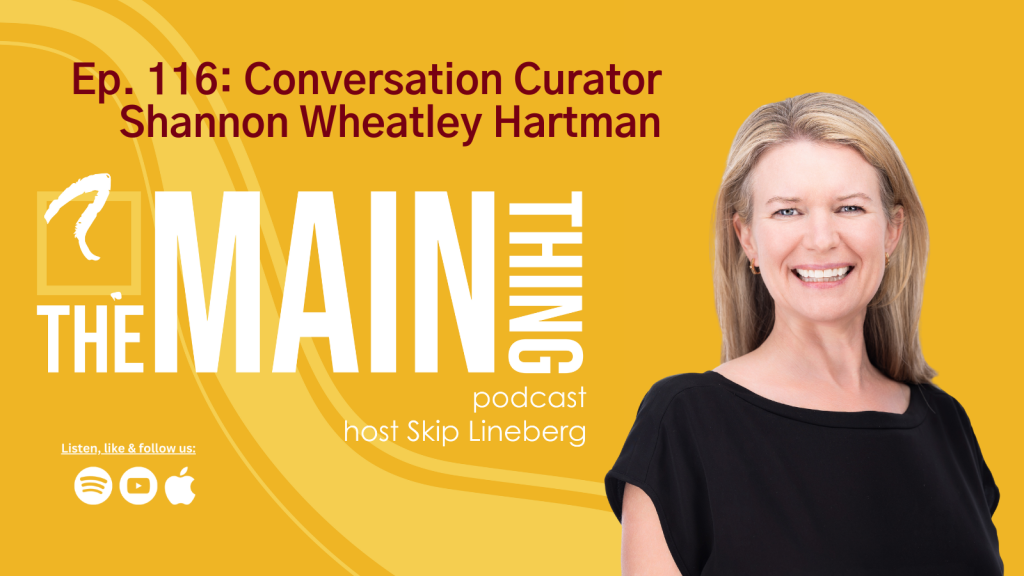
Fostering Democracy and Personal Growth Through Collaborative Exploration
What if embracing diverse ideas could transform not just your personal growth, but also strengthen democracy itself? Tune into an enlightening conversation with Dr. Shannon Wheatley Hartman, president of the Interactivity Foundation. She reveals how an exploratory mindset opens doors to innovative thinking and community building. Drawing inspiration from her mentor, Dr. Jack Byrd, Shannon shares invaluable lessons on being present and supportive in our interactions. We dive into the foundation’s commitment to nurturing democratic skills like generous interpretation and comfort with ambiguity, underscoring the ongoing importance of fostering wisdom in our everyday lives.
More About Our Wise Guest – Dr. Shannon Wheatley Hartman
Shannon Wheatley Hartman is the President of the Interactivity Foundation, a nonpartisan and non-advocacy organization founded decades ago in Parkersburg, WV. The foundation has grown to become a nationally recognized leader, focused on strengthening democracy through discussion.
Shannon is an expert facilitator who has been working to advance civic discussion skills and mindsets in communities and classrooms for over 15 years. She entered the nonprofit world through academia. She has a Ph.D. in political science and has taught at several universities. Whether she is teaching a class or working with a community group, she has always been passionate about creating the conditions and nurturing the necessary skills to help groups think better together.
Democracy isn’t defined by the absence of difference or conflict, but the ability to celebrate differences and work together through disagreements.
Shannon and the work of the Interactivity Foundation helps to support this in classrooms, communities, and workplaces.
Perhaps unintentionally, Shannon tests out all of her new discussion experiments on her family. She lives with a wonderfully supportive husband, three daughters, and a very enthusiastic dog, “Scouty Boy.” They gravitate to activities that encourage exploration, like traveling, hiking, mountain biking, and wild baking experiments.
Shannon joins us from Philadelphia.
Get ready! Over the next 19 minutes, you will discover why Dr. Shannon Wheatley Hartman is one of the wisest people I know.
Resources
Connect with Shannon on LinkedIn
Interactivity Foundation website
Our podcast website for additional wisdom resources
Credits
Editor + Technical Advisor Bob Hotchkiss
Brand + Strategy Advisor Andy Malinoski
PR + Partnerships Advisor Rachel Bell
Marketing, Social Media and Graphic Design Chloe Lineberg
Stay Connected with Us on Social
YouTube @themainthingpod
Twitter @themainthingpod
Instagram @themainthingpod
Facebook @TheMainThingPod
Help Support and Sustain This Podcast
- Become a subscriber.
- Share the podcast with one or two friends.
- Follow us on social media @TheMainThingPod
- Buy some Main Thing Merch from our Merchandise Store.
- Buy a book from our curated wisdom collection on bookshop.org.
- Become a patron and support us on Patreon with funding.
Episode Chapters
[0:03:54] – Traveling north to escape the heat and awaken the brain
[0:05:35] – Skip and Shannon reveal how they’re connected
[0:06:29] – The work of the Interactivity Foundation
[0:09:45] – Shannon shares her main thing wisdom nugget
[0:10:28] – Building collaboratively with purpose and patience
[0:13:54] – Ego, fear and other blockers to building democracy
[0:18:18] – Cooking down the kitchen
Keywords
Wisdom, Personal Growth, Democracy, Diverse Ideas, Exploratory Mindset, Collaboration, Community, Critical Thinking, Problem Solving, Ego, Fear, Impatience, Curiosity, Comfort with Ambiguity, Democratic Discussions, Wisdom, Analytical Mindset, Building, Purpose, Patience, Loneliness, Engagement, Interaction, Culinary Experiments, Resourceful, Enriching Experience, Gratitude, Kentucky, West Virginia, WVU, Jack Byrd
Full Transcript of Episode
00:00 – Announcer
Wisdom. It’s an incredibly valuable asset, some would say more precious than gold. It’s attractive, appealing, admirable. Conversely, a lack of wisdom is the basis of immaturity, blind spots and bad decisions. Wisdom, it can be gained over time, but it can’t be rushed. But wisdom can be shared. That’s precisely what we are here to do right now. Today. We are here to hack wisdom, to distill it, to understand it and to process it. Why? To get better at life. Welcome to the Main Thing. This is your new nine-minute podcast. I’m your host, Skip Lineberg, and I’ve set out to interview the wisest people I know. We’ll see what we can learn from each one when they’re faced with an incredibly difficult, soul-piercing question.
0:00:59 – Skip Lineberg
Hello and welcome to your wisdom podcast. Twice a month here at The Main Thing Podcast, we bring you a concise, high-impact wisdom lesson, something that you can apply right away. Fresh insights and unique perspectives from the wisest people around, all of it to help you along your personal growth journey. If you are new here, I’m so glad you’ve chosen to spend some time with us. I’m Skip Lineberg, and I’ll be your host.
Hey, after you listen to this episode, I invite you to head over to our website, themainthingpodcast.com, where you can access the full gamut of our wisdom resources, including our wisdom newsletter.
When my mentor, Dr Jack Byrd, told me about Shannon Wheatley Hartman, I couldn’t wait to meet her. You see, Dr. Byrd had chosen to pass the leadership torch for his nonprofit foundation to Shannon and after just a few conversations with Shannon, I knew I had to get her on the show.
As you listen to today’s episode, you will discover Shannon’s main thing and you will also learn about the importance of exploring diverse ideas and opinions, especially those counter to your default position. You’ll learn about a powerful question that can both expand someone’s thinking and help you to understand why someone holds fast to a certain belief. Shannon is the president of the Interactivity Foundation, a non-partisan and non-advocacy organization founded decades ago in Parkersburg, West Virginia. The foundation has grown to become a nationally recognized leader, focused on strengthening democracy through discussion.
Shannon is an expert facilitator who works to advance civic discussion skills and mindsets in communities and classrooms. She has a PhD in political science and has taught at several universities. Whether teaching a class or working with a community group, Shannon has always been passionate about creating the conditions and nurturing the necessary skills to help groups think better together.
She lives with a wonderfully supportive husband, three daughters and a very enthusiastic dog, “Scouty Boy”.
Shannon joins us today from her home office near Philadelphia.
Get ready! Over the next several minutes, you will discover why Shannon Wheatley Hartman is one of the wisest people I know.
03:41 – Skip Lineberg
Shannon Wheatley Hartman, welcome to The Main Thing Podcast.
03:49 – Dr. Shannon Wheatley Hartman (Guest)
Thank you, Skip. I am so happy to be in conversation with you today.
03:54 – Skip
I understand that you and your family just got back from a trip to Nova Scotia and, first of all, what a smart move to go north, where it’s cool in the midst of this sweltering summer we’re having. Tell us a little bit about your trip to Nova Scotia.
04:06 – Dr. Shannon Wheatley Hartman
We live just outside of Philadelphia and summers are getting hotter and we also have three children, so I am very full work life. So being able to drive and and control our, our vacation that way it’s, it’s really helpful. We’ve been heading north and it was just a lovely. I’ve never been to Nova Scotia, so it was a lovely trip through New England and then traveling around Nova Scotia.
I think we really love travel, for the destination, but also for what it does for us. It’s the exploratory mindset. I would put it in the same camp as personal and professional development. It’s building a different way of seeing the world. And what if we all could wake up every morning with that kind of enthusiasm and excitement that we have when we’re somewhere else, like on vacation? And what if we could have that in our everyday lives? And so when we travel, I remind myself of that. And build those skills.
05:12 – Skip
It does awaken a different part of the brain, doesn’t it?
05:14 – Dr. Shannon Wheatley Hartman
It does, it does.
05:18 – Skip
Speaking of awakening the brain, let’s talk about our mutual friend. How we’re connected is by way of Dr Jack Byrd, who appeared on Episode 3 of this show, back in our first season. Tell us a little bit about how you became connected with Dr Byrd.
05:35 – Dr. Shannon Wheatley Hartman
Oh wow, I could talk all day about Jack Bird. He’s one of my favorite people. I think most of my experience with Jack has been professionally, through the Interactivity Foundation and working under his mentorship as president and then working with him also as a colleague.
I think what I’ve learned from Jack is to lean into focusing on the person right in front of you. Right in front of you, you can change somebody’s life if you are fully present and actively listening and do whatever you need to do to support that person in that moment. And then everything else is a distraction. But in that moment when you’re with people, be with them and do what you can to be supportive.
06:24 – Skip
The Interactivity Foundation. Tell us about it, with the work that you do and its mission.
06:29 – Dr. Shannon Wheatley Hartman
Our mission is to strengthen democracy through discussion, and we do that by bringing people together or helping other people bring people together in meaningful discussions.
06:41 – Skip
Yeah, wow, so important, so vital and probably forever, but it seems more vital nowadays, doesn’t it?
06:47 – Dr. Shannon Wheatley Hartman
It does, it does, but we’ve been around for so many years and it is so important and it’s always going to be important the work of democracy building. It’s never done. We never arrive at a full, perfect democracy. We always have to keep doing this work.
Things like learning how to build on the ideas of others, or learning how to practice generous interpretation, or cultivating curiosity, like expressing your ideas with confidence and humility. So things like getting comfortable with ambiguity these are all skills and mindsets, and we don’t take it for granted that people just are born with these. Instead, we think they have to be cultivated and they have to be practiced, and they can be practiced in classrooms, in communities or in workplaces.
07:42 – Skip
You guys are also planting seeds with the very young citizens of our country, aren’t you?
07:48 – Dr. Shannon Wheatley Hartman
It’s never too soon to start. So we’re talking like 12 or 10 to 14 year olds, and really the focus there is not so much on collaborative discussion, but it’s the work that you do in your mind before you even get to talking with others. And so thinking about what does it mean to live a purposeful life? What does it mean to have purpose and to work with others? And so this is an interactive journal designed for young folks, and it can be used in groups, like in a classroom or with after school programming or different kinds of ways that kids organize, but it can be used in groups or individually, and it’s just starting planting that seed earlier. Instead of asking kids what do you want to be when you grow up, why aren’t we asking them what kind of impact do you want to have?
08:42 – Announcer
One. Nine. Two. 192 extra minutes of wisdom. That’s what you get when you become a patron of the main thing podcast. Many of you continue to say we want to hear more from these wise guests. That’s precisely what patrons of our podcast get exclusive access to bonus episodes called the whole thing. These 30-minute special shows bring you a deeper dive into our guest’s wisdom Less editing, more laughter, Less time limits, more stories.
Unlock those 192 extra minutes of wisdom for yourself for as little as $9 per month through the Patreon platform. When you become a patron, you also get access to wisdom essays, behind the scenes glimpses and access to special patron only wisdom gatherings. Head over to patreon.com/themainthingpodcast. Go unlock your 192 extra minutes of wisdom.
09:45 – Skip
Shannon Wheatley Hartman what’s the main thing you’ve learned in your lifetime so far?
09:53 – Dr. Shannon Wheatley Hartman (Guest)
Skip, the main thing I’ve learned so far is to be a builder. But not just any builder. To be a builder who’s thoughtful, collaborative and in my community, or for my community.
10:15 – Skip
Yes, be a builder. That is a fabulous nugget of wisdom! Shannon, would you take us inside that and explore all the meaning and nuance that I know you have packaged into that powerful three word phrase?
10:28 – Dr. Shannon Wheatley Hartman
So the first part is is about thoughtful, and what I mean by that is don’t keep building the same old structures and and I think this is where I know I’ve been talking about the exploratory mindset, but this is something different. This is the analytical mind, this is critical thinking. But this is something different. This is the analytical mind, this is critical thinking, and I’d say I got to this part of that statement back when I was in academia. We’re very trained to be analytical and practice our critical thinking skills.
I think that when we’re being thoughtful builders, we do have to critically analyze what’s been done before and highlight those flaws, those concerns. However, you have to do the next thing, which is replace it with something else, something better, and building it. And it’s so, so, in many ways, easy to tear down. It’s so very hard to build up, and so being thoughtful is using those critical and analytical skills.
11:28 – Skip
And Shannon, that … to me … has a definite element of a growth mindset. And not walking in the territory of scarcity thinking—but more growth and abundance.
11:44 – Dr. Shannon Wheatley Hartman
That’s right, and I think that’s the second part. The second part of that equation is being thoughtful but also being collaborative.
So, one: collaborating with others. You can’t build alone. If you’re going to build anything meaningful you have to build with others. So one in many ways, you have to put your ego aside. Resources are not scarce, Ideas are not scarce, so lean into collaborating with others, sharing that experience together which, by the way, is fun and is an antidote to the loneliness crisis that I think this country is facing.
Also, when you’re doing this with others and being really open and seeking out divergent thinking, difference of ideas, whatever you build is going to be so much more stable and so much more interesting because you have greater buy-in. You have a greater number of stakeholders invested in it. So build thoughtfully, but build with others.
That’s part one and part two, and then part three is: you need to have purpose. Build for something. Build for your community, not just for yourself, not just for your in-group, but thinking about like for your community.
You’re with others and, as we talked about, you’re with others to build something better than what you’ve had before. And so you can be that problem solver in your community—and not waiting for somebody in DC, or somebody somewhere else, to solve those community issues. You can do it.
13:18 – Skip
Not waiting to be rescued.
13:20 – Dr. Shannon Wheatley Hartman
Right. Who wants to do that? Who wants to wait to be rescued?
I think we can do it in all parts of our life community, workplace and at home, teaching our kids to build on the ideas of others instead of tearing them down.
13:34 – Skip
Now, I love that example, applying it to parenting.
13:34 – Skip
If someone’s listening today and they haven’t thought about this idea of being a builder and some of the collaborative methods that you’ve talked about today, what might they be bumping into in the before condition, as pain points or symptoms or struggles?
13:54 – Dr. Shannon Wheatley Hartman
I think ego is always one obstacle, because we want when we’re doing the work, we want to get the credit for it. And when you’re building with others, the spotlight might not be on you or your organization you might be sharing that spotlight. It might not be on you or your organization you might be sharing that spotlight. So, coming to terms with it’s better to share the spotlight. And then I think, fear. Fear is an obstacle for growth and I do see building as growth and I think the fear sometimes is fear to engage that which is different. Fear of different ideas. Fear of looking silly or not, which is different? Fear of different ideas. Fear of looking silly
14:33 – Skip
Maybe even fear of change.
14:35 – Dr. Shannon Wheatley Hartman
Absolutely right! So it’s much more comfortable. And when I said you could be a builder, but you know, many people just keep rebuilding that which is already built and and because it’s it’s, there’s a blueprint for that.
14:45 – Skip
And then defending it. We have to protect it and defend it.
14:49 – Dr. Shannon Wheatley Hartman
Yes, yes, and it’s scary. It’s scary to change. And change is slow, and innovation is often rejected the first several times around. So it all happens in stages.
15:02 – Skip
So true.
15:05 – Dr. Shannon Wheatley Hartman
But maybe that leads to the third bit of the strategy. The third strategy is patience, right? Like, maybe people get frustrated by building with others and building something different and so their impatience discourages them from doing it.
I think when we’re talking about especially big issues and people getting hurt, we want to fix it right away. And we also need to do that, not lose that sense of urgency and think about how do we fix it in a way where more voices are in the conversation. We’re fixing it long-term and not a Band-Aid, and that’s the slow bit of the process that I know is so frustrating for so many people.
So kind of not dismissing that urgency and while in tension with: we need to make sure we’re doing it in a way that honors the wider range of stakeholders and voices.
16:11 – Skip
Shannon, what’s an action step that someone who’s listening now they encountered something new, this new idea of be a builder. What’s a small action step they could take, today or tomorrow, to get down that path a bit?
16:21 – Dr. Shannon Wheatley Hartman
My big word is engage. Engage with your own mind, but engage with others. So how do you engage and reach out? And don’t just reach out to you know … the safe people.
16:39 – Skip
The safe. The known. The familiar.
16:41 – Dr. Shannon Wheatley Hartman
That’s right. So, reaching out to the unknown, unknown people, organizations, build up your own skills. Like we all, all of us are a work in progress. And I’d say also asking questions. Right, so asking questions it just, instead of statements. More and more questions. It helps if you ask yourself questions all day long, but ask others questions. Talk less. Ask. Ask more questions.
17:06 – Skip
My favorite question … this will be old hat to you … but to me something new I’ve learned in the last couple of years is: “Tell me more about that.” An expander. “Could you tell me more about that?” It just opens and expands and invites more communication, more learning.
17:23 – Dr. Shannon Wheatley Hartman
Yeah, and I would also say, like, when you hear something that you don’t like: “Like where does that idea come from?”
“What experiences inform that position?” And it helps to humanize that looking for the values, looking for the experiences in people. Again, going this back and forth between that exploratory mindset and that curiosity about others, versus the analytical and the … “Well, you’re wrong. And let me tell you why you’re wrong.”
Instead it’s: “Huh! Well, you’re interesting. I don’t see it that way. Can you tell me more?”
18:03 – Skip
Yeah, let me read it. I wrote this down. I would say, “Shannon, where did that idea come from? I want to understand that.”
Okay, I wrote that down. I’m using that.
18:17 – Skip
Shannon, as we close out this wonderful conversation, I just want to ask you about something that you might be wanting to explore next. If you had a free Saturday next month, what might be something that you’re going to dive into?
18:32 – Dr. Shannon Wheatley Hartman
My children and I, we love to bake. So you know we love to check out new recipes and try that out. And one thing that we often do in the house is I call it “cooking down the kitchen.”
When the cupboard’s starting to get too big, and there’s random things left in the refrigerator, I might spend a whole week where or maybe in a couple of weeks. No new groceries are allowed in the house and I have to cook down what’s left in the kitchen and it turns into some very experimental recipes.
Some of our best meals have come out of cooking down the kitchen, but I’d also say that some not-great meals have come into this. So it might be time to cook down the kitchen soon.
19:21 – Skip
Shannon, it’s been a delight, it’s been a pleasure, it’s been a learning experience and I just want to thank you.
19:27 – Dr. Shannon Wheatley Hartman
Thank you, Skip. Thank you so much.
19:29 – Skip
So long for now.
19:32 – Announcer
Wow, that goes by incredibly fast, doesn’t it? Time flies when you’re hacking wisdom. I hope you’re left wanting more Sync up with us again next time, on The Main Thing, for nine more minutes of wisdom.