
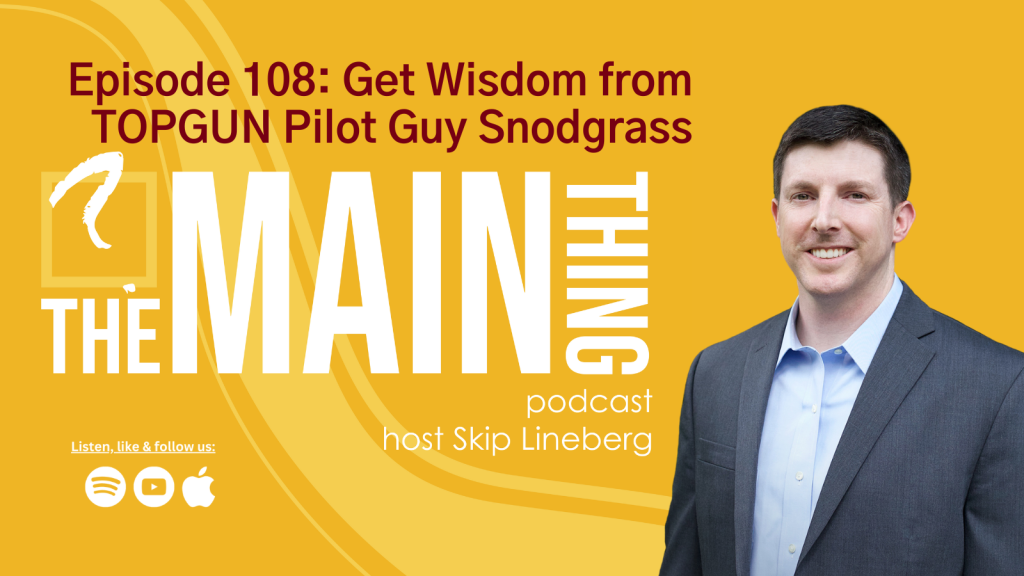
Navigating Life with a Fighter Pilot’s Precision and Focus
Join us for a thrilling flight into the world of discipline, strategy, and the art of mastering life’s greater lessons with retired TOPGUN pilot and instructor Guy Snodgrass. Listen in as we navigate Guy’s journey from an Eagle Scout with lofty dreams to his days at the US Naval Academy, into the cockpit of an F-A-18 fighter jet, and beyond to his role as a Top Gun instructor. We’ll unpack the realities of military aviation, contrasting Hollywood’s depiction with the true rigors and dedication of the job, while extracting the disciplined approach and strategic thinking that propelled Guy to the pinnacle of his career.
More About Our Wise Guest – Guy Snodgrass
Guy Snodgrass is the owner of Defense Analytics, a consulting company focused on international policy, business strategy, and technology policy.
A retired U.S. Navy Commander, Guy served as a F/A-18 fighter pilot and TOPGUN Instructor. He also served as the Pentagon’s Director of Communications and former Secretary of Defense James Mattis’ Chief Speechwriter. He’s the author of two published books, including “TOPGUN’s Top 10: Leadership Lessons From the Cockpit.”
Guy joins today from Dallas, TX.
Strap into your cockpit and get ready! In this fast-paced 19 minute conversation, you will discover why Guy Snodgrass is one of the wisest people I know.
Resources
Learn more about Guy via his website
Connect with Guy Snodgrass on LinkedIn
Pick up a copy of Guy’s book “Top Gun’s Top Ten” from our Bookshop
Credits
Editor + Technical Advisor Bob Hotchkiss
Brand + Strategy Advisor Andy Malinoski
PR + Partnerships Advisor Rachel Bell
Marketing, Social Media and Graphic Design Chloe Lineberg
Stay Connected with Us on Social
YouTube @themainthingpod
Twitter @themainthingpod
Instagram @themainthingpod
Facebook @TheMainThingPod
Help Support and Sustain This Podcast
- Become a subscriber.
- Share the podcast with one or two friends.
- Follow us on social media @TheMainThingPod
- Buy some Main Thing Merch from our Merchandise Store.
- Buy a book from our curated wisdom collection on bookshop.org.
- Become a patron and support us on Patreon with funding.
Episode Chapters
[0:03:02] – Becoming a navy fighter pilot – from dream to reality
[0:04:50] – TOPGUN Hollywood’s version contrasted with the real thing
[0:07:30] – Guy’s transition from military and public service to private sector
[0:09:30] – How Skip and Guy are connected
[0:11:32] – Guy reveals his Main Thing wisdom
[0:15:39] – Advice for those who feel frazzled
[0:18:26] – The importance of continuous learning
Full Transcript of This Episode
0:00:00 – Announcer (Intro)
Wisdom. It’s an incredibly valuable asset, some would say more precious than gold. It’s attractive, appealing, admirable. Conversely, a lack of wisdom is the basis of immaturity, blind spots and bad decisions. Wisdom, it can be gained over time, but it can’t be rushed.
But wisdom can be shared. That’s precisely what we are here to do right now, today. We are here to hack wisdom, to distill it, to understand it and to process it. Why? To get better at life.
Welcome to the Main Thing. This is your new nine-minute podcast. I’m your host, skip Lineberg, and I’ve set out to interview the wisest people I know. We’ll see what we can learn from each one when they’re faced with an incredibly difficult, soul-piercing question.
0:00:59 – Skip Lineberg
Welcome back to the Main Thing Podcast. I’m your host, Skip Lineberg. In just a moment, you’ll hear from our special guest, a retired TOPGUN pilot and TOPGUN instructor at the US Navy Strike Fighter Weapons School. What wisdom will we learn from this top performing gentleman, so adept at strategy, execution and communication?
But first, a warm welcome to our first-time listeners. I’m so glad to have you here with us. To learn more about all the wisdom offerings available to you, just head over to our website, themainthingpodcast.com. Once you’re there, I encourage you to sign up for our wisdom newsletter. It’s a great supplement to our podcasts.
Now for our special, wise guest. Guy Snodgrass is the owner of Defense Analytics, a consulting company focused on international policy, business strategy and technology policy. A retired US Navy Commander, Guy served as an F/A-18 fighter pilot and a TOPGUN instructor. Fighter pilot and a TOPGUN instructor. He’s the author of two published books, including “TOPGUN’s Top 10: Leadership Lessons from the Cockpit.” Guy also served as the Pentagon’s Director of Communications and former Secretary of Defense Jim Mattis’ chief speechwriter. Guy joins us today from the Dallas-Fort Worth area.
Step into your cockpit, buckle up and get ready. Over the next nine minutes, you will discover why Guy Snodgrass is one of the wisest people I know.
0:02:33 – Skip
Guy, good morning, and welcome to the Main Thing Podcast.
0:02:39 – Cdr. Guy Snodgrass
Hey, good morning, Skip, Great to be with you.
0:02:42 – Skip
First of all, before I get any further, thank you for your military service defending our nation.
0:02:47 – Cdr. Guy Snodgrass
Yeah, I appreciate it. One – I always appreciate it when people say that. Wonderful experience in the military. Tongue in cheek, I’ve always replied, “Thanks for the paycheck.” Yeah, obviously we’re taxpayer funded, and it was such an honor to be able to live your dream, so I look forward to talking about that a little more.
0:03:02 – Skip
Absolutely. New listeners are probably here because they saw that you were a TOPGUN pilot and TOPGUN instructor. I’d like to get a little bit into your military career, your career as a Navy officer and pilot, and progressing into how you became a TOPGUN instructor.
0:03:23 – Cdr. Guy Snodgrass
Probably around the age of 11 or 12, I really wanted to pursue naval aviation as my pathway. I wanted to be a Navy fighter pilot. That was largely because I’d been a Boy Scout growing up, became an Eagle Scout. We always did our annual fundraiser at the air show. You’ve got all these jets and other cool planes screaming overhead. That was the dream. To get there.
You graduate high school, got accepted to the US Naval Academy, from there, had some additional training afterwards, but ultimately found my way into flight school. And so now it’s a competition all the way through. So you have to compete to get the type of aircraft you’re going to fly. The three major bins are jets, props or helos. To fly helicopters.
Okay, I qualify for jets. So that gets you in the jet training, and now you have to qualify yet again for what type of platform you’re going to fly. So I was once again very lucky throughout that pathway to get selected for fighter jets, in my case the F/A-18 Hornet, initially the original Hornet. Went through that process. Became a fighter pilot, stationed out in Virginia Beach, Virginia, for my first tour of duty. Saw combat during Operation Iraqi Freedom and from there, based on flight performance and capability, got selected to be a student at TOPGUN … and then subsequently stay as an instructor at TOPGUN.
The cool thing is that was actually very early in my career, while still a Navy lieutenant. Then that kind of carries you through your experiences for the next … I guess at that point … about 15 years, until I retired as a Commander in the United States Navy.
0:04:50 – Skip
How realistic or unrealistic is what we saw on the Hollywood screen, versus a typical day in the life?
0:04:56 – Cdr. Guy Snodgrass
Yeah, I’d say the flying scenes are fairly realistic, both the original movie from 1986 and the most recent one that came out, I guess, at this point a year, two years ago. They did a great job with putting cameras all over the insides of the cockpit, on the exterior to get those really neat flying shots, so those are very realistic, I’d say.
Pretty much everything beyond that – they take a lot of liberties, like the plot lines and the romance and fights breaking out in the ready room. Stuff that you would never see.
It’s a great draw and I love it for the fact that, even sitting there as a guy who had recently retired from being a fighter pilot—and I’ve got my three young kids with me and we’re watching this— and it still brings that excitement. It leads to a lot of young men and women who are looking to possibly pursue that as a career.
0:05:48 – Skip
So, Guy, just a typical day. When you’re there, you’re in school, you’re competing to be a TOPGUN pilot. What time do you wake up, and how does your day start? I’m just real curious, like what that typical day is like.
0:05:59 – Cdr. Guy Snodgrass
It’s a bit of a meat grinder. I’m not going to lie. It’s usually six days a week, meaning Monday through Friday, and then at least a half day on Saturday or Sunday. And it’s just because of the sheer amount of the workload you have. Monday through Friday is almost solely geared towards training the students, and so typically you might show up anywhere between 5:00 and 5:30 in the morning.
0:06:20 – Skip
That’s when you actually arrive on base, so you’re getting up what: typically maybe 4:00 or 4:30?
0:06:25 – Cdr. Guy Snodgrass
You show up on base. Your first brief is going to be around 5:45 or 6:00 in the morning. You will brief for about an hour. Then we call it “walking to the jet.” But basically now you leave the briefing room, get all your flight gear, your headset. You get dressed. It takes another 15 minutes to a half hour, and then you get out to the flight line. You climb into the jet. And so usually two hours after you’ve started the brief you are engines on, ready to taxi and get airborne.
The flight itself lasts about an hour and a half, maybe an hour and 15 minutes, depending on how aggressive you’re maneuvering and how fast you’re burning your fuel. And then you’ll land, take off your flight gear, head to the debrief room. And the debrief at TOPGUN, that’ll take you all the way through and past lunch. Then you have usually about a half hour, maybe an hour, to kind of get recycled. Then you head into your second flight brief. And so after you go through that second phase, usually you’re done with your debrief somewhere around 10:00 or 10:30 PM. Then you run home, and you crash, so that you can wake back up the next morning and do it again.
0:07:29 – Skip
You finished up as an instructor there, and then how did you get into what you’re doing now, founding your company Defense Analytics. Tell us a little bit about that transition, how you planned it and what you’re doing today.
0:07:42 – Cdr. Guy Snodgrass
Sure. So TOPGUN was certainly a seminal moment early in my career, and then it carries you through, as I mentioned, the remainder of my career. I had several other tours of duty in fighter squadrons. I was the commanding officer for a fighter squadron based out of Japan. So that’s like being a CEO of about 250 people, a little over a billion dollars in assets, with the jets and all the equipment we had, and so that gives you that high-level managerial and leadership experience interspersed throughout there.
I had two tours of duty at the Pentagon, so both times I was a speechwriter. The second time I was doing that for the Secretary of Defense, a guy named former General James Mattis, and so he was Secretary of Defense under the previous administration. Now you’re exposed to everything at the high level. You’re working with the president and his team. You’re working with cabinet secretaries. So you have a high level exposure to the United States and our allies and partners as we travel internationally.
Using all of that experience and exposure made it quite easy when you transition from wearing a uniform to then subsequently re-entering the private sector. Now you’ve got a lot of really great experiences, knowledge base, Rolodex, everything.
So I used that as an opportunity, to not only start my own company and provide consulting to companies that want to bring in that kind of skillset, but then also write a couple of books which has been a passion project of mine.
The first one was detailing my time with Mattis: what I learned, what I saw, what I kind of wish I had known, as I was coming up as a more junior officer or a junior staffer. I mean, you don’t have to be a military officer to appreciate it.
And then the second book was definitely a passion project, which was: Hey, thinking back as a TOPGUN instructor, what are the things that I really learned? What are those core components for success? I came up with ten of them and then put that in my second book, which is “TOPGUN’s Top 10.”
0:09:30 – Skip
Guy, you and I are connected through a mutual friend, Jeff Lovejoy. And Jeff was our guest on Episode 33. Folks, I’ll put a link in the show notes if you want to dive back and hear Jeff’s main thing and our wisdom conversation.
Guy, how do you know Jeff? Take us through that story of how you and Jeff met.
0:09:50 – Cdr. Guy Snodgrass
So once I retired in 2018, I lived in the Washington DC area for a couple years. During the pandemic, my wife and I, who both grew up in North Texas, wanted to get back to family. So we moved here in 2020. During that summer, and shortly after we moved here, I got to know one of my neighbors. He owns another company. It’s a construction company. Through him I met one of Jeff’s really good friends, a guy named Steve. And Steve had heard me speak on a couple of occasions and said, “Wow, you know this guy’s really good. Hey, Jeff, you’re looking for a keynote speaker for a technology conference you’re doing. Guy would be a great fit.” And so that’s where I got connected in with Jeff.
0:10:28 – Announcer
One. Nine. Two. 192 extra minutes of wisdom. That’s what you get when you become a patron of The Main Thing Podcast. Many of you continue to say, We want to hear more from these wise guests. That’s precisely what patrons of our podcast get: exclusive access to bonus episodes called “The Whole Thing.” These 30-minute special shows bring you a deeper dive into our guests’ wisdom. Less editing, more laughter. Less time limits, more stories.
Unlock those 192 extra minutes of wisdom for yourself for as little as $9 per month through the Patreon platform. And when you become a patron, you also get access to wisdom essays, behind-the-scenes glimpses, and access to special patron-only wisdom gatherings. Head over to Patreon.com/themainthingpodcast. Go unlock your 192 extra minutes of wisdom.
0:11:27 – Skip
Guy Snodgrass, what’s the main thing you’ve learned in your lifetime so far?
0:11:32 – Cdr. Guy Snodgrass
Skip, the main thing I’ve learned in my lifetime so far is that time is your most valuable resource. It’s a lesson I learned from my dad. It’s the one thing you know. It’s the one resource you can never get more of, and once you spend it, you can never get it back. So that’s why time is my most valuable resource.
0:11:49 – Skip
Yeah, time is your most valuable resource. I love it. I want to know more about it.
0:11:55 – Cdr. Guy Snodgrass
Sure. So you know it actually came from my father. I remember growing up and he would just repeat that mantra. He had so many great sayings. He was a guy who, who just was very wise, and he was not afraid to share that with his kids, even when he didn’t necessarily seek it. But I just remember as a kid hearing that all the time, and it made more sense the older I got.
I mean again, it’s the one resource that you have, you know, unlike money, unlike friendships, unlike marriages. I mean there’s so many things in life that, unfortunately, maybe it goes sideways, maybe you lose money and you’re in a bad spot. But hey, guess what? Your fortunes turn around. You can work harder, you can seek resources and you can always make money back. You can always remarry. I mean there’s so many things that can be changed.
But again, once you have this finite amount of time assigned to you throughout your life. How you spend it becomes very important. Where do you apportion that resource? When you’re young, you don’t necessarily think about it as much, because it feels like money’s your most important resource. You know you’ve got oodles of time. You’re young and you’ve got so much runway ahead of you.
And then suddenly, I think for most people, as you hit maybe your thirties, possibly even toward midlife in your forties, you suddenly realize: Whoa, you know what? Money’s not the most important thing—it’s my time. And time seems like it’s starting to go by faster and faster.
So I like learning those lessons as early as I possibly can, because it’ll inform the decisions I made in my twenties or in my thirties. Then I believe, if you do that, it’s so much, it’s a lot like financial investing. Warren Buffett has talked about compounding interest being the eighth wonder of the world. I think if you can find ways to save time or accelerate your ability to manipulate time to be able to get the most out of a given moment of time early on … hey, guess what: it compounds? Because where your contemporaries may be trying to play catch up later on, you’ve already set things in motion … so that it’s going the direction you need it to or want it to later in life.
0:13:53 – Skip
Guy, was there a moment, a seminal moment, when that crystallized for you? Or perhaps a wake-up call where you said, I need to really begin to embrace and apply this thing that I heard from my dad that the time is my most valuable resource?
0:14:08 – Cdr. Guy Snodgrass
Sure, I think overall flight training. I think as you get certainly into being a TOPGUN instructor, you realized that there was more to do at any given day than you had time available.
Okay, and so you know, in the military we would call this a high demand, low availability resource. There’s just insatiable demand for the time that people want from you or your organization is striving to get from you. You only have 24 hours in a day and of course that’s total time. That’s not even the time you need to spend recharging, asleep, et cetera. So you realize that there are more tasks to do than there is time to fill it. And so it really forces you to become much more judicious with your time management. And then those skill sets I saw benefit me greatly whenever I was working for a four-star admiral who was leading the United States Navy. And when I worked for a former four-star Marine who was leading the entirety of the United States military for the president of the United States.
And so it crystallizes in that you very quickly learn to separate the wheat from the chaff. You say, These are the things that only I can do. Here are the things that I can delegate for others to do, or sometimes you know the things you can push away completely.
0:15:25 – Skip
Guy, if someone has not yet embraced your wisdom—that time is their most valuable resource—what kind of things might they be bumping up against? What kind of pain points might they be experiencing that would say: you need to spend some time here?
0:15:39 – Cdr. Guy Snodgrass
I think one the pain point you will experience is simply anxiety. You begin to feel frazzled. The symptoms that lead to that feeling are typically easy time wasters. That could go away, but there’s just a lot of synergy within organizations to keep them.
Examples would be email. People feel like they have to be tethered either to their mobile device or to their desktop at work, and they have to be incredibly responsive to emails right now. So instead of focusing, you know, like a laser on tasks that they actually need to accomplish, you’re splitting that attention because you’re constantly checking the email. You’re constantly answering the phone.
The other big one that really hinders an organization is is extraneous meetings, or meetings where maybe you only really need five people, but you invite 30 because you want to be inclusive and you don’t want someone to feel left out. Yeah, it’s the ability to identify: where are the ways we can trim the fat for time wasters so that we offer you back more time to be focused on the task at hand? Because there are certain things that only you can accomplish, and you need the time to actually do those in a fulsome way.
0:16:48 – Skip
Hey, Guy, we touched briefly on your book. I’d like you to just go a little deeper. The one that it really intrigues me is “TOPGUN’s Top 10.” Can you tell us a little bit more about that and what inspired you to write it … and why someone might want to pick up a copy?
0:17:02 – Cdr. Guy Snodgrass
Sure, throughout my military career we always talked about being brilliant at the basics. I reflected on my time as a TOPGUN instructor. What were those pivotal things that I had learned and how did they make a difference throughout my career … and then the careers of others? And it really was helped that I had traveled the world with Secretary Mattis. You know we hit something like 45 or 50 nations during my year and a half with them.
And so you’re seeing not only American leaders but you’re seeing world leaders, and they all followed under the same brilliance-at-the-basics thing. So I captured those, and then put a fun aviation component to it to make it more exciting.
So maybe it was a remaining calm under pressure. And I talk about when one of my engines exploded. I walked them through, like you’re in the cockpit. Here’s what happened: your engine blows up, and now you’re trying to save the jet and not crash into a apartment complex. Here’s the really interesting aviation story. But then, on reflection, here’s how that can apply to your normal life.
0:17:58 – Skip
Guy, as we close out here, I just kind of want to give you a minute or two of open mic time, as you think about our audience of listeners. These are people that are seeking wisdom. They’re personal-growth oriented. They want to get better at life. Do you have a closing thought or an intention that you would share with our audience?
0:18:16 – Cdr. Guy Snodgrass
Sure and I suspect, based on the conversation we’ve had and I know that you had with Jeff and others, I don’t think it’ll be a surprise. So I’ll simply reinforce it, that is: never stop learning. The most dangerous people I’ve ever run across throughout the entirety of my life are those who reach some point, whether it’s they feel like they’ve attained a certain level of success or a certain age. And they say, you know, I’ve got every skillset I need. I’m kind of done learning. I’m going to wall myself off and just be who I am. And I think that’s very dangerous because, of course, things are always changing.
0:18:47 – Skip
Yeah, great, great advice.
Guy, thank you for everything today. The main-thing wisdom. The conversation, the stories, the encouragement. I just can’t thank you enough.
0:18:59 – Cdr. Guy Snodgrass
Yeah, thanks, Skip. It’s been a pleasure being with you and with your listeners. I really enjoy your podcast. And best of luck to you, as you continue to grow.
0:19:06 – Announcer
Wow, that goes by incredibly fast, doesn’t it! Time flies when you’re hacking wisdom. I hope you’re left wanting more. Sync up with us again next time on The Main Thing for nine more minutes of wisdom.
Transcribed by https://podium.page