
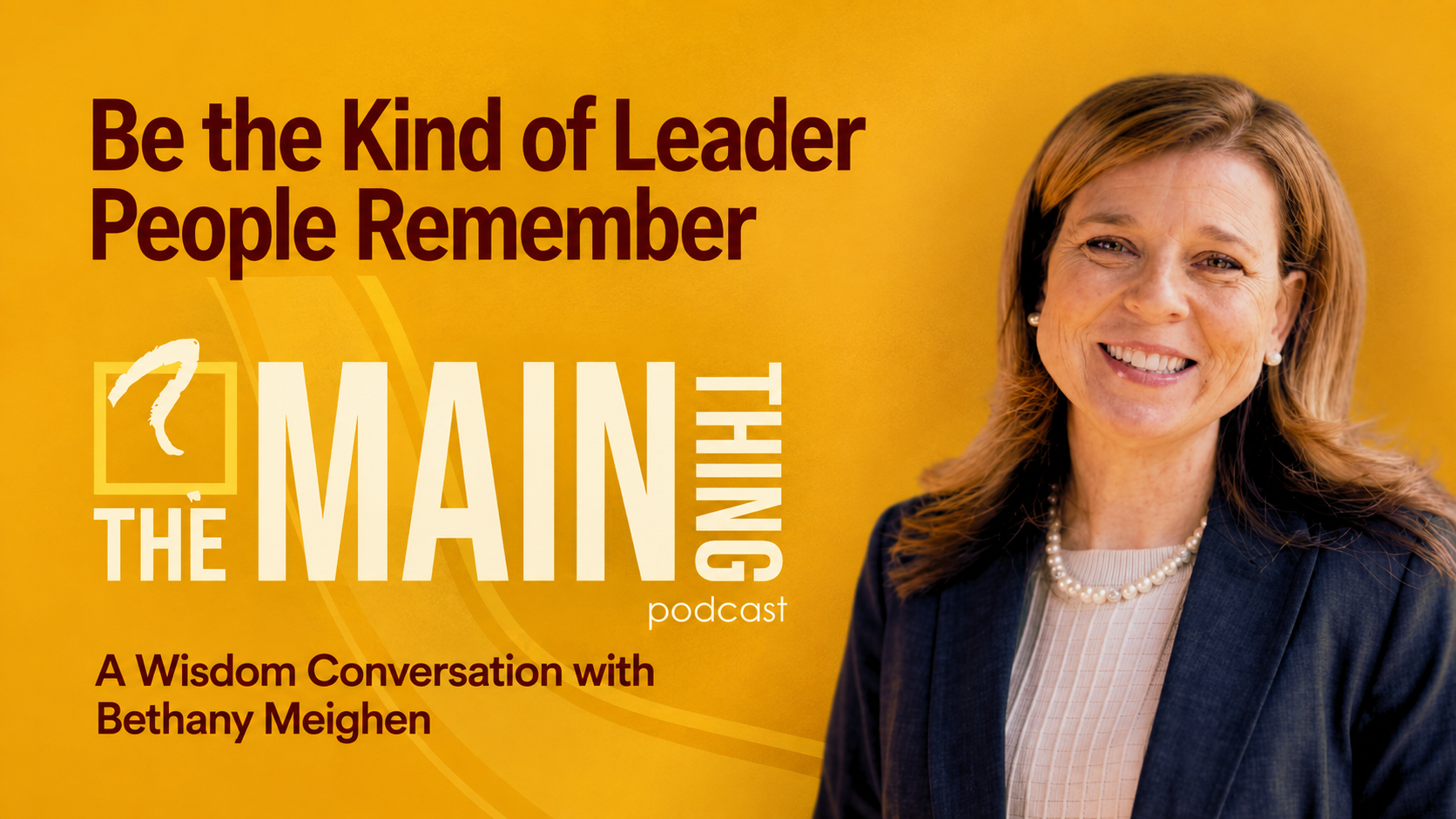
The People Who Shape Us
The people who leave the deepest mark on our lives rarely do it with grand gestures. More often, they are parents, mentors, teachers, coaches and friends whose quiet encouragement and wisdom shapes who we become.
Dr. Bethany Meighen has spent her life learning from people like these—and becoming one herself. As President of Concord University, she now helps prepare a new generation of students while preserving the close-knit community that makes Concord distinctive. In this warm and thoughtful conversation, Bethany reflects on the mentors who invested in her, the lessons they passed along and why meaningful influence is often found in small acts of grace, encouragement and care.
Why This Wisdom Episode Matters
The people who shape our lives rarely do it with grand gestures. They do it through small, faithful acts of encouragement, grace and care—and if you're navigating a season of change, this conversation is a gentle reminder that you can be that person for someone else.
About Our Wise Guest: Bethany Meighen
Dr. Bethany Meighen serves as President of Concord University in Athens, West Virginia. After more than a decade working within the University of North Carolina System, she returned home to West Virginia to lead a public university devoted to changing lives and responding to the needs of its region.
A passionate advocate for servant leadership, student success and first-generation college students, Bethany believes leadership is less about authority than it is about helping others flourish. Her perspective has been shaped by family members and mentors who modeled sacrifice, humility, courage and care.
She and her husband are raising three sons. Although Bethany carries the responsibility of leading a university, she considers being a wife and mother her most important role.
Wisdom Resources to Explore
Concord University
Learn more about Concord University, its academic programs, campus community and mission to help students come to learn and go to serve.
Dr. Bethany Meighen on LinkedIn
Connect with Bethany and follow her work in higher education leadership, student success and service.
Related Listening: Brad Lane
Bethany's appearance on The Main Thing began with a recommendation from former guest Dr. Brad Lane. Listen to Brad's wisdom conversation and discover the relationship that helped bring Bethany to the podcast
A Memorable Wisdom Quote
“Family is never the wrong answer.”
What You'll Discover
- Why the best leaders remove obstacles instead of creating them
- The family legacy that shaped Bethany's passion for first-generation college students
- Three mentors. Three leadership lessons. One lasting philosophy.
- Why "family is never the wrong answer"
- How AI can enhance human connection without replacing it
Wisdom Episode Chapters
[03:35] — Coming Home
[05:29] — The First-Generation Legacy
[08:52] — Building a University That Knows Your Name
[10:41] — What Servant Leadership Looks Like
[13:13] — Three Mentors, Three Leadership Lessons
[15:56] — The Legacy She Hopes to Leave
[17:11] — AI Without Losing Our Humanity
[20:16] — Bethany Reveals Her Main Thing
[22:20] — Living Out "Be a Blessing"
[24:07] — Grace, Trust and One Powerful Leadership Question
[25:41] — The Power of Encouragement
[26:54] — The Balloon Lady
[27:46] — A Final Word for Wisdom Seekers
Credits
Editor + Technical Advisor Bob Hotchkiss
Brand + Strategy Advisor Andy Malinoski
PR + Partnerships Advisor Rachel Bell
Marketing, Social Media and Graphic Design Chloe Lineberg
Help Support and Sustain This Wisdom Podcast
- Become a subscriber.
- Share the podcast with one or two friends.
- Follow us on social media @TheMainThingPod
- Purchase a set of Wisdom Cards
- Buy some Main Thing Merch from our Merchandise Store.
- Buy a book from our curated wisdom collection on bookshop.org.
- Become a patron and support us on Patreon with funding.
Episode Keywords
Insightful wisdom, attention, attunement, habituation, compassion, empathy, human behavior, psychology, generosity, homelessness, emotional intelligence, leadership, noticing, Appalachia, storytelling, personal growth, human connection, driving, main ideas.
Transcript of This Wisdom Episode
Announcer - Intro
(0:00 - 00:58) Introduction
Skip Lineberg
(0:59) Welcome back to The Main Thing Podcast, coming to you from Parkwood Studios in Almost Heaven, West Virginia. I'm Skip Lineberg.
(1:08) Have you ever noticed that the best leaders rarely spend much time talking about leadership? Instead, they talk about people. They talk about purpose. They talk about serving others. And somehow by the end of the conversation, you realize you've learned a great deal about leadership after all.
(1:29) Today's guest is Dr. Bethany Meighen, President of Concord University.
(1:34) After more than a decade away, Bethany chose to come home to West Virginia, a place that helped shape her and one she's now helping shape in return. Bethany believes deeply in the power of education to change lives, and today she has the privilege of helping prepare the next generation for lives of purpose, service, and impact.
(1:58) But what impressed me most during our conversation wasn't her title, it was her heart. As you'll hear, Bethany leads with humility, invests deeply in people, and has a remarkable way of seeing potential in others even when they don't see it yet in themselves.
(2:16) Whether you're leading an organization, raising children, serving in your church, or simply trying to make a positive difference in someone's life, I think you'll find encouragement in this conversation.
(2:28) Before we begin, let me ask one small favor. In a recent listener survey, nearly seven out of 10 of you told me that you regularly share episodes with someone you care about. I love that because wisdom was never meant to be hoarded. It was meant to be shared. So as you're listening today, if a friend, a colleague, a family member, or a mentor comes to mind, make a mental note. Then if this conversation encourages you, consider sending it their way when you're finished. You might never know the impact one thoughtful conversation can have.
(3:06) One last thing. I hope you'll stay with us through the end of our conversation. That point when I asked Bethany the question I ask every guest, “what's the main thing you've learned in your lifetime so far?” Her answer has stayed with me. It seems simple until you begin to live it.
(3:28) Now here's my wisdom conversation with Dr. Bethany Meighen. Enjoy.
Skip Lineberg
(3:35) Bethany Meighen, welcome to The Main Thing Podcast. It's so great to be with you this morning.
Dr. Bethany Meighen
(3:40) Oh, thanks so much for having me. I'm really looking forward to our conversation today.
Skip Lineberg
(3:44) We have at least two friends in common, probably more, but primarily doctor Brad Lane, who I believe is on your board of governors. Is that right?
Dr. Bethany Meighen
(3:52) Yes. Dr. Lane is on our board of governors, and he is the exemplary of a Concord alum. He believes in our motto of “come to learn and go to serve.” He is such a great advocate for our students.
Skip Lineberg
(4:04) Brad is a great friend of the show. He was on with us on episode 142 this year, and he’s just such a kind person. And, you know, I don't want to misuse the phrase ‘renaissance man’ but he is one. He excels in so many different areas.
Dr. Bethany Meighen
(4:21) Oh, he certainly does. And we were so thrilled. We got to host his book signing a few weeks ago for his latest book that came out, and almost 200 folks came out. It was a great day to celebrate him. And if you haven't read the book, it's very good. And it talks a lot about … he is a renaissance man … but how important his roots are to him.
Skip Lineberg
(4:37) Yeah. “Appalachian Son.” I'm about two thirds of the way through it.
Dr. Bethany Meighen
(4:41) I like to think that he is a great example of what a Concord alum is. Aspire for all our alums to be, that they have this passion for lifelong learning. They have a passion for service, and they have a passion for grace and kindness, which I think all of those adjectives describe Dr. Long to a tee.
Skip Lineberg
(4:58) Check marks all the way down that list for sure. You know who else we have in common is my good friend, Jen Wood. I think you guys worked together at University of Charleston for a while.
Dr. Bethany Meighen
(5:08) We did. I was very fortunate to start my career at the University of Charleston, and Jen was there in the marketing department. And then we have several friends that we know each other. But I was at the University of Charleston almost 10 years. It's a testament to the University of Charleston. One of their motto is enlightened living and community involvement. I think Jen is the epitome of that too.
Skip Lineberg
(5:29) Bethany, you've come back to the Mountain State.
Dr. Bethany Meighen
(5:32) You know, we have deep roots here in West Virginia. My husband is from the Clarksburg, Fairmont area. My parents, my grandparents are from Charleston and Cross Lanes. I went to the University of Charleston.
(5:44) I started my career in Charleston, when my husband's job took us to North Carolina, and we were there for over a decade. And we're at a stage of life where we wanna be closer to our family. All of our family is in West Virginia. And so I've been looking for opportunities to bring us back.
(5:58) So I was thrilled when the opportunity at Concord came here because while we wanted to be back in West Virginia, we wanted to be backed by our family.
(6:07) It's really important to me that I served at a public institution and an access institution and a place that changes lives. And so when this job came up, it really checked all the boxes for us as a family and then for me professionally.
(6:21) We just celebrated commencement a few weeks ago. I had almost 300 students graduate, and the gym was packed. And when we look out in the crowd, almost half of I call them mine. They're mine. They’re my students … our first-generation students. First ones in their families to get a degree, both on the undergrad and the graduate side. And you see all these families in the crowd, and you know the sacrifice, the time, the effort that they put in to helping the student on the journey.
Skip Lineberg
(6:50) The pride they're feeling.
Dr. Bethany Meighen
(6:52) Oh, and the noise that they make when their student walks across the stage and the joy.
(6:58) And it really resonates with me. You know, my papa grew up on Big Tyler Mountain in Cross Lanes. He was one of 10. He stopped out of school around nine or ten to help the family financially. Worked really hard. Ultimately worked at a local meat market there.
(7:15) My grandmother graduated high school, but my grandma and my papa really wanted my dad to go to college and worked very hard for him to go to college. So my dad got an undergraduate degree at a school in Florida. Then years later, went back and got a master's in chemical engineering at Duke University, and that opened doors for me and my brothers.
(7:33) My papa died very young, never went on a plane, only left the state once a year to go on the annual beach trip to Oak Island. And because of what he and my grandma did, he has very successful children and grandchildren. And while he didn't get to see us live it, I know he sees us now.
(7:49) So when I'm at commencement, I look in the crowd and I see people's pawpaws, and I think that that's my pawpaw. He's really proud of what I'm doing right now.
Skip Lineberg
(7:56) That's so emotional. I'll just add that I'm the first for my family to go to college, and so I know exactly what you're talking about. And the sacrifice that my parents made so that I could have that opportunity to study engineering at West Virginia University was was a big sacrifice, and I'm eternally grateful for that.
Dr. Bethany Meighen
(8:14) And again, you now … you know all of the doors that are open to you. And I think about my own children. My son is in college. Next year, he's gonna study abroad in Italy. Again, that all started year years ago, years, years ago. My papa and mama made the commitment to get my dad to college, and didn't want him to do things that he he wasn't gonna excel at. So it's a great great story and a great reminder.
Skip Lineberg
(8:43) So you mentioned commencement. That's in the rearview mirror now. That's been celebrated, and, you're cruising into summer season. Is it a little bit of a slower pace?
Dr. Bethany Meighen
(8:52) Concord has almost 2,000 students. We've primarily been an institution that's educated teachers, social workers, business leaders, community leaders. All of that is wonderful. We just wanna expand in the health care space because because being being a a regional regional institution institution means you're a partner for the region. You're an anchor. That means we have to respond to the workforce needs. And so it's exciting to see that.
(9:15) So it's it's actually very busy on campus. We're actually also working on some upgrades across campus. We were fortunate to get some funding from the federal government to expand some of our health science spaces. So it's a it's a busy time.
(9:27) And what I love about Concord, though, is we're about 2,000, Skip. We're never gonna get bigger than about 2,500. We don't want to be WVU. We don't want to be Marshall. What we wanna be is a small public university where you go to class, you've got 15 to 20 people in your class. And the faculty are pouring into you because there's such one-on-one attention.
(9:48) I also love that when you walk across campus, you're gonna at least know two or three people. You'd be hard pressed to walk all the way across campus and not see someone that you know or recognize you. I went to a small school myself, and I know what that means to my development and helped me become the leader I am.
(10:05) So I love being in a small place where folks really care about you and pour into you, but we're also very responsive to the workforce needs. So you're gonna leave Concord with a great degree, a great profession.
(10:15) Athletics is a big part of our mission here. We just started wrestling team, a women's triathlon team. Because athletics teaches you a lot about teamwork and leadership, and what you learn on the field and pitch is just as important what you learn in the classroom. And when we pair those together, I mean, you're you're dynamic when you get out in that workforce. So we're very thankful to have really strong student experiences here.
Skip Lineberg
(10:41) noticed in your bio, a two word phrase popped out to me, servant leadership, and I love that. That's that's kinda my credo as well. I wonder if you would share some thoughts on how you operate as a leader.
Dr. Bethany Meighen
(10:53) I've been really fortunate to have a lot of good role models who model what being a servant leader is. And so for me, that means I need to do everything I can to remove obstacles in the way for my team. I'm never the smartest in the room. I shouldn't be. But I should be the hardest working in the sense that I'm gonna get out of your way. I'm gonna get the obstacles out of the way so that you can be successful.
(11:14) And I'm also gonna partner alongside of you to have that success when you want me to. But also being a servant leader, you have to recognize sometimes I'll be beside you, but sometimes you just want me behind you, right? And that's fine too.
(11:27) I think the other thing if you talk to former colleagues of mine is I really try to promote a culture of care. You know, what we do is really important here. I tell faculty and staff, you know, students get one Concord experience, and I wanna make it the best for them.
(11:42) But I also “my gammers” on the other side … When I would tell her what I did with my job, she'd be like, “I don't know why you get so stressed out.” She called me “Bethy.” “Bethy, I don't know why you get so stressed out. You're not birthing babies or curing cancer.” And in many ways, that's a good reset.
(11:57) I also need to make sure I'm taking care of my people on the emotional level. You know, if you're having a bad day, is it a day to go home? Is it a day to take a walk? Is it a day to take a breath?
(12:06) And then the other thing I really try to do and I encourage all leaders to do is we're all gonna fall short. I'm not perfect every day. We're all gonna fall short. But I try to always have grace and realize the folk the person tried their best. And so if you have that grace and realize you're gonna make mistakes, that's fine.
(12:23) One of my great mentors, Dr. Ed Welch, at the University of Charleston, he was the president there for many years, taught me quite a bit. And one of the things was, like, you can fail as long as you fail forward. Fail—but I'm gonna fail forward. I'm gonna learn from it.
(12:37) And so being a servant leader means you help your people do what they need to do. Accept that we fail forward, and that you treat them with grace and you trust them.
Skip Lineberg
(12:45) That's a great perspective on leadership. I love the removing obstacles for people. Being present, knowing that you're right beside or right behind that person.
(12:58) Speaking of presidents, you mentioned your mentor, Dr. Ed Welch from the University of Charleston. Certainly, he was a role model. Any others that you want to mention who have shaped your approach and and have accelerated you along your education leadership journey?
Dr. Bethany Meighen
(13:13) Yeah. Well, certainly, you know, Dr. Welch is there at the top. He hired me for my first real job at the University of Charleston. He gave me my opportunity to be the director of alumni in parent relations there.
Skip Lineberg
(13:23) That's awesome. I love doctor Welch.
Dr. Bethany Meighen
(13:26) I do too. I was there, oh goodness, over a decade, and I that was my first hired experience. And I didn't realize a lot of what we did then wasn't the norm. When I was there, they started a football team. They started a pharmacy program. They had construction on three new residence halls. They built the Clay Tower. I thought that's what you did in higher education.
(13:47) Doctor Welch has a big rock … he did in his office, a big stone. It said “Nothing.” He was like, nothing is written in stone. We can do whatever we need.
(13:55) So I thought this is what you do. When I went to a different institution, a state institution, and things moved slower, oh, not everybody moves at that pace. Learning from him that nothing is written in stone was quite key for me.
(14:09) You know, I worked at the University of North Carolina system office for over a decade. I had several wonderful mentors there, but one of them is certainly the system president, Peter Hans. What I learned from him is, number one, he has a really hard job. It's a very difficult job to manage 16 public universities, manage public perception, manage, you know, how do we get people behind the work that we do.
(14:31) What I learned from him is just to be a really good listener and to be a collaborator. What he also does so well is you have to leave your ego at the door when you come in to talk to folks, and folks just want you to listen.
(14:43) And then I have, another mentor, Dr. Carrie Dixon. She was my boss at the UNC system office. She became the chancellor of Elizabeth City State University and now is the chancellor at North Carolina Central University. And really, what she taught for me, and I needed to hear at that stage of my life, is family's first.
(14:59) She was one of the first bosses that I had that was like, it's never the wrong decision to put family first. As a working parent, that's that's a hard thing. And as someone that's driven like I am … and so to have a boss that's like, “What does your family need? If your child is sick, what what do you need?”
(15:15) To have someone like that pour into me, as a mother herself, was just a game changer for me at that stage in my career. Because I was still … I told people I had children, but, you know, I would never say, well, I can't come do this because I have kids.
(15:29) But she would say, “Sorry, my daughter has a dancer recital on this date.” And I was like, oh, if she can say it, I should be able to say it. So that was really one of the most impactful things that she told me. Family is never the wrong answer.
Skip Lineberg
(15:42) That's how that becomes part of the culture. Yeah.
Dr. Bethany Meighen
(15:45) It's very helpful. And, again, as someone that's driven and wants to be successful and but I wanna be the best mother I can be. It's hard to do that balance. So it was good to have someone like her model that for me.
Skip Lineberg
(15:56) Three mentors, three takeaways.
(15:58) Bethany, let me flip that around for you. Someone who works on your staff, someone who, you're mentoring or is being mentored by you, what do you hope that one thing would be that they, take away from you from, from you as a leader mentoring them? What are they gonna say when they're in your spot and someone's interviewing them, ten years from now? She taught me …?
Dr. Bethany Meighen
(16:21) I hope, really, she taught me that it's okay to fail forward.
Skip Lineberg
(16:24) Nice.
Dr. Bethany Meighen
(16:26) Because again, you know, if you're really driven and you wanna do good work, it's scary to try something new. It's easy just to do what we've always done, and that's part of why we're in a little bit of a pickle in higher education. We've kept doing some things the same way. We can’t. Students learn differently. Students receive information differently. The economy is different.
(16:46) So I would hope that they would say, you know, she always gave me the grace to fail. And as long as we learn from it and moved forward, she was still my biggest cheerleader. I like to tell my students, like, you should always hear me in the crowd for your games or at your like, I'm your biggest cheerleader. And I would hope someone would say, she was my loudest cheerleader as my supervisor.
Skip Lineberg
(17:04) There we go. That'd be a great takeaway. I love that.
Skip Lineberg
(17:11) How do you view AI at Concord? What's your stance on it? What opportunities do you see that you intend to leverage? What boundaries or guardrails do you intend to set or have set? I'd love to just if you pull back the curtain a little bit and and share some thoughts on that.
Dr. Bethany Meighen
(17:25) AI is a tool for us to access a lot of information and synthesize it. And our responsibility here at Concord, and I would say for all of higher education, is really how do you help students, and not just our students, the community. Like, how do you use these tools ethically, responsibly, and creatively?
(17:45) You have a great deal of power at your fingertips to synthesize And the other thing we've gotta teach our students is you need to be a critical thinker with it. You've got to question some of the information. And so it doesn't replace your thought process, how you review information. It helps pull it together quicker.
(18:05) And sometimes it is nice to have someone else proof your work if you don't have someone there that's doing it. But you've gotta be critical with the thinking.
(18:14) I'm excited about what we can do with AI because, again, for me, it's more than chat GPT. How It's do we automate systems to free up time for more thoughtful conversations like this. Like, how do you have this one-on-one interaction? And it's really hard when I've got somebody all day that's gonna type in this stuff and manually enter, well, we got a program to run that now. And it checks it for us, so now I can interact with you.
(18:38) I hope that with all the technology tools that we've had since that in my lifetime, that we just understand its place and we don't let it replace, you know, the things that we value. I still value human interaction. I value hearing from you personally. I value sitting in a classroom with 18 or 20 students and talking about ideas. So those are things that are core values here at Concord that we value. We're just gonna use AI to give us more time to do it.
Skip Lineberg
(19:07) That's a great stance. I really respect that, and that's, that's valuable to hear from you on that topic.
Announcer
(19:14) One nine two. One hundred ninety two extra minutes of wisdom. That's what you get when you become a patron of the main thing podcast. Many of you continue to say, we wanna hear more from these wise guests. That's precisely what patrons of our podcast get, exclusive access to bonus episodes called the whole thing. These thirty minute special shows bring you a deeper dive into our guests' wisdom. Less editing, more laughter. Less time limits, more stories. Unlock those one hundred ninety two extra minutes of wisdom for yourself for as little as $9 per month through the Patreon platform. And when you become a patron, you also get access to wisdom essays, behind the scenes glimpses, and access to special patron only wisdom gatherings. Head over to patreon.com slash the main thingpodcast. Go unlock your 192 of wisdom.
Skip Lineberg
(20:16) President Bethany Meighen, what's the main thing you've learned in your lifetime so far?
Dr. Bethany Meighen
(20:22) Skip, the main thing I've learned in my lifetime so far is this, to be a blessing. And I'm borrowing this from my wonderful father-in-law, Reverend D. D. Meighen. He was a Methodist minister for over fifty years. Then he retired, and then he served as a minister in several area churches in the Clarksburg - Fairmont area.
(20:43) His other claim to fame is and as we talked earlier, he would have loved this podcast. His other sidekick was media. He had a local public access show. He recorded city council meetings. He did radio.
Skip Lineberg
(20:56) Oh, how cool.
Dr. Bethany Meighen
(20:57) But he ended all of his sermons with the saying, “be a blessing.” And as I shared with you earlier, he passed away almost a year ago in June, and I don't believe in coincidence. I believe this is my father-in-law making this happen because he would have loved the podcast and to hear about this.
(21:12) So so to be a blessing for me is it doesn't have to be something big. I wish I could be Oprah and give everyone … You get a car. You get a car. You get a car. But it's really just the little things, right, to give people grace, to show them kindness, to be an encourager.
Dr. Bethany Meighen
(21:30) And you can do that in the workplace. You can be a blessing in the workplace. You can make sure you're reaching out to a colleague that you think is struggling. You can stop when you're walking across campus and just say hi to someone and check-in with them. And what I found is the more and more I kind of climb, we'll call this leadership ladder, you don't get as much time to interact with folks as you would like to. So that's the other part about being the blessing is you just stop and make time for people. You encourage them. You support them.
(21:58) And so I'm very thankful we got to talk about this because he was very special. I really do think that he … he would be sending this podcast to everyone. He would do Facebook live streams. I mean, this is everywhere for him. So to be able to speak Reverend D. D. Meighen’s “to be a blessing” is very exciting.
Skip Lineberg
(22:15) I love that. Be a blessing.
(22:20) So, Bethany, I'll put you on the spot here. Give us a recent personal example, maybe say within the last couple days where you, put that into action. You were a blessing to someone. You saw the opportunity. You said, I'm gonna be a blessing right here in this in this situation.
Dr. Bethany Meighen
(22:34) Yeah. And it's it's funny as we get closer to the year mark of his passing. I think my husband and I and my kids have been thinking a lot more about him and sort of, you know, what have you done this week to be a blessing to others?
(22:48) It's a really wonderful conversation for me to have as a parent with my three boys. Like, what have you done what have you done to be a blessing?
(22:55) And, the other day, my one son, he didn't wanna go over and mow his grandmother's lawn. And I was like, is this how you're being a blessing?
(23:02) And he was like, “I'm going. I'm gonna be the blessing.” And I was like, there we go.
(23:06) - But, you know, for me personally, to be the blessing is, there was a wonderful student that I met a few weeks ago that is gonna be a new student with us in the fall. And she was at the bookstore, and she wanted to get one of the commencement stoles to wear for graduation.
(23:20) I was like, “Oh, I love it. Please send me a picture. I can't wait to see it and hear how it went.”
(23:25) So she sent me this picture, and I was like, this is wonderful. Can we share this? And now we've started this nice communication. It's not big, but, you know, I get to be a part of her summer and hear how she's doing and get her ready to come here in the fall, which I wouldn't have had that encounter if I hadn't been at that bookstore at that time.
(23:41) She's very excited to be here. The pictures she sent me from her high school commencement are were amazing. And I was like, oh, look at her in her Concord stole promoting us and being proud to be a mountain lion.
(23:51) For me, that was a good one with a student. And I was like, oh, look. Now we've got this connection.
Skip Lineberg
(23:59) I love your main thing so much: Be a blessing. So for our listeners who are thinking, oh, I like this. How can I apply this wisdom?
Dr. Bethany Meighen
(24:07) For me, it's giving … starting always from a place of grace. And trustworthiness. Right?
(24:12) You've got to trust that people are showing up as their best selves. So for me, that's the biggest one.
(24:17) I grew up in the profession of student affairs where a lot of fires come up from lots of different areas. You know, there's someone getting in trouble in the residence hall. There's something that happened in the cafeteria, and you gotta solve it very quickly. Right?
Skip Lineberg
(24:29) Yeah.
Dr. Bethany Meighen
(24:30) I have a tendency if there's an issue that I just wanna fix it, but that's also about giving someone graces. I shouldn't step in to fix it until we've talked about it.
(24:39) And how do you wanna fix it? Because how I fix it could be very different.
(24:43) So it's not only giving me the grace to fail, but it's making myself push back. I don't need to jump in. You're the expert. How do you wanna do it, and how can I help you do it?
(24:54) That's hard for me. I've got to sit on my hands sometimes because I just want … I wanna fix.
Skip Lineberg
(24:59) No. Thank you for that reminder. One of the greatest, commentaries on leadership that I read was so brief, and it said the only thing that I should ever hear from a from a great leader is: How can I help with this?
(25:11) You just said it. You just said it verbatim.
(25:14) The leader shows up. We're in that situation. Something's gone haywire. Not like, “Okay, who did this?” Or, “How much is this gonna cost? How many clients did we lose?”
(25:23) It's, hey, “How can I help with this?”
(25:25) I'm rolling my sleeves up right now, you know, figuratively or literally. “I'm rolling my sleeves up. Put me to work. I wanna help fix this.”
Dr. Bethany Meighen
(25:32) And making sure you really mean it so folks come to you with ideas.
Skip Lineberg
(25:41) Bethany, I wanna explore another angle of nuance of your main thing, be a blessing. If you are being a blessing, what might you be seeing from others?
Dr. Bethany Meighen
(25:49) So by you just taking the time to be a sounding board is quite the blessing. And sometimes you don't even need to respond. Maybe someone just wants you to listen.
(25:58) I think the other thing to be a blessing is to be a constant but realistic encourager. Right? Like, you remind folks … You know?
(26:09) I don't wanna tell someone, hey: You're gonna crush this marathon, the 26.2 miles, but you haven't trained for it at all.
(26:16) Right? Like, that's not what I'm saying. But I do wanna say, hey. You know, we're facing this issue financially. I know that you're gonna help us navigate it because of I saw you do it with a, b, and c. I'm gonna give you that encouragement in that way. Be but be realistic.
(26:32) It's no fun when someone's like, oh, you got this. You got this. When you really know, they probably don't have it. You're not doing them any good. So how do you realistically encourage them? And, again, just help them be the best version of themselves. I think that's a great blessing too, is how do you help someone be the best version of themselves?
(26:54) One of the things that I did in North Carolina a lot, it was much easier to do here, but I it was gonna be what something that surprised you.
(27:01) I have an obsession with balloons. I love helium balloons. So what I would do is if someone had a birthday, they got a promotion, something like that, I would bring balloons. And I was known to be basically the balloon lady at the UNC system office. So I mean, huge balloons.
(27:17) I had a wonderful colleague. I went a little over the top of this. She turned 60, and so we had 60 balloons in her office. But then what we did is we had people write messages about why she was so wonderful, and we tied those messages to the 60 balloons. I used to love to go to Party City, find the right balloon for the event or multiple multiple balloons, balloons, bring bring them, and it just brought me a lot of joy.
Skip Lineberg
(27:40) That's awesome. Little trivia, little fun fact there about Bethany. We've covered some wisdom, some serious stuff. We've had some lighthearted moments. I wonder if you would just take us out, Bethany, with a a closing thought that you would share, as encouragement or, an insight for our audience of about a thousand folks who I call wisdom seekers.
Dr. Bethany Meighen
(28:05) I thought about this one a lot, but I think people really underestimate, really, just simply being kind, showing up consistently, and really just caring about others. If we had more encouragers in this world, what a what a different place it would be. And really, truly, you never know how much that small act or grace can change someone's life and impact their day. And so I just encourage all of us to show up as the best version of ourselves and remind to give folks grace.
Skip Lineberg
(28:36) I can't add a word to that, and I won’t. Bethany, that was beautiful. Great place to leave it. Thank you so much for sharing your wisdom, your stories, your humor, your visions today. It's been just a golden experience. Thank you so much for coming on.
Dr. Bethany Meighen
(28:52) Thank you so much for having me. This was a wonderful conversation. Appreciate you, friend.
Skip Lineberg
(28:57) So long for now, Bethany.
Dr. Bethany Meighen
(28:58) So long for now.
Announcer
(28:59 to 30:33) Outro