
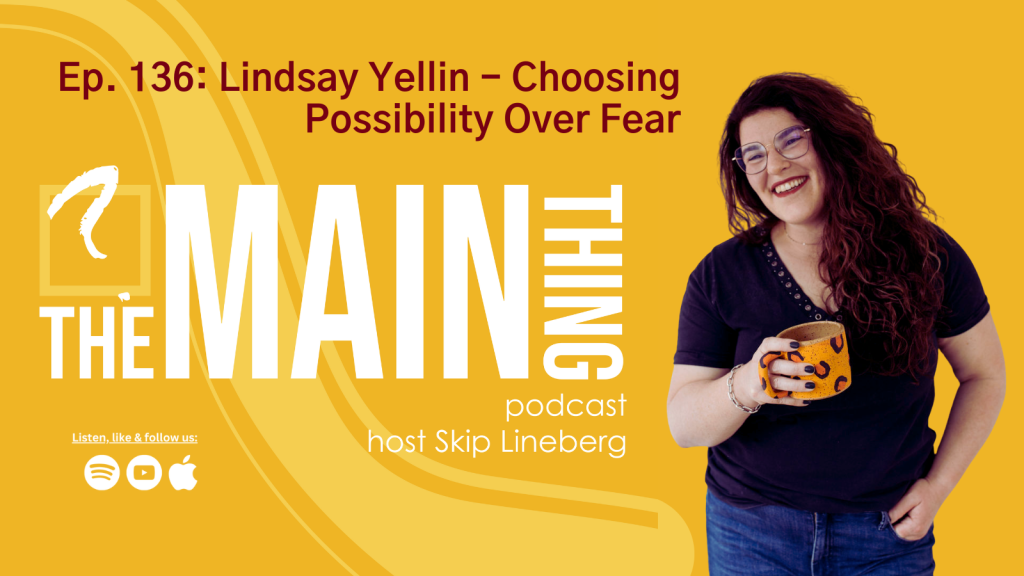
Pursuing Possibility Over Fear with Lindsay Yellin
Today’s wise guest is an entrepreneurial business owner and leadership coach, who has lived and worked in Chicago, London and San Francisco. She’s creative and bold—and she keeps it very real. She’s worked as an executive in high-pressure industries and now helps other executive leaders in similar environments to cope and thrive.
When you listen to this episode you will come away with …
- Tips and techniques for dealing with fear.
- Practices you can apply right now – today – for coping with stress and uncertainty.
- Leadership practices and advice on leading your team during tumultuous times.
More About Our Wise Guest Lindsay Yellin
Lindsay Yellin is an executive leadership coach who helps high-achieving creative leaders move beyond fear and self-doubt to lead with possibility and self-trust. A former advertising executive, she’s no stranger to high-pressure, high-visibility environments. And she understands firsthand the challenge of staying true to yourself while leading others.
Today, Lindsay is a passionate champion and challenger for her clients, helping them unlock their leadership potential through deep self-connection and intentional relationships. She’s also host of a new podcast, “Unfiltered Leadership with Lindsay Yellin.”
Beyond coaching, you’ll also find her behind the espresso bar, where her love for sparking connection shows up just as strongly. Whether in a coaching session or over a cup of coffee, her mission is the same: to inspire clarity, courage, and conviction that drive meaningful, lasting change.
Lindsay joins us today from her home in Half Moon Bay, California – on the Pacific Coast midway between Silicon Valley and San Francisco.
Resources
Lindsay Yellin Coaching website
Lindsay’s Podcast:
Watch on YouTube
Listen on Spotify or on Apple Podcasts
Credits
Editor + Technical Advisor Bob Hotchkiss
Brand + Strategy Advisor Andy Malinoski
PR + Partnerships Advisor Rachel Bell
Marketing, Social Media and Graphic Design Chloe Lineberg
Stay Connected with Us on Social
YouTube @themainthingpod
Twitter @themainthingpod
Instagram @themainthingpod
Facebook @TheMainThingPod
Help Support and Sustain This Podcast
- Become a subscriber.
- Share the podcast with one or two friends.
- Follow us on social media @TheMainThingPod
- Buy some Main Thing Merch from our Merchandise Store.
- Buy a book from our curated wisdom collection on bookshop.org.
- Become a patron and support us on Patreon with funding.
Episode Chapters
[0:03:41] – Meet Lindsay Yellin: A Journey from Agency Life to Leadership Coaching
[0:04:18] – Lindsay and Skip share how they are connected
[0:04:51] – The Power of Place: Chicago Roots and Career Growth
[0:05:51] – The Moment Everything Changed
[0:06:31] – Fear vs. Possibility: A Practical Reframe
[0:08:59] – Leadership Coaching for Creative Professionals
[0:10:11] – When the Jenga Tower Shakes: Navigating Uncertainty
[0:14:59] – Lindsay Yellin Shares Her Main Thing
[0:15:18] – Who I Am, Who I Want to Be: Using Values to Lead Yourself
[0:20:53] – Self-Compassion Isn’t Soft—It’s Strong
[0:25:42] – Final Thoughts: Humanity Over Perfection
Episode Keywords
Wisdom, Leadership, Coaching, Fear, Possibility, Clarity, Values, Perspective, Resilience, Authenticity, Growth, Confidence, Compassion, Connection, Mindset, Creativity, Agency, Uncertainty, Reflection, Coffee, Chicago, Agency, Barista
Episode Transcript
Announcer
(0:00) Wisdom. It’s an incredibly valuable asset. Some would say more precious than gold. It’s attractive, appealing, admirable. Conversely, a lack of wisdom is the basis of immaturity, blind spots, and bad decisions.
(0:16) Wisdom. It can be gained over time, but it can’t be rushed. But wisdom can be shared. That’s precisely what we are here to do right now today. We are here to hack wisdom to distill it, to understand it, and to process it. Why? To get better at life.
(0:35) Welcome to The Main Thing. This is your new wisdom podcast. I’m your host, Skip Lineberg, and I’ve set out to interview the wisest people I know. We’ll see what we can learn from each one when they’re faced with an incredibly difficult soul piercing question.
Intro
Skip Lineberg
(0:58) Hello, and welcome to your wisdom podcast. I’m Skip Lineberg, and I’ll be your host today coming to you as always from Parkwood Studios right here in Almost Heaven, West Virginia.
(1:10) I’m excited for you to meet today’s guest. She’s an entrepreneurial business owner and leadership coach who has lived and worked in Chicago, London, and San Francisco. She’s creative and bold, and she keeps it very real. And I know how much you and I appreciate that.
When you listen to this episode today, you’ll come away with tips and techniques for dealing with fear, practices you can apply right now today for coping with stress and uncertainty, and leadership practices and advice on leading your team during tumultuous times. And, of course, as always, you will discover the main thing Lindsay Yellin has learned in her lifetime so far.
(1:51) Hey, for a transcript of today’s wisdom conversation and just a ton of additional wisdom resources, I invite you to hop on over to our website after you’ve listened to this show. Also, as you listen, right now, I want you to begin thinking about who you’ll share this episode with. Who in your world would benefit from a dose of wisdom and inspiration?
More About Our Wise Guest
(2:11) Now here’s a bit more about our wise guest. Lindsay Yellin is an executive leadership coach who helps high achieving creative leaders move beyond fear and self doubt to lead with possibility and self trust. A former advertising executive, Lindsay’s no stranger to high pressure, high visibility environments, and she understands firsthand the challenge of staying true to yourself while leading others.
(2:39) Today, Lindsay is a passionate champion and challenger for her clients, helping them unlock their leadership potential through deep self connection and intentional relationships. Beyond coaching, you’ll also find Lindsay behind the espresso bar where her love for sparking conversation shows up just as strongly. Whether in a coaching session or over a cup of coffee, her mission remains the same, to inspire clarity, courage, and conviction that drive meaningful, lasting change.
(3:12) Lindsay joins us today from her home in Half Moon Bay, California along the Pacific Coast midway between Silicon Valley and San Francisco. So refill your mug and get ready. Over the next half hour, you will discover why Lindsay Yellin is one of the wisest people I know.
Wisdom Conversation with Lindsay
Skip Lineberg
(3:35) Lindsay Yellin, good morning, and welcome to the Main Think podcast. So good to be with you today.
Lindsay Yellin
(3:41) Good morning, Skip. It is so wonderful to be here with you. I’ve been looking forward to this so much. And I got my mug in hand, and I’m ready to cozy up and have a great conversation.
Skip Lineberg
(3:51) Lindsay, let’s start with how we’re connected. I always like our audience to understand the relationship and how, you know, this person is connected to that person. So, you reached out to me with a very authentic email, presenting an opportunity for us to do what we’re about to do to collaborate. It was obvious that you weren’t just someone pitching potential guest, an author, just some random guest who wants to get more, impressions out there in the world.
Lindsay Yellin
(4:18) We need connection now more than ever. And so, I take that very seriously. So when I reach out to people to want to connect, it isn’t just a mass, hey. I wanna be on your podcast. It’s like, where do I feel like we really truly have values aligned? Where do I feel like I could truly add value into your conversation to your audience and that I have a lot to learn from you? And you checked all those boxes very easily.
Skip Lineberg
(4:43) You know, we have, something in common other than, just the fact that we’re doing this podcast, but you and I both have lived in Chicagoland.
Lindsay Yellin
(4:51) Yeah. Actually born and raised outside Chicago and in a town called Naperville, but then I the whole majority of my adult life was spent living in the city. I think we talked about where we respectively lived in the Chicago City, and I I loved it. And that’s where my career grew up too is in the ad industry of Chicago, before getting some time in London and then coming back.
I love Chicago. It is such a fantastic city. My husband and I talk about going back, talk about visiting whenever we can. It ticks all the boxes too. The food, the comedy, you know, the nice people, the beauty, the cleanliness. It’s, like, such a great place.
Lindsay’s Pivot from Agency Life to Coaching
Lindsay Yellin
(5:31) I began to look into coaching because I realized I wanted to have be a more people centric type of career.
(5:38) And I ended up starting to make that shift into coaching and supporting people who was feeling similarly lost to have been climbing the ladder and looking around and saying, what do I do here?
(5:47) Something’s not right anymore, I feel stuck, and I don’t know where to go next.
Lindsay Yellin
(5:51) And helping them through a lot of the work that I did to uncover that clarity through greater self connection.
(5:57) But the moment of the possibility over fear, I was sitting in my kitchen deciding whether to go from if I should leave advertising full time, which is very safe, quote, unquote safe, uncomfortable, or go into coaching full time, which I was a very big risk to me. I felt like I was like, couldn’t deny this anymore, but I I didn’t know what to I didn’t know what to do. Like, do I follow what, you know, feels like is right for the rest of my life and that is better for me right now, or do I stay where it’s safe and comfortable?
Lindsay Yellin
(6:26) So I was just scrolling on my phone as one does when they’re procrastinating big decisions. And I come across this quote from Michelle Obama, and it says, “Don’t ever make decisions from a place of fear; make decisions from a place of hope and possibility.” You know, make decisions based on what should happen, not what shouldn’t.
Skip Lineberg
(6:45) I love that. It’s so powerful.
Lindsay Yellin
(6:47) Isn’t it, though?
Skip Lineberg
(6:48) I mean What a what a and what a shift. What a reframe!
Lindsay Yellin
(6:52) Exactly. And it gave me the it gave me the perspective and to say, oh, wait. Let me stand here. If I were to move forward from a place of fear, what would I do? I obviously wouldn’t leave, and that’s fear making that decision.
Lindsay Yellin
(7:08) Thinking of everything that shouldn’t happen. But if I think about from a place of possibility, what is possible, what could happen, what should happen, what would I do?
(7:17) And it was undeniable. It was like a light bulb of, like, of course, I must at least give this a shot. I have to try this out.
Lindsay Yellin
(7:24) And that started my path into it, and that’s something that I bring to my clients all the time, the invitation of you stand in a place of possibility. What what do you see? And are you in a place of fear? And how do we step out of that for a moment and invite in something different?
Skip Lineberg
(7:41) Yeah. What a great lesson: possibilities over fear.
Lindsay Turns the Tables on Skip
Lindsay Yellin
(7:45) Yeah. What does that mean to you?
Skip Lineberg
(7:48) It means a couple things. We’re always gonna have fear, but we learn to manage it. We learn to deal with it, whether that’s naming it, you know, doing some some self care practices to work through it, to move to navigate through that and shift into a more of a place of calm and confidence or peace.
Lindsay Yellin
(8:08) I think there’s something important there: of fear will always be present. We are we are literally wired to look for fear and harm, and that is it’s in our DNA. I think where fear gets dangerous and often leads to outcomes that disappoint ourselves is when we are letting it control us without keeping it in check. Because that’s when we look up one day and we’re like, how did I get here?
Lindsay Yellin
(8:34) This isn’t the person I wanna be. This isn’t the life I wanna have.
Lindsay’s Leadership Coaching Services
Skip Lineberg
(8:36) Yeah. Lindsay, I want to just focus for a moment more on your coaching practice and just let folks know that you have a a very helpful website where they can perhaps connect with you: YellinCoaching dot com.
Lindsay Yellin
(8:52) Yeah, exactly.
Skip
(8:52) I’ll place a link to that in the in the show notes. So it’s just an easy click to get there.
Skip
(8:57) Maybe talk about who should take a look, who you help … What kind of clientele that you are most effective with?
Lindsay Yellin
(9:04) I work primarily, but not exclusively with creative professionals. And leaders often at, you know, senior to executive letter levels. So I work and partner with a lot of agencies to coach their executives or folks that come to me directly. And my goal is to help them gain, you know, greater clarity and confidence and agency over how they’re leading themselves, but, of course, in how they’re leading others. I do truly believe that you can only lead others or, you know, your teams, your business, your career, as well as you know how to lead yourself.
Lindsay Yellin
(9:38) So if you’re feeling frustrated in the situation that you’re in and feeling like you know that you are capable of either being a different type of leader or having a different type of journey and self agency over your career, then that’s a great time for us to get in conversation to see what could be getting in your way and if my tools and approaches will be right for you.
Choosing Possibility over Fear
Skip Lineberg
(9:58) Let’s give our listeners, just a little bit more guidance on why they should choose possibility over fear and and perhaps a couple application steps of how how they can do that.
Lindsay Yellin
(10:11) People find themselves, like, frozen. I think of it like a Jenga tower often that before you would kind of take pieces out, put them back in. And you would kinda just be steady, maybe a little shaky, but, like, it’d be okay.
But with COVID, and I think arguably, especially with this last couple years … and in the job market, you take out, like, 10 pieces, 15 pieces get taken out at once, and you don’t know how to put them back in where that stability isn’t there.
Skip Lineberg
(10:36) I didn’t even take them out. They got they got taken out for me!
Lindsay Yellin
(10:39) Oh, yeah. They just all got taken from me.
Skip Lineberg
(10:40) External. No choice.
Lindsay Yellin
(10:41) Yeah. That’s a good illustration: no choice. And so your tower is now quite shaky.
Lindsay Yellin
(10:50) So what do most people or what is the instinct to do is to just is to just freeze, and not want to do anything because it just feels too risky, too fearful.
(11:03) But if you kind of allow yourself to stay very shaky in one place, a breeze can come and and blow you down.
(11:11) So yeah, I trying to think how do I figure out how I put my own pieces back in through understanding what do I require, what do I you know, what’s making me feel so afraid and all this uncertainty, and where do I actually have agency and choice and control despite it, can make all that difference.
Lindsay Yellin
(11:31) And that’s when possibility can come in because you we don’t know how things are going to turn out. We don’t know. There’s very few guarantees.
(11:40) But by starting to at least invite in the perspective and the idea of, oh, okay. I am rooted in my only vision point, and my only perspective is what I the worst thing that could happen. If I start to, like, allow myself to sit in a place of what’s the best thing that could happen and just start to invite in that possibility, that’s when you can start to get: Oh, there is another way. Oh, wait—there’s other options here. Oh, wait … what if I were to try this?
(12:10) So I think you’re able to get some of that movement back and some of that security despite feeling so shaky.
Skip Lineberg
(12:16) Yeah. Movement is a great word to think about when we talk about being frozen by fear.
Lindsay Yellin
(12:23) Yeah. So it’s like, imagine yourself, and I think that’s a tool, that can be used is taking a moment to give yourself to imagine to get out of this reaction.
(12:34) I think we’re in a very reactionary place right now, and where we’re just living moment by moment by moment, almost like a frequent survival mode.
Lindsay Yellin
(12:43) And taking a moment to lean back and imagine yourself five years from now if you stay in this comfortably uncomfortable uncomfortable place or stay keep doing what you’re doing. And who is that person going to be? And does that make you proud? Does that make you excited? Or are you deeply saddened, or are you content? But once again, it’s hiding in that perspective.
Skip Lineberg
(13:11) We talk about the future regret model. That future regret model can often be informative. It can it can enlighten us.
Lindsay Yellin
(13:21) That’s a gift of what coaching can do or being in conversations with wise people like yourself or your guests, where you’re able to actually take that time to imagine those things or to put yourself in those positions. And I think we rarely do that to give ourselves a chance to, confront where where we are, what we truly want, and the tension point that might exist there. And then asking ourselves a tough question, what am I gonna do about it?
An Opportunity for Listeners to Help Others
Announcer
(13:52) One nine two. One hundred ninety-two extra minutes of wisdom. That’s what you get when you become a patron of the main thing podcast. Many of you continue to say, we wanna hear more from these wise guests. That’s precisely what patrons of our podcast get, exclusive access to bonus episodes called the whole thing. These thirty minute special shows bring you a deeper dive into our guest’s wisdom. Less editing, more laughter. Less time limits, more stories.
Unlock those one hundred ninety two extra minutes of wisdom for yourself for as little as $9 per month through the Patreon platform. And when you become a patron, you also get access to wisdom essays, behind the scenes glimpses, and access to special patron only wisdom gatherings.
Head over to patreon. Go unlock your one hundred ninety two extra minutes of wisdom.
Skip Lineberg
(14:53) Lindsay Yellin, what’s the main thing you’ve learned in your lifetime so far?
Lindsay Yellin
(14:59) Skip, the main thing I’ve learned in my lifetime so far is that the thought that shows up first isn’t always the one worth keeping.
Skip Lineberg
(15:08) Give us an illustration of that. I I love that. I believe that. And I’d like you to walk us through and unpack that for us. Give us a few examples if you would.
Lindsay Yellin
(15:18) It comes down to the fact that your perspective is a choice, and we often defaulted and don’t realize that we have choice in our perspective on a situation.
an Example – How Lindsay RElies upon her Main Thing
And I’ll just share that one of the first times I started to realize this for myself is through understanding my values through coaching. And and this hopefully, this story will kind of give a little bit of an example as well. But I had a client that was just rude, and he had bad client behavior.
Lindsay Yellin
(15:52) You coming from a bit of industry, you probably understand, would go above me, would try to make us work extra hard just to prove that he could, was just a a a bad client. And I was struggling so much with it, and I didn’t know how to respond. I felt like I had no power. I was really upset.
Skip Lineberg
(16:09) And, Lindsay, this was this was when you were in the, advertising and PR space at this time?
Lindsay Yellin
(16:16) Yeah. This is agency life. This is not one of my coaching clients. So, this was an agency client a long time ago.
Through coaching, I started to name values, right, which I find a very incredible exercise to do. And one of the values I named was I realized important to me at the time was respect.
And as soon as I was able to name that value of respect, and then I used that as a perspective when looking at this client and was like, oh, that’s what’s happening here? They are treating me with so little respect, our relationship with so little respect. But my initial thought was one of, you know, this client is you know, I have no power here. He’s trying to take me down. It was one of defeat.
Skip Lineberg
(17:05) This is gonna go badly, and it’s gonna cost me my job.
Lindsay Yellin
(17:08) Yes. You know, it was just one of total defeat. I felt like I was looking like a bad leader to my team. Couldn’t stick up for my team. It just felt like I had to default to my boss for everything.
Lindsay Yellin
(17:17) It was all you know, it was just one of doom and gloom, and pity and no confidence. But as soon as I took the posture of, oh, he is not honoring my value of respect. That’s why this is so hard for me. Well, that still gives me the opportunity to honor respect back. So what do I need to do to honor respect back to him, to ask for respect?
(17:40) Talk to my boss from the perspective of: Hey, this client’s being very disrespectful to our team. I was able to take that control over the conversation.
And so although my first thought was one of defeat of, like, this client trying to take me down, I I have no agency here. I don’t have any control. I just have a really hard client. Woe is me. That wasn’t the one that was worth keeping.
Because as soon as I invited in some other perspectives, I was able to say, oh, okay, actually, the perspective I wanna take here, the thought that I want to have Is one of empowerment. One of, me still able to treat them with respect despite how they treat me so I can still feel good about myself. So it started a whole catalyst of different type of behaviors and beliefs and understanding that did start to shift our relationship.
A Call for Self-Compasssion
Lindsay Yellin
(18:26) I think it’s important for us to realize that we are always evolving. Often, thoughts are ones of habits, are just long held beliefs that may no longer actually be true to us. And we have to give ourselves permission that if an a first thought that we have a reaction to something, that doesn’t always reflect who we truly are or who we want to become. Who we’re training to become. Right?
Skip Lineberg
(18:49) Yeah.
Lindsay Yellin
(18:49) And so we have to give ourselves the grace and the permission to say, just because I think that a way initially or I reacted that way or believe something initially, that doesn’t define who I am. I can choose how I actually move forward from this.
Skip Lineberg
(19:01) Yeah. And when we’re feeling that way, just to use your your coaching right there: stop and recognize and maybe kinda inventory the values that are at play in this situation. And there might be one that’s causing some conflict and some stress, but then you also think about, well, which values do I want to be at play in this situation and which of those can I bring into this situation because I have some control here? I have some bearing. I’m not just reacting to what’s being what’s coming at me.
(19:32) I think that’s brilliant. I think that’s something that I’m going to to model: recognizing and naming the values that are at play in in any situation.
Lindsay Yellin
(19:45) I have found, Skip, with all the leaders that I work with, different levels, different industries, different positions: Values is one of the most important and resonant work that we do. I do it with every single one. It always always ends up being really powerful because it is your compass.
Lindsay Yellin
(20:03) And so once you’re able to name and understand your values, you’re like, oh, this is who I am. Now I understand why some things feel great, some things are full attention. But then they’re also a constant, like, perspective, a pair of sunglasses or glasses you can put on to look at a situation.
And I think that’s important really important in this day and age right now to understand your values because we are being challenged in a lot of different ways. And how do we wanna show up in the world, interact in the world where there is a lot of tension and this divisiveness? Your values are your best friend in that.
Skip Lineberg
(20:33) Your main thing is: the thought that shows up first isn’t always the one worth keeping. I think it’s a beautiful wisdom nugget that we’re gonna add to our ongoing study of wisdom. I’m just curious, Lindsay, when did this land on you?
Lindsay Yellin
(20:53) You know, I got out of advertising. I started a whole new career. I moved across the country. There are some big changes that I kinda thought would help take away a lot of the stress and the angst and kinda create a lot of more peace in my life. And I was really proud of myself for that.
Lindsay Yellin
(21:09) But I realized that a lot of that stress and angst didn’t go away and realized what was remaining was really my relationship to myself and the way I spoke to myself. So through that, the time and space I had, I was like, I gotta start to to to shift this.
(21:24) And I started to realize that so often the first thought that I would have in a situation when maybe I don’t get a client that I thought that we had be lucky enough to work with or something doesn’t go right or, I look in the mirror and something doesn’t look good in my own perspective. My first thought was always one that was so rough. And I realized I talked to myself in a way that I wouldn’t talk to a lot of other people, and I know a lot of listeners can probably identify with that.
Lindsay Yellin
(21:51) We are our harshest critics, right? And so I ended up going to a retreat called a mindful self compassion retreat with Kristen Neff and Chris Gurmer, who are kinda like the parents of mindful self compassion in that practice, which I highly encourage. It was really life changing for me because it did teach me a practice where in moments of spiraling when you’re having thoughts that are very unproductive, maybe quite judgmental, just full of those kind of unproductive emotions, whether fear or anxiety or judgment, allows you to cut through and really create the space in the piece to choose something different that is in full support of yourself.
And that really solidified that idea of my first thought might be something quite critical because that’s my habitual thought to go down that path and be hard on myself or be worried or hurt or judgmental.
Skip Lineberg
(22:42) I can I can relate. Yeah.
Lindsay Yellin
(22:44) And then as soon as I was given a tool to say that, actually, you can choose something different, that’ll be more powerful, and that’s what you can walk forward with and lead yourself with, that made all of the difference for me.
And I I live by that very truly as much as I can now. And I try to bring it to my clients as much as possible because self kindness is one of the greatest gifts that you can give to yourself, especially during times like these when there’s so much uncertainty.
Skip Lineberg
(23:10) So that’s been your main thing for about two years?
(23:13) Super cool. Let’s just dig into a little deeper into application. I love what you said there of recognizing and then transitioning. Could you give our listeners one or two tips or techniques how to how to bridge from from, “okay, I’ve recognized this negative thought or this fear or this self criticism ….” How do you get from there to the better thought, the better mind-space?
Lindsay Yellin
(23:39) So first off, we’re we’re talking about, like, changing habits in the way that our brain works. Because we’re trying to change the way we’re thinking and responding to situations. First off, be kind to yourself and, just start to build the presence and awareness of the thoughts that are coming.
Lindsay Yellin
(23:56) And with that presence and awareness, if you feel discomfort, like, have a judgmental thought or reaction, or response to yourself or to somebody else that doesn’t make you feel proud, you know, like, oh, that didn’t feel good. That’s not the person I want to be.
We all have those moments and feel quite guilty. It’s letting yourself … let yourself be with it for a moment and just, acknowledge it and understand that, you know, you don’t have to shame yourself for it, that you can always choose something different and bring in those other perspectives.
Lindsay Yellin
(24:28) Maybe it’s one of values. Maybe it’s one of possibility. Maybe it’s one of self compassion and say, what what do I want to be true here? And it’s never too late to change the narrative in your head for yourself. It’s never too late to, go back and repair with somebody or to start to leave yourself different and try to shift an outdated belief.
Lindsay Yellin
(24:48) The most powerful thing you can do really is start to name it. So if you have a response or behavior that isn’t productive, whether it’s an intrusive thought, whether it’s like a saboteur type of, like, takeover of a part of yourself.
(25:02) You know, often with my clients, we’ll we’ll start by just naming and understanding them because you are you are not bad. These parts of yourself are not bad. They’re just trying to protect you and keep you safe from something.
Lindsay Yellin
(25:14) So the more you can understand that, the more than you can say, oh, I see you, but you’re not useful for me anymore. So I want to choose something different, which can be that second thought.
Skip Lineberg
(25:21) I think that’s just such a unique and valuable lesson that you’ve added to our wisdom archive. Lindsay, as we wrap up here today, I wanna give you a moment of open mic time to share with our audience of roughly a thousand wisdom seekers. A closing thought, a word of encouragement.
Lindsay Yellin
(25:42) I want to just reflect that the last week or so, I’ve spent a lot of time in person and in workshops with creative leaders that are leading big teams and projects and clients right now. And I just think you know, we talked about this at the beginning, but I think it’s important to underscore that, like, this is such a time, where where folks are having to lead themselves, their families, their teams, or companies through just constant uncertainty. It’s just like a relentless wave of unknown.
And it’s just feeling like cultures are just, like, permeating with, you know, with a lot of fear based on all those unknowns. So I just think it’s important to acknowledge that you’re not alone in feeling overwhelmed or worried about how do I continue to lead myself and others when they’re looking for certainty and security, but I don’t feel secure myself.
Lindsay Yellin
(26:35) And I just wanna share that don’t try to be everything for everyone, and don’t try to be perfect. That this isn’t a time for protection or perfection. It’s a time for humanity. And just showing up every day and creating a space for people to feel heard and not alone and see that you’re kind of in the struggle with them is the most powerful thing that you can do.
Skip Lineberg
(26:57) Yeah. In those times, we we need to focus on humanity, not perfection.
Lindsay Yellin
(27:03) Exactly.
Skip Lineberg
(27:05) Wow! There’s there’s another big wisdom chunk for for us to enjoy and and apply and take with us.
Lindsay, thank you so much for your time, bringing yourself, your wisdom, your humor. This has been a real joy for me.
Lindsay Yellin
(27:23) This has been an honor for me too. Thanks, Skip. I appreciate it.
Skip Lineberg
(27:27) So long for now.
Lindsay Yellin
(27:28) So long.
Outro
Announcer
(27:31) That goes by incredibly fast, doesn’t it? Time flies when you’re hacking wisdom. Thank you for listening to this wisdom conversation.
(27:38) If you enjoyed this podcast and found the wisdom lesson valuable, then I encourage you to share it with a loved one or friend. Did you know podcast recommendations from one person to another remain the strongest form of podcast growth worldwide? It’s true, and we’d appreciate you helping spread the good word.
(27:57) Let’s give a big hearty thank you to the crew of the main thing podcast. These are the folks who truly keep the wisdom pipeline flowing. Audio engineer, Bob Hotchkiss, Strategy advisor, Andy Malinoski. Public relations and partnerships guru, Rachel Bell. Social media and digital marketing expert, Chloe Lineberg. Graphic designer, Emma Malinoski.
(28:21) And, of course, our patrons. Those generous folks who provide monthly funding support to help underwrite our cost of production. I couldn’t do it without you, nor would I want to.
(28:32) Your feedback matters a lot. If you have a question, a suggestion, maybe an idea, or even a nomination of a future show guest, I’d love to hear from you.
(28:42) Email me at info at themainthing podcast dot com. Well, that’s a wrap for this show. I’m your host, Skip Lineberg, signing off for now and inviting you to join us again next time for another special delivery of wisdom.