
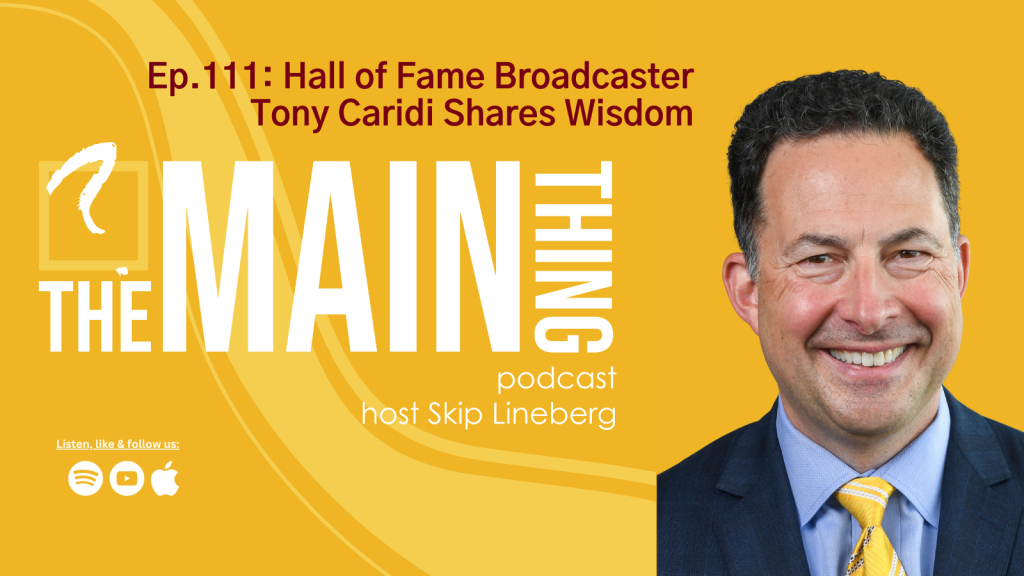
Voice of the Mountaineers: Tony Caridi on Sports Broadcasting, Love and Life Lessons
What does it take to be the enduring voice of a sports team and earn the loyalty of its fans? Join us in a riveting wisdom conversation with Tony Caridi, the iconic voice of the West Virginia University Mountaineers, as he shares the secrets behind his captivating career in sports broadcasting.
We explore Tony’s journey from New York to Morgantown, his efforts to win the hearts of West Virginians, and the profound wisdom he’s gained from broadcasting legends like Jack Fleming. Tony’s reflections on building a genuine connection with his audience and the nuances of live reporting bring invaluable insights to anyone interested in the world of sports journalism.
Tony Caridi also opens up about the technical prowess and emotional resilience required to excel in sports broadcasting. Listen as he recounts the memorable highs and lows of covering significant football games, from the Sugar Bowl to the Fiesta Bowl, and the meticulous preparation that goes into creating unforgettable game-day experiences. Tony emphasizes the importance of honoring the institution and maintaining high standards, sharing the lessons he learned from Jack Fleming that have shaped his career and storytelling craft.
Beyond the world of sports, this episode delves into deeper life lessons, exploring Tony’s perspective on love, resilience, and faith. This conversation is a treasure trove of authenticity, audience engagement, and timeless wisdom from one of sports journalism’s most respected voices.
More About Our Wise Guest – Tony Caridi
Tony Caridi is the voice of the West Virginia University Mountaineers and a professional sports broadcaster whose career encompasses play-by-play commentary on radio and television.
Tony is a graduate of the prestigious Syracuse University Newhouse School of Public Communications. He is a 2022 inductee of the Syracuse University WAER Broadcasting Hall of Fame and a multiple winner of the West Virginia Sportscaster of the Year honor. Tony is also a published author, and he’s the co-host of the popular podcast “3 Guys Before the Game.”
Tony and wife Joan reside in Morgantown, West Virginia, where he joins us today.
So lace ‘em up and get ready. Over the next several minutes you will discover why Tony Caridi is one of the wisest people I know.
Wisdom Resources
Check out Tony’s podcast 3 Guys Before the Game
Connect with Tony on LinkedIn and Twitter
Tony’s website
Credits
Editor + Technical Advisor Bob Hotchkiss
Brand + Strategy Advisor Andy Malinoski
PR + Partnerships Advisor Rachel Bell
Graphic Design + Social Media Chloe Lineberg
Stay Connected with Us on Social
YouTube @themainthingpod
Twitter @themainthingpod
Instagram @themainthingpod
Facebook @TheMainThingPod
Episode Chapters
[0:03:39] – Thoughts on podcasting and “3 Guys Before the Game”
[0:07:09] – Growing up in Lockport, NY; Tony’s early years; family values
[0:13:03] – Tony’s love of sports; his calling toward broadcasting
[0:15:34] – Broadcasting career and the move to West Virginia
[0:19:10] – Following a legend; working beside and learning from Jack Fleming
[0:29:48] – Handling the ups and downs of WVU sports teams
[0:35:48 ]- The power of love in life
[0:40:50] – Guidance from Jesus for life’s rules
Keywords
Sports Broadcasting, Tony Caridi, West Virginia University, Mountaineers, Broadcasting Career, Broadcasting Excellence, Jack Fleming, Sports Journalism, Audience Engagement, Podcasting, Authenticity, Resilience, Life Lessons, Love, Jesus, Guidance, Rules, Wisdom, WVU Transition, Syracuse University
Transcript of This Episode
0:00:00 – Announcer
Wisdom. It’s an incredibly valuable asset, some would say more precious than gold. It’s attractive, appealing, admirable. Conversely, a lack of wisdom is the basis of immaturity, blind spots and bad decisions. Wisdom, it can be gained over time, but it can’t be rushed. But wisdom can be shared. That’s precisely what we are here to do right now. Today. We are here to hack wisdom, to distill it, to understand it and to process it. Why? To get better at life.
Welcome to the Main Thing. This is your new nine-minute podcast. I’m your host, Skip Lineberg, and I’ve set out to interview the wisest people I know. We’ll see what we can learn from each one when they’re faced with an incredibly difficult, soul-piercing question.
0:00:59 – Skip Lineberg
Hello and welcome. If it’s your first time here, I’m Skip Lineberg and I’ll be your host today, whether you’re new or returning, so glad to have you here.
Each episode, we bring you a concise, high-impact wisdom lesson from one of the wisest people on Earth. Studying our guests’ wisdom and learning together, we all get just a little better at this thing called life.
Today, you’re in for a real treat at this thing called life. Today, you’re in for a real treat. Let’s just say that today is a great day to be a Main Thing listener, wherever you may be. In just a moment, you will hear from Tony Caridi, the beloved longtime voice of the West Virginia University Mountaineers. We’ll have fun as we explore his expansive wisdom and even more fun sharing stories from the annals of Mountaineer sports history.
Whether you’re a Mountaineer fan or not, even if you aren’t much of a sports fan, you’ll be glad you listened to this show today. You’ll learn what it’s like to work under the pressure of having to perform live at a high level before a national audience. Plus, you’ll discover how a Hall of Fame broadcaster approaches the basics of his work. Last but not least, you’ll hear Tony’s insights on building an audience while earning their trust and loyalty.
Before I bring Tony on mic with us, I want to encourage you to head over to our website: themainthingpodcast.com. Once there, you’ll be able to access the many resources we bring to you to help you grow and increase in wisdom. This includes our twice-monthly wisdom newsletter, plus much, much more.
Now for our special wise guest, Tony Caridi. I had the pleasure of interviewing this legendary sports journalist, who’s a graduate of the prestigious Syracuse University Newhouse School of Public Communications. Tony is a 2022 inductee of the Syracuse University WAER Broadcasting Hall of Fame. He’s a multiple winner of the West Virginia Sportscaster of the Year honor. He’s also a published author and he’s the co-host of one of my favorite podcasts, “Three Guys Before the Game.” He and his wife, Joan, reside in Morgantown, west Virginia, where he joins us today.
So lace them up and get ready! Over the next several minutes, you will discover why Tony Caridi is one of the wisest people I know.
0:03:32 – Skip Lineberg
Tony Caridi, welcome to the Main Thing Podcast.
0:03:36 – Tony Caridi
Skip, it is my absolute pleasure to be with you.
0:03:39 – Skip
Well, I appreciate it, Tony. It’s going to be great to explore some wisdom with you. And you know I did a little math before you came on air and I’m looking at 547 episodes of Three Guys Before the Game, one of my favorite podcasts with a notable host. Average runtime of 67 minutes, tony. So, considering that I’ve listened to every single episode, not missed a one, that’s 36,649 minutes of my time. I’ve invested in three guys 611 hours. Any guess how many days of my life I’ve listened? 25 day, Tony.
0:04:18 – Tony Caridi
Let me just say this I apologize. I apologize that we put you through that. That’s an amazing set of metrics.
0:04:33 – Skip
You know, I tried to stop and I couldn’t.
0:04:36 – Tony Caridi
That is wild. Yeah, there’s something there exactly what it is. I don’t know. We talk about it among ourselves. We talk about it when folks like you, you know, bring it up and say, hey, they’re listeners. We always ask those questions like OK, exactly what is it? Why do you do that? Why do you give us your time? Probably the most heard one is the fact that it just makes people feel in and, for those that are outside of the state of West Virginia, it makes them feel like they’re home.
0:05:15 – Skip
Yeah, yeah, for sure. It’s part of a community, it’s fun to be part of it and I’m not at all remorseful about 25 days.
What do you enjoy most about it? What keeps you going?
0:05:28 – Tony Caridi
I think, the ability to just let it go. And so obviously I’ve been, you know, spent my life doing conventional radio. So conventional radio has commercials every X number of minutes and so, for example, sports line, you know, I just know we’re going to take breaks at 1530 and 45. Okay, and so it. I think it’s kind of like driving, but you have to keep putting the brakes on, and I think with podcast audio, it just gives you a freedom just to go, and for those that have listened to it, as you could tell, we just kind of go, and to me it takes away the guardrails that I normally operate under when I’m doing Sportsline.
I feel that when I’m doing Sportsline, it needs to be more of a, to be more of a for lack of a better term more of an informational delivery, because you’ve got a finite amount of time You’re on. For you know, basically, was it 54 minutes? Technically you’re on, and so I think the podcast format, with no time window in it whatsoever, just lets us be us, and I think, over a period of time, as it’s gone on and it’s evolved, that what people are hearing is exactly how it is, you know, when we’re not on a microphone or in front of a microphone and I think that makes it more natural. Yeah, and I think that may be one of the reasons why people have listened to it.
0:07:09 – Skip
Tony, to help our listeners get to know you. Not all of our audience are as familiar with you as I am and are not diehard Mountaineer fans. I was hoping that you would talk a little bit about your early years. You know growing up where you grew up, growing up in your family business. Tell us a little bit about that part of your life, your early years.
0:07:27 – Tony Caridi
Sure. So I was raised in a place called Lockport, New York, which is approximately 25 miles away from Buffalo. It’s in that Buffalo, Niagara Falls area and I am one of three kids, two brothers, or there are two boys and a girl.
0:07:45 – Skip
Okay.
0:07:46 – Tony Caridi
And my parents owned and operated a grocery store in Lockport, new York, and that would be the quintessential grocery store. That was literally in a neighborhood you know, just homes, houses, houses, houses, and then there’s the grocery store and then house, house, house after it. And the background is that my dad came from Italy when he was 32 years old to the United States in 1957.
And met my mom and my dad’s intention when he first came over here was not to stay here, but was just literally was a vacation, because he was in the citrus business there with his brothers a big family business and, um, it was their off season and he met my mom and, uh, they married and they bought a grocery store. And they were in that store for 52 years, seven days a week, nine in the morning until 10 o’clock at night, and that is kind of our life and we didn’t have employees, they just had kids.
And so we had the three kids and you were literally born into it. I would come home from kindergarten and instead of going home I would never go home from school I would go to the store and they had a little cot set up in the back and I would take a nap and off we went, and that’s how I was born and raised, and so that was our life. That was our life.
0:09:15 – Skip
Caridi’s Market?
0:09:17 – Tony Caridi
Joe’s Locust Market. So my dad’s name was Giuseppe, which translates into Joe, and it was on Locust Street, so it was Joe’s Locust Market.
0:09:28 – Skip
Oh, I love it. Wow, and what an image that pops in my head. I think many of us of a certain age had those sorts of neighborhood grocery stores, and you can smell it. You can see the wood floors. I think most of them had a big barrel with a block of cheddar cheese up on top of it right, yeah, we had the whole thing.
0:09:48 – Tony Caridi
So my dad, besides groceries we did meat. He cut meat. We also had a 25-foot lunch counter. We were heavy into pizzas and subs and eventually, later on, we did soft serve ice cream. Yeah, it was the full deal.
0:10:05 – Skip
Wow, my grandfather on my father’s side was a meat cutter in one of those markets Piccolomini’s Market in Martinsburg, West Virginia, right there on the corner of Winchester Avenue and King Street.
0:10:18 – Tony Caridi
Awesome.
0:10:19 – Skip
Yeah, I hear you talk a lot about cooking, and I love to follow what you share with us in the audience on social about cooking. Do you think that imprinted on you with that life experience?
0:10:29 – Tony Caridi
I do, and I think it was as much of the store being in the store and being around food as it was just what food means to the Italian culture. Oh yeah, because although my dad was, you know, from Italy, my mom was born here, but both of her parents were from Italy, and so it was the culture of Italian food that, I think, is what kind of still keeps me into the world, that I’m in loving it and enjoying it, because for those that have been around it, I mean, food is the centerpiece of basically everything you know.
0:11:08 – Skip
Yeah, yeah, I’m married into an Italian family. I totally understand that, for example, there’s a sick family member. Last night after work we scrapped our plans. We went to the store and we made the Italian chicken orzo lemon soup, because that has the healing power and you take when someone’s sick. You take that pot of soup over and they magically get well in a day or two. And so that’s what we did last night.
0:11:32 – Tony Caridi
Oh, buddy, yeah, you’re right in that line. Yeah, that’s kind of how we were.
0:11:40 – Skip
Watching you and following you and listening to you. I know that you’re a hard worker. I feel like that’s part of one of your values, and did you get that work ethic from growing up in the market?
0:11:52 – Tony Caridi
There’s no question. Yeah, absolutely so. I think that both you know, obviously both of my parents were raised in different times. Literally, my dad was born just a few years before the Depression and so I think both he and my mom, you know, were born and raised in that era and they continued to have that scarcity mentality throughout their lives, despite the success that they had within their business. It was always that, you know, that fear, because they had seen. You know, my dad just saw unbelievable things. You’ve got to remember I mean raised in the Depression, world War II, the bombing that was in Italy. He was from Calabria and the bombs you know being Sicily is only three kilometers away from where he was, just across the Strait of Messina, the bay, and he saw it all. And I do think those life experiences forever just changed the way that he thought and the way that he rolled, and so, yeah, there’s no question that it imprinted on me as well.
0:13:03 – Skip
What do you love about sports and sports journalism?
0:13:06 – Tony Caridi
Sports is that one thing that’s still out there. That is a reality show and you truly do not know what the outcome is going to be. And I think that is why people very anxiously look forward to sporting events, because they probably have a feel they think they have a feel what’s going to happen.
But there’s always those times, those moments where things happen that just force you to, one, never forget and, two, to keep you coming back.
So, to me, the excitement of the unknown and then having the honor of telling that story, describing that story while it’s happening to me, that is what makes me really excited about it.
0:13:57 – Skip Lineberg
Did you always know that this is what you wanted to do? Or at what point did that light bulb go off and you’re like, hey, I think this is my thing.
0:14:07 – Tony Caridi
According to my wife. I am unusual in that I pretty much knew where I wanted to be and what I wanted to do long before many other people have that moment. Okay, so I can think back all the way to fifth grade when I first started to kind of like become obsessed with the radio and listening and doing those kinds of things. And interacting with the radio station, morning disc jockeys, calling in, winning a silly contest and doing those kind of things. And so I was always intrigued by it.
Then that just evolved through the years. Started to do, you know, acted in plays, like when you’re in fifth and sixth grade, seventh grade I think. I did it all the way up to eighth grade and then started doing public address announcements in school. Then that just continued to grow. Got involved in an Explorer post and really saw a radio station for the first time.
And then when I went to school I just went as a communications major, Got a real taste of like doing it and I went okay. And then that in my freshman year a guy asked me if I would go out and do a high school basketball game with him on the campus radio station and we sat in the stands.
0:15:29 – Skip
So you guys were up in Syracuse, right?
0:15:34 – Tony Caridi
No, actually I started at a different school. I spent my first two years at a school called the State University of New York at Geneseo SUNY, Geneseo, Okay and I was there for my first two years and at the end of my freshman year I was able to get an internship at a television station in Buffalo, spent the summer there, and that was an eye-opening moment as to what the world and the business was really like. So by the time I went back for my sophomore year, I realized that I needed to get into a program that was a little bit more robust.
And that is when I said OK, what about Syracuse? And I drove to Syracuse with my dad during my fall semester and we checked it out and I transferred in and basically spent my whole sophomore year just doing core classes so that when I got to Syracuse I pretty much had my core done. Yeah, I think it just focused on the broadcast journalism stuff and that’s what it was and that was that. Obviously, it was a massive move, changed my entire life, changed my entire direction by going to Syracuse.
0:16:44 – Skip
And an esteemed school of journalism there and broadcasting with the likes of help me out, Bob Costas, Mike Tirico.
0:16:51 – Tony Caridi
Oh, we can go a bunch. We can go Marv Albert. We can go Dick Stockton, Len Berman, Sean McDonough. I mean Ian Eagle has come into fame. Just tons and tons of guys that have come through here. We were in a really good class I had. Sean McDonough and I were suite mates my senior year. Greg Papa, who’s the voice of the San Francisco 49ers, was in that class. Dan Ford, who’s the voice of the Cincinnati Bengals and the Cincinnati Bearcats, was a year younger. Jim Jackson’s the voice of the Philadelphia Flyers on TV.
Just a ton of guys. We had a great, great group of guys and that’s just continued through the years!
0:17:30 – Skip
What a list of all-stars in the industry. That’s incredible. What about playing sports? Do you also like to be a participant?
0:17:37 – Tony Caridi
You know, growing up I was a basketball, baseball guy, soccer to an extent. And obviously as you grow older, as you get older, you kind of realize, okay, what’s the viability of going forward?. And I looked at it and went like broadcast booth, that’s your best place, and so that’s kind of where it ended.
0:18:01 – Skip
Tony, I want to shift to leaving New York state and Syracuse and coming to West Virginia. I was at WVU, studied engineering there, so I was on campus from 84 to 88. Looks like around the time that you came there, you came around 88, didn’t you?
0:18:21 – Tony Caridi
I actually came in 84. My first year was your first year, so I started here in August of 84.
0:18:30 – Skip
Okay, okay. And so, gosh, that’s uh what 40 years now. Yeah 40 years.
0:18:38 – Tony Caridi
Yeah.
0:18:39 – Skip
Morgantown’s home, right?
0:18:41 – Tony Caridi
It is. And my dad always used to kid me, because when I first came out, as you know, in the broadcast world people just bounce around a lot.
And so when I took the job here. I said, six months. I said, I’ll be here six months, and then I’ll go. And many, many years later he would always say, “Six months – How’s that six months going? Pretty good?” Six months has gone pretty good. That’s how it all went down.
0:19:10 – Skip
Tony, when you looked like you were going to have a permanent role with West Virginia University and becoming a voice of the Mountaineers, if not the voice of the Mountaineers, I’m curious to know how you approached kind of gaining acceptance, because at least back then maybe less to a lesser extent now West Virginians were protective and kind of, you know, colloquial and not incredibly receptive to outsiders and I wondered if you had a strategic approach to how you were going to gain acceptance amongst West Virginians and the people across the state.
0:19:48 – Tony Caridi
So that’s a good question, and I do think you’re right in the sense that you know West Virginians have to have to trust you before they, before they like you. And I think that there’s no question. I think the circumstance that I was involved in when that all happened was an unintentional good position in the sense that I had already been here for 13 years, and so I think the acceptance was much easier, although it wasn’t perfectly smooth, but much easier than it would have been had they gone out and brought in someone that people weren’t familiar with.
0:20:35 – Skip
And you just drop … you parachute it in … and all of a sudden there’s this guy, Tony. Who’s he?
0:20:40 – Tony Caridi
Yeah, that oftentimes doesn’t work well and I’ve seen it happen in other schools and other markets. People just go like wait a second, we’re not taking this guy. And so I mean I had already been on the Mountaineer Sports Network doing other things. I started doing feature reports and then I did believe it or not, color on the old MSN football delayed broadcasts, and then I started doing play-by-play, and then I was doing MSN television play by play in basketball and did women’s basketball on radio, and so I had done enough stuff and then, in addition to hosting the talk show, you know, statewide since ’86, I think that that opened the opportunity up at that time and that made it smoother.
But the reality of it is, when you’re the person after an absolute legend, an icon in the business, it’s just never going to be incredibly smooth and it takes a while. It takes time for people to get used to the sound, and it’s a change from Jack. And I could totally get it. It just had to go through that process, and then eventually it does.
0:21:53 – Skip
Yeah, and we’re talking about Jack—Jack Fleming, of course, the legendary voice of the Mountaineers. Tony, what did you learn from Jack? You guys overlapped there for a number of years. What did you, what did you learn from him and what have you taken from him that you still incorporate into how you approach the business?
0:22:20 – Tony Caridi
I think the professionalism of the broadcast and the importance doing a game on the Mountaineer Sports Network and what we do on our podcast or on our nightly talk show, they’re two different things. When I get in there and it’s time to do the game, to me I mean that’s going to be the audio archive of that one game, archive of that one game. And you know not to say that we’re going to go in there and be just, you know, absolutely dead serious, like we’re doing a deposition.
But there is a level of there’s a level of professionalism that I always want to maintain because it is so important to our listeners as to what is happening, why it’s happening. And so I learned that from Jack. I learned the significance and the importance of the network. And then, in addition to that, you know just the technical aspects of a broadcast how he did it, how he said the word Mountaineers with the T, how he said West Virginia and put the T on the end of West. I love that, yeah, right, and so I learned all those things from him.
0:23:25 – Skip
You’re also uncanny about W-V-U, oh yeah, it’s two U’s right W-U.
0:23:31 – Tony Caridi
Yeah, there’s two U’s there. It’s a “double U.” W-V-U.
0:23:35 – Skip
And I feel like you honor the institution the way you carefully present it.
0:23:40 – Tony Caridi
Well, sure, I think you have to. I mean, I truly do. I mean so the network has its own life right.
This network was the brainchild of really two guys Mike Parsons, who for years served in the athletic department at West Virginia, and Dale Miller, who was the president of West Virginia Radio Corporation. Those two had a passion for the network that was unparalleled. They wanted it to be the absolute, very, very best. No question about that.
Like, we can’t control how many games West Virginia would win or they would lose, but we knew that every time MSN went onto the air that we could be the absolute best network out there.
Dale was absolutely obsessive to that end and he accepted nothing but excellence. And that made everyone on the broadcast, whether it was me or Hoppy or whomever. It made you absolutely bring your A game, because if you didn’t, you’d be failing everyone else around you and that would be the lesson that I took away from that experience.
And then, as far as you know the X’s and the O’s, I absolutely would ask Jack, you know about formations and like, how you call this? How would you call this? What would you say here? How do you do that? And then I listened to him and saw what he did, and he was masterful in the craft of doing that, so I took a ton from him.
0:25:06 – Skip
Yeah, yeah, I think of the scene setter, especially prior to a football game. You tune in and he starts into that scene setter and you can feel the breeze on your forearm and you can see where the moon is in the sky and you can sense the can see where the moon is in the sky and you can sense the, the, the mood of the crowd, and it’s just it. It gives me goosebumps talking about it and you’ve, you’ve carried that forward. And we just love that when we’re listening.
0:25:36 – Tony Caridi
Oh, I appreciate that. Yeah, Jack was besides being a great announcer, he was a great writer, as you could hear that on those scene-setters. And the thing about him that I don’t have the, I don’t have the guts to do. He would go into the booth like 90 minutes before the game, whatever it was, and he’d take out a long legal pad and he would handwrite the scene setter. And I get a little nervous when I do mine the morning of the game. I normally do it the night before the game.
But he would go in there, and he would stroke it out with a pen, and hold the legal pad up. And then he would read that thing.
0:26:13 – Skip
Can you imagine? Wow, that’s a cool glimpse behind the scenes.
Tony, this is going to be an impossible question, I would have sensed, but I’m going to throw it out there and you know, we may keep it, we may cut it, but you’ve called thousands of basketball games and football games.
What’s one football game that stands out to you?
0:26:36 – Tony Caridi
Well, that question is kind of like asking which one of your kids you love the most. Right?
0:26:42 – Skip
I know, and I’m so sorry. That’s the disclaimer.
0:26:44 – Tony Caridi
You’re certainly not the first one to ask that … and not to be evasive in the answer. But I think that there’s probably a collection of games in which the result was unexpected that makes those games the ones that you would at least put into the group. That you would say, okay, this is the biggest or this is the best.
And so to me, a couple that just pop out, and they’re going to be the ones that folks remember the most. And you know it would be the Sugar Bowl in Atlanta against Georgia, because it was basically a home game for the Bulldogs. They just won the SEC Conference Championship there in that stadium a few weeks earlier, and West Virginia goes out there and, you know, just puts together a fantastic, memorable night.
And then the other was, you know, after Rich Rodriguez had resigned and Bill Stewart took over, and we went to the Fiesta Bowl and played an Oklahoma team that you know had a, an eventual Heisman winner in Sam Bradford and people before that game gave West Virginia, you know, almost no chance whatsoever. And West Virginia went out there and steamrolled them.
You know those will always be among the group of games. You know the other one would just be the zaniness of the Orange Bowl, when they scored, you know, 799 points against Clemson.
And so those you know so not huge surprises. But through the years, I mean I’ve done a ton of them, and so there’s some that just pop back and you just say “Wow.”
0:28:31 – Skip
That Oklahoma Bowl victory in the Fiesta Bowl. I stayed up so late and I feel like you guys did extended coverage and that feeling of that upset win and the euphoria that came with it. I just remember staying up until about 2:00 in the morning some ridiculously stupid late time and you just didn’t want that to end.
You just didn’t want that to end and, as I recall, this may be not totally accurate, but there was even the radio coverage went into. We’re hearing reports that Coach Stewart may be appointed from the interim coach to head coach and you know things are moving in that direction. It was just so, so thrilling. So much drama, so much excitement and didn’t want that.
0:29:16 – Tony Caridi
No, you’re right. We went super late post game, came back to the hotel, it was as if it was 7 o’clock at night. The place was just going crazy. And you’re right. I think I slept two hours.
And then I got the note that said: Hey, there’s going to be a press conference tomorrow morning before we leave to go back home, and Stew is going to be named as the head coach. So that literally happened in a series of hours, which makes it even more memorable.
0:29:48 – Skip
So this is from my better half, Lisa. She says, “I want to know from Tony how he handles the ups and downs of WVU athletics—and is his job tougher for him personally when our teams are having a week or losing season?”
0:30:02 – Tony Caridi
So I handle it better now than I did when I was younger. I didn’t do well with losses, you know, for a pretty good, long period of time. And then I think you get a better sense of perspective, and you kind of are able to digest those better.
And the second part of the question is do you struggle more when the team is struggling? And I don’t think there’s any question to that, because you know everyone wants to win. We do understand that you’re not going to win every single game. But when things are not going well and there are things that are happening that you see … and you know these are the reasons why things aren’t going well, that becomes frustrating. And then you add on to the fact that no one’s going to stop playing the games. You still have to go through it. That’s when it becomes kind of upsetting.
You know most recently. You know this past basketball season you go 9-23, and you never won back-to-back games the entire season. Now, you knew going into the year that it was going to be just a year unlike any other because of the absolute bizarre circumstances that surrounded it. And so you can kind of go into it saying like, hey, I know success compared to how we normally have it is going to be limited. However, when it happens and when it’s happening, it still was hard and it still was very disappointing.
0:31:36 – Skip
Thank you for being so candid there.
Thinking about this past basketball season and kind of dialing back to what you love about sports … Lisa and I were away in late January. We went to Fayetteville just for a getaway weekend. And so we’re sitting at the new Secret Sandwich Society in Fayetteville. First time we had been there since they reopened and remodeled.
We’re sitting at the bar, and someone says, “Oh, the Mountaineer game is about to wrap up.” Well, we hadn’t been following it.
So, I pull up the app on my phone and I discover that there’s five minutes left and we have a chance to beat Kansas. And so there we go, we turn the phone sideways for the bigger screen, and we prop it up against a salt shaker. And we’re watching and listening to you and watching the last five minutes of the game there from from the restaurant in Fayetteville. Lo and behold, we pull off a stunning upset.
0:32:31 – Tony Caridi
Great days. Those are great memories, aren’t they!
0:32:33 – Skip Lineberg
Those are!
0:32:35 – Tony Caridi
We all have our little “Hey, I was here when this happened. I was here when this happened.” And yeah, I mean, obviously those are few and far between this season. But those are always special.
0:32:46 – Skip
Yeah, mathematically we didn’t have a chance. We weren’t going to pay attention to it, and then you just get sucked right in.
0:32:51 – Tony Caridi
Like I said earlier, those are the best ones when you don’t expect to win, and you win. Those are so much more enjoyable than the ones when you’re supposed to win and you do win.
It’s just … they’re different. I think that underscores sports fans as a whole, but I think it particularly underscores West Virginia sports fans. And that goes to just that belief that permeates our state: tell us something that we can’t do, and we’ll show you that we can.
And I think that is why there’s such great passion for our sports teams through the years, because they have always been built on that kind of a mentality, or at least some of the most memorable teams have had that underdog mentality and that just gets everyone, you know so much farther bought in.
And you know this past football season, you know they used the fact that they were picked to finish dead last in the conference. And they used that as an absolute catalyst to what they were able to do. And I think that kind of embodies, you know, West Virginia sports fans. That makes it more enjoyable when you’re able to do that.
0:34:06 – Skip
We’re a state—we’re a group of Davids. Just show us a Goliath.
0:34:10 – Tony Caridi
Yeah, and I truly believe that. And that’s a good thing. I think that’s what has always kind of attracted me and kept me here, because that’s kind of you know how I was raised, as well.
You know that’s kind of my background. My dad, you know, obviously, had never been in the grocery business in his life and didn’t speak a word of English. And he said, ok, I’m digging in and no one’s going to stop me. And he did. And I love that mentality. I really, really love that mentality.
0:34:50 – Announcer
192. One hundred ninety-two extra minutes of wisdom. That’s what you get when you become a patron of the Main Thing podcast. Many of you continue to say, we want to hear more from these wise guests. That’s precisely what patrons of our podcast get: exclusive access to bonus episodes called “The Whole Thing.”
These 30-minute special shows bring you a deeper dive into our guests’ wisdom. Less editing, more laughter. Less time limits, more stories. Unlock those 192 extra minutes of wisdom for yourself for as little as $9 per month through the Patreon platform. And when you become a patron, you also get access to wisdom essays, behind the scenes glimpses and access to special patron-only wisdom gatherings. Head over to patreon.com/themainthingpodcast. Go unlock your 192 extra minutes of wisdom.
0:35:48 – Skip
Tony Caridi, would you share with us: what’s the main thing you’ve learned in your lifetime so far?
0:35:55 – Tony Caridi
Skip, I’d say the main thing I’ve learned in my lifetime so far is that love is our greatest gift.
And I think it sets us apart from anything else that’s out there that breathes. And I think that, when used properly, it can do so much, it can fix so much. It can heal so much. And that’s the takeaway.
Unfortunately, I think that we oftentimes don’t use our superpower gift enough. And I think as a result of that, you know, we have a lot of issues and a lot of things that you know are bad and we struggle with that don’t necessarily need to be there. But it’s because of the absence of love either delivering or accepting and I think that pulls us all in an opposite direction, and that’s the takeaway that I have.
0:37:01 – Skip
Love is our greatest gift. That’s your main thing. When did that crystallize for you?
0:37:06 – Tony Caridi
I think probably when children came. And you have these little beans that you are assigned to raise, and to love, and to care for. And so our first child, Michael, was born in 1991. And then we were blessed with twins in ’95. And I think that you know, you just you see it right on a moment to moment basis, how that evolves. The love evolves right from you, from them. And I think probably that was a seminal moment and I think it was probably, you know more, a ramp up through the through years. But I think when you have your own kids, you see that.
0:37:59 – Skip
Tony, your main thing love is our greatest gift. That’s so cool, so important, such great wisdom, and I’m surprised by it.
0:38:06 – Tony Caridi
You didn’t think I was going to say, It’s a great day to be a Mountaineer, did you?
0:38:15 – Skip
Tony, let’s talk about application of your main thing: love is our greatest gift. Maybe a recent personal example, even outside of family, where you had to live that? When you had to lean on that to get through a challenge or a difficult situation?
0:38:32 – Tony Caridi
Sure. So I think that you know, in everyday life, you know, we see various things that are going on around us and I have opportunities to, you know, talk to people, to motivate people, that kind of get you know that come across in my path and I think that when I sit down with someone and just have a straight, heartfelt conversation that they’re able to truly understand and get what you’re trying to say to them, with love being, you know, the main component of it, to have them feel that trust, to feel that there’s a concern, to feel that there’s a respect for what it is that they’re going through.
I just see that, as I refer to that earlier, you know, to me it’s like this, this super gift that you have, that can settle people down. Unfortunately, there’s such great anxiousness and nervousness and tension among people. And I think sometimes if we would just firstly have the opportunity to identify who’s struggling with that right now and just having that conversation because obviously we’re our own worst enemies in our heads oftentimes. And if you can just come alongside someone, and give them a different perspective. Or hey, you know what you’re going through? I get it, and it’s normal.
As soon as someone understands that you’ve got them, that there’s true, you know love there behind them that becomes a great elixir. That becomes a great healing tool to them. And so that’s kind of what I, through the years, look at and say, ok, that is the great gift that you have. I say, you know, love is our greatest gift, but unfortunately, you know, love is also the gift we probably don’t use enough.
0:40:50 – Skip
Yeah, very well said. Very well said,
Tony, I think we’re both Christians, we’re both Jesus-followers, and I think this love main thing has an element of faith to it. And I can’t help but think about the concept of grace in the context of this discussion of love. That grace is unmerited favor. Someone didn’t deserve love, but you gave it to them anyway. It’s transformative, isn’t it?
0:41:16 – Tony Caridi
Sure. So my definition is undeserved forgiveness right. So that’s grace. Yeah, so undeserved forgiveness, and there’s no question about that.
But you know, the world that we’re living in now has become so much. You know you could have God rule and you can have self rule. And you want to throw in another category? You could have man rule. And by that I mean the rules that men have made, that this is right and this is wrong.
And we can get into such a wrong, wrong road and go down such a wrong road, if you adhere to those things that are man-made, or obviously self-rules. Right?
0:41:59 – Skip
I agree.
0:42:02 – Tony Caridi
To me, when you get into those kind of issues or those situations like, where do you go? Well, just go refer to Jesus.
Like, forget about everything else that could have come down through history, that was man created, and just go to the Word. And like what did he say? Follow that, and forget about everything else.
If we were just to do that, so much of the stuff that we’re dealing with today and all of these controversies, and all of these issues, and all of this craziness.
You know it just goes back to the bracelet, right? The bracelet was right about 15 or 20 years ago. What would Jesus do?
There was a reason why that thing kind of got popular and lasted for a while. Because that was the fundamental statement that we all need to have, that we still need to refer to. But now people take things out of context, and they take this piece or that piece to obviously embolden what they want to believe.
0:43:18 – Skip
To substantiate their man rule that they’ve created.
0:43:21 – Tony Caridi
100% … to legitimize whatever it is that they’re doing. That is the one thing that becomes undefeated. It’s “un-defensible” if you just do that.
0:43:34 – Skip
Yes, indeed, 100% agree.
0:43:39 – Skip
Tony, thank you for sharing your wisdom with us. Sharing great stories with us. Giving us glimpses behind the scenes, and talking about your early life.
As we wrap up I just want to give you a moment, a little open mic time, for you to share a closing thought or an intention with our audience of personal growth oriented wisdom-seekers. People that want to get better at life.
What would you leave them with, Tony?
0:44:05 – Tony Caridi
Well, I would say collectively, I wouldn’t say, hey, this is what you need to do. I want to put myself in here as well. And that is: we all have to do better. You know, the word kindness has really become popular, and that’s a good thing. That’s a great thing, and that theme is the direction, obviously, that we need to go into.
And so, if I said earlier that you know love is our greatest gift, you know we all need to love more. That’s what we need to do. We all need to love more. We all need to have the presence to identify when situations are in front of us where love could be that great gift that we have that can help someone.
And you can call it kindness, you could call it respect, you could call it, you know, genuine interest … whatever you want to go with. But if we would just use our gift of love more, the situation that we’re in will improve. It’s undefeated. Like I said, it will always work. If it’s true, genuine love, you can get through it. We just all, collectively, have to use our gift.
0:45:27 – Skip
Great place to leave it. Tony, that’s great advice, great wisdom that you’ve shared today. I can’t thank you enough.
0:45:33 – Tony Caridi
It’s my pleasure, buddy. It’s great spending some time with you. We certainly do appreciate it, and the opportunity to chat with you.
0:45:40 – Skip
Tony, so long for now.
0:45:42 – Tony Caridi
Thanks, Skip.
0:45:44 – Announcer
Wow, that goes by incredibly fast, doesn’t it? Time flies when you’re hacking wisdom. I hope you’re left wanting more.
Sync up with us again next time, on The Main Thing, for nine more minutes of wisdom.
Transcribed by https://podium.page